Category Archives: Figurative

I strive to render the human figure, our abode of living, tingling consciousness, as succinctly and eloquently as possible. When it’s successful, it’s a communication from my embodied consciousness to yours.

Silverpoint underdrawing on toned gesso ground. 13.3 x 21 cm or 5 1/4 x 8 1/2 in.

Silverpoint underdrawings, batch #2

Silverpoint underdrawing #05 on toned gesso ground. 13.3 x 21 cm or 5 1/4 x 8 1/2 in.

Silverpoint underdrawing #05 on toned gesso ground. 13.3 x 21 cm or 5 1/4 x 8 1/2 in.

I’ve completed six more panels, so I figure it’s time for an update. Illustrated here are a few of those that I that have found to be particularly interesting/beautiful for various reasons. The most evocative appear to be those whose compositions include human beings or parts thereof. It’s as though each one is from some unwritten comic book – captions not included (Hergé would have understood). Additionally, the abstract panels cause me to wonder/admire anew at how the iconoclastic impulse of Islamic art continues to produce such interesting varieties of texture and pattern.

Silverpoint underdrawing #07 on toned gesso ground. 13.3 x 21 cm or 5 1/4 x 8 1/2 in.

Silverpoint underdrawing #07 on toned gesso ground. 13.3 x 21 cm or 5 1/4 x 8 1/2 in.

Further, one very general note. I feel I am serendipitously creating 21st century daguerreotypes(!). (Who knew?) It’s as though by using silver to recreate images based on a digital photograph the mechanistic process has come full circle: human to machine back to human. And again, because the drawing stylus is silver it’s almost impossible to achieve a line that is darker than a 50% grey value. All values are compressed thereby, necessitating a multitude of small decisions. Adding in the white highlights makes each panel come alive – my own gevoelsmatig pleasure.

Silverpoint underdrawing #11 on toned gesso ground. 13.3 x 21 cm or 5 1/4 x 8 1/2 in.

Silverpoint underdrawing #11 on toned gesso ground. 13.3 x 21 cm or 5 1/4 x 8 1/2 in.

The raison d’être for these remains as underdrawings. And I have no doubt that their beauty and subtlety will contribute to the whole in as-yet-to-be-experienced ways. However, some will be held back for individual display and appreciation. For this, I think I have a plan…

Silverpoint over tinted acrylic gesso ground, highlighted with (acrylic) titanium white. 13.3 x 21 cm or 5 /1/4 x 8 1/2 in.

Silverpoint Studies, Batch #1

Panel #10, Silverpoint over tinted gesso ground, highlighted with white. 13.3 x 21 cm or 5 /1/4 x 8 1/2 in.

Panel #10, Silverpoint over tinted gesso ground, highlighted with white. 13.3 x 21 cm or 5 /1/4 x 8 1/2 in.

Panel #01, silverpoint underdrawing over tinted gesso, highlight with white. 13.3 x 21 cm or 5 1/4 x 8 1/2 in.

Panel #01, silverpoint underdrawing over tinted gesso, highlight with white. 13.3 x 21 cm or 5 1/4 x 8 1/2 in.

I’ve been doing some underdrawings for a new project. It will be a different approach to the same image/subject matter as the “A Piece of Me” project, completed in December 2020. However, instead of being executed in a full textural and chromatic range this one will be untextured,  monochromatic and ghosted back. It will be done in silverpoint on acrylic and overpainted (in acrylic or oil, TBD) on sixty four panels.

Here’s a selection of some of the individual panels I’ve created so far with some notes. 1) Using silver point means that I can never reach a rich dark value (this is not india ink!). So that’s fantastic and exactly what I’m looking for. 2) In addition, since I’m creating them on tinted grounds, the darkest value provides less contrast than if I were starting from a white ground. Again, excellent! 3) The tinted ground itself establishes a middle value and allows me to lay in white washes to bring in some highlights. 4) Inevitably, the value range is compressed and subtlety reigns. Nice.

Panel #02, silverpoint underdrawing over tinted gesso, highlighted with white. 13.3 x 21 cm or 5 1/4 x 8 1/2 in.

Panel #02, silverpoint underdrawing over tinted gesso, highlighted with white. 13.3 x 21 cm or 5 1/4 x 8 1/2 in.

Panel #03, silverpoint underdrawing, silverpoint on tinted ground touched up with white. 13.3 x 21 cm or 5 1/4 x 8 1/2 in.

Panel #03, silverpoint underdrawing, silverpoint on tinted ground touched up with white. 13.3 x 21 cm or 5 1/4 x 8 1/2 in.

I can already see that, when the composition warrants it, a few of the panels are or will be worthy of individual display, though I’m not sure how to handle that. Should I create them (only) for integration into the final piece? Or should I create some for appreciating in isolation (only)? It’s a great problem to have which, at the moment, I don’t have to solve. I can simply create the little panels, fall in love and see where it all goes.

Anna, Back. Multimedia on panel. 44.5 x 63.5cm or 17.5 x 25 in.

Anna, Back – a Mixed Media Project, March 2021

I recently completed the back side to this double sided portrait painting. (See spotlighted image above) The front side had been completed in 2011, however for many (technical) reasons, I had not been able to fully realise my original vision.

Anna Front. A mixed media painting on panels. 44.5 x 63.5 cm or 17.5 x 25 in.

Anna Front. A mixed media painting on panels. 44.5 x 63.5 cm or 17.5 x 25 in.

The front side consisted of 25 independent individual blocks, which were painted separately. See linked image here on the right for a full description. However, I had always wanted the back side to present an etherial yet unified mirrored image of the front. However due to the piecemeal nature of the front substrate, the project lacked any structural unity for realising such a vision. So I had to create it. See glueing and framing Anna on my companion blog site atelierartisanal.com.

Original egg tempera underpainting for Anna - Back. 2011

Original underpainting in egg tempera for Anna – Back. 2011

As for the painting of the back, my idea was simple enough. Create a chromatic underpainting in egg tempera as a mirror image of the front, yet lighter in value, say, 50%. See left. Allow that egg tempera to cure long enough – which turned out to be 10 years! (certainly not my original intention). Then add in some white (oil) scumbles (to lighten and unify) followed by a transparent blue glaze (with clouds) to send her skywards. But since ten years of storage had elapsed – as well as the intervening necessity of glueing all the pieces together – I had some additional preparatory work to do before realising these plans. You can read about grouting and glazing Anna here.

Since texture had always been part of my original vision and because some of the front panels were textured, their mirror image on the back was, also. That meant that besides the grid as a definitive texture, there would also be a variety of textures on some of the panels. These elements would influence the global glazing in a way that, thankfully, was not under my control. Thus, after letting my white scumbles dry, I took a deep breath, lay in a transparent blue glaze and threw in some energetic white clouds for accent. After forty years – of leaving the originally unpainted blocks to languish in storage – ten years – of indecision and curing the egg tempera – two months – of framing and repairing – and forty five minutes – of actual painting – I was finally done. I am very happy with the result but whew!

I don’t think I’ll try something like this again.

Ever. 😉

Pieces of Me, mixed media collage. 168 x 106.4 cm or 66 x 42 in.

Casablanca #1: Pieces of Me

Pieces Of Me. Fully assembled and hanging on the wall. 66" x 42'' or 168 x 106 cm unframed/ 69" x 45" or 175 x 114 cm, framed.
Pieces Of Me. Fully assembled and hanging on the wall. 66″ x 42” or 168 x 106 cm unframed/ 69″ x 45″ or 175 x 114 cm, framed.

“Pieces Of Me”. A composite painting based on a photograph and consisting of 64 individually painted panels (measuring 5 1/4″ x 8 1/4″ or 13 x 21 cm). Each panel is painted separately in either egg tempera, oil, encaustic or acrylic. Some panels were pre-prepared as a collage, according to the design, before painting commenced. All were then mounted on a backing board which also serves as a frame for hanging on the wall. Assembled weight with board is approximately 35 pounds.

Pieces of Me, during the assembly process on a finished pieces of beech plywood. 69" x 45"
Pieces of Me, during the assembly process on a finished pieces of beech plywood. 69″ x 45″

The full size Image is 66″ x 42” or 168 x 106 cm, unframed (see spotlighted image above). Or framed, 69″ x 45″ or 175 x 114 cm, see image to the left. Thumbnail to the right, shows the image as it builds during the assembl process.


A Piece of Me #05, oil on panel over cotton. 21 x 13.3 cm or 5 1/4 x 8 1/4 in.

A Piece of Me #05, oils

Underdrawing for A Piece of Me #05.

Underdrawing for A Piece of Me #05.

A Piece of Me #05, oil on panel over cotton. 21 x 13.3 cm or 5 1/4 x 8 1/4 in.

A Piece of Me #05, oil on panel over cotton. 21 x 13.3 cm or 5 1/4 x 8 1/4 in.

I can’t believe it, but this panel marks the end of the line. It’s the final oil panel as well as the final panel in the whole project of sixty-four. Soon begins the work of mounting and assembling. And from there, tweaking decisions. I am expecting and welcoming a certain amount of visual dissonance but I also know that (just like in American politics) too much dissonance can destroy the unitive vibration of the whole. So there may be some changes to make? We’ll see. But for now there’s cause to celebrate! The champagne is in the fridge. It’s been almost two years.

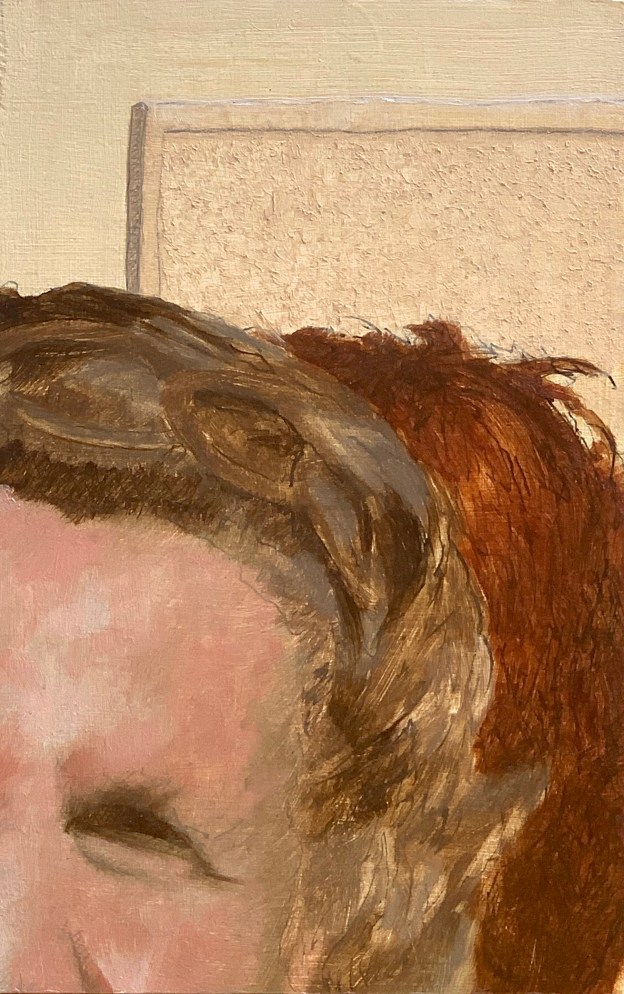
So again, this was the last panel. One quarter of my face. For those of you who have been following this project you will remember that in any particular medium I tend to leave the more important/challenging panels for the last. I begin with the abstract compositions, then proceed to the body parts compositions, then the complex figurative groupings, leaving my face (which was cut up into four sections) for the last.

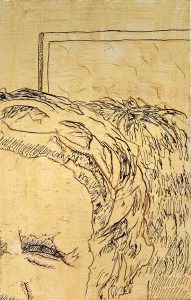
To render this panel I began with the underdrawing in pen and ink over a yellow imprimatura. See above, right. Then I covered the face area with an underpainting of terra verte (green) and let it dry. After a few days I laid in a  clear glaze and set to work, moving from background to foreground. There was: the back wall, two heads of hair and one face. After three hours of work I had achieved what I was looking for – a rendering of the forms with spontaneity and freshness. I’ll leave it to dry and see if anything else begs for my attention. But I’m pleased with what I have so far. If I make further changes they will be small ones.

A Piece of Me#30, oil over acrylic modeling paste on panel. 21 x 13.3 cm or 5 1/4 x 8 1/4 in.

A Piece of Me #30, oils

Underdrawing over yellow ochre imprimatura for A Piece of Me #30.

Underdrawing over yellow ochre imprimatura for A Piece of Me #30.

A Piece of Me#30, oil over acrylic modeling paste on panel. 21 x 13.3 cm or 5 1/4 x 8 1/4 in.

A Piece of Me#30, oil over acrylic modeling paste on panel. 21 x 13.3 cm or 5 1/4 x 8 1/4 in.

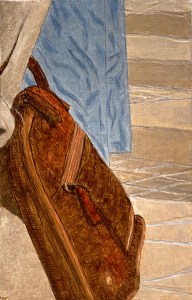
Wow, sculptured texture. Twice. This panel is a celebration of the painting knife. It all began on the preparation phase. I applied an acrylic modelling paste to the lightly primed panel. (The design had already been transferred.) I started with the rear tiles and worked my way forward, the fabric folds and my beloved leather handbag. At that level it was white on white: a polar bear in a snow storm (toting a handbag).

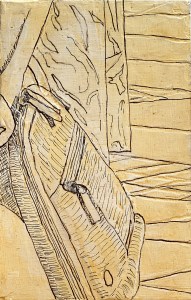
After that dried, I covered the panel with a light yellow ochre imprimatura, and transferred the design (once again), this time to lay in the underdrawing (see above right). I find as I work on these panels, in acrylic, encaustic and (pure) oil, that the hard lines of the pen nib are much preferable to the light washes created  by a brush. Both can render a design and set up formal values, but the nib sets up texture in such a way that a few covering strokes can soften but not eliminate them. Nice! Egg tempera and the mixed technique – as media – do not possess the covering power needed to soften this harshness, so it’s necessary to use washes for the underdrawing.

Underpainting for A Piece of Me #30, oil on panel over pre-sculpted acrylic modelling paste. 21 x 13.3 cm or 5 1/4 x 8 1/4 in..

Underpainting for A Piece of Me #30, oil on panel over pre-sculpted acrylic modelling paste. 21 x 13.3 cm or 5 1/4 x 8 1/4 in..

During my first painting session (see second image, right) and after a few hour’s work I had introduced the main colours of the compositional forms. Overall, it looked good but was too coarse, light and sketchy. Something more was needed. But what? I let it dry for about a week as I wondered.

Then yesterday after detailing the tiles, my linen jacket and glazing the lady’s blue shirt with some ultramarine blue, I decided to bring that blue glaze into the purse. Everything darkened in a nice way but now there was nothing left to do but reclaim that beautiful russet glow of the leather with the painting knife. I spread on burnt sienna, just like buttering toast. A delicious bodily opacity emerged. Oh yeah, this is going in a good direction. Then I had to dig out the highlights and shadows describing the form now buried under this avalanche. I added detail where needed, letting the form tell me what to do. (See above left as well as the spotlighted image in the online view of this post.) It took me about an hour, but wow, just as dinner was ready, I was satisfied, ready to surrender to different kind of knife.

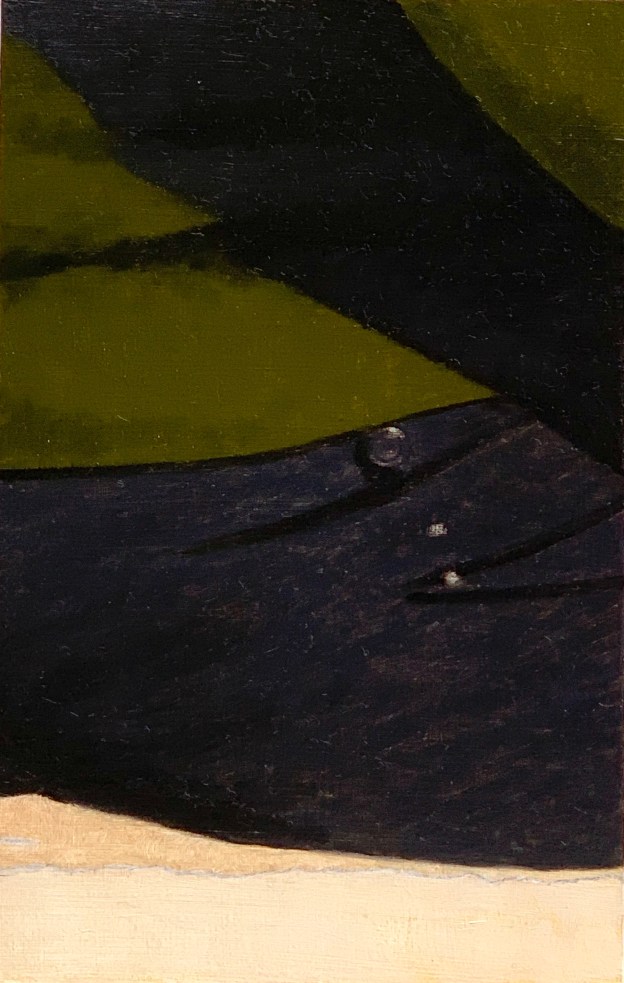
A Piece of Me #25, oil on panel. 21 x 13.3 cm or 5 1/4 x 8 1/4 in.

A Piece of Me #25, oils

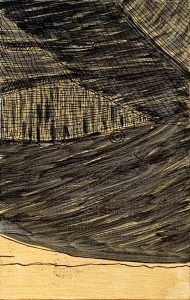
A Piece of Me #25, underdrawing.

A Piece of Me #25, underdrawing.

A Piece of Me #25, oil on panel. 21 x 13.3 cm or 5 1/4 x 8 1/4 in.

A Piece of Me #25, oil on panel. 21 x 13.3 cm or 5 1/4 x 8 1/4 in.

The challenge on this panel was simply dimensionality. The man’s pants and sweater were both quite dark, so it was difficult to read where the fabric folds and shadows were. Of course, I could guess a bit, given its placement relative to the whole image, but in any case, I wanted to create interest and motion there. So I introduced that in the underdrawing. See the image to the right.

Thus on the oil level I had three basic shapes to render: the ledge, the pants and the sweater. I rendered the pants in dark gray and reserved black only for the creases and deepest shadow accents. Same with the sweater, two tints of dark green accentuated by dark gray and/or black for the deepest creases/shadows. As it turns out, the buttons on his pants piqued the interest, interrupting an otherwise monovalumatic field of grey (hey, I just created a word!). BTW: those buttons were created by removing paint so as to expose the substrate rather than adding white back in on top (which I avoid whenever possible). It’s one of my pet-painting-peeves.

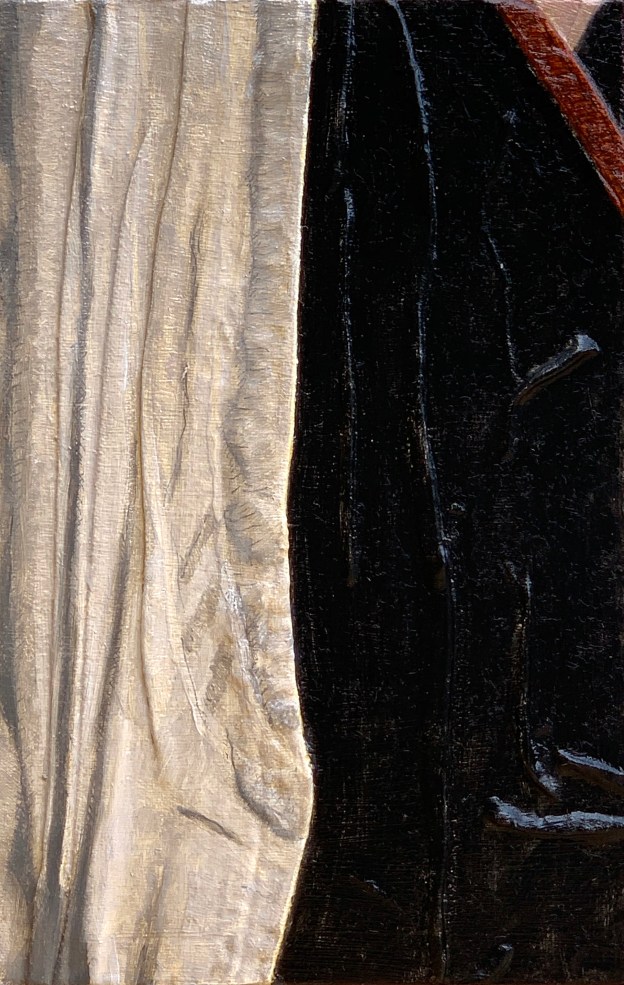
A Piece of Me #20, oil on panel over collage. 21 x 13.3 cm or 5 1/4 x 8 1/4 in.

A Piece of Me #20, oils

A Piece of Me #20, oil on panel over collage. 21 x 13.3 cm or 5 1/4 x 8 1/4 in.

A Piece of Me #20, oil on panel over collage. 21 x 13.3 cm or 5 1/4 x 8 1/4 in.

A Piece of Me #20, underdrawing over collage..

A Piece of Me #20, underdrawing over collage..

Collage on panel. What can I say? These kinds of panels go quickly. The oil level took me just two hours. Sometimes I think I should put more time into them on the final stages but then I remember how much time I put into getting the collages right, so I don’t.

This time around I did the underdrawing slightly differently though (pictured to the right). The panel posed a further challenge after resolving the underdrawing adhesion issues that I had had earlier. That’s because I didn’t want to create a large cross-hatched value using a pen nib for the black shirt area. instead I wanted to set in a darker wash quickly and easily, plus I knew the collage with its uneven surfaces would present challenges to a pen nib, anyway. So I mixed up a thin wash of mars black oil paint and laid it in with a brush. After a few days of drying time it helped me to achieve a dark, undulating mass rather quickly.

The linen jacket to the left required the most “effort”. I put that in scare quotes because it’s actually a process of discovery which, though it does take time, does not feel like work. The reason being that because the collaged shapes did not entirely match the highlights and shadows of the jacket folds in the original design, I had to do some tweaking. In the end I’m really happy with how it turned out. It reads quite well and I think will pair nicely with its neighbours in the final assemblage.

A Piece of Me #13, encaustic on panel. 21 x 13.3 cm or 5 1/4 x 8 1/4 in.

A Piece of Me #13, encaustic

A Piece of Me #13, india ink underdrawing

A Piece of Me #13, india ink underdrawing

A Piece of Me #13, encaustic on panel. 21 x 13.3 cm or 5 1/4 x 8 1/4 in.

A Piece of Me #13, encaustic on panel. 21 x 13.3 cm or 5 1/4 x 8 1/4 in.

This is the final panel of the encaustic series. It’s been an interesting journey dipping my toes back into melted wax. I’ve learned a number of new tips and tricks, many of which are best summarised in my recent post on my companion website atelierartisanal.com.  I also have understood how important it is to protect my own health. The fumes arising from the melted varnish (which is combined with the beeswax to create the medium) are bad enough but then you also need to avoid oxidizing whatever solvent you may be using – even so called “bio-solvents”. By the end I was wearing a vapour mask from outer space as well as goggles. No gloves or hazmat suit, though. 😉

Thematically this panel was an important one: one-quarter of my face, plus part of the neck and shirt of the lady standing behind me. I had left it for the end, knowing the subtlety that would be required for those precious skin tones. And even though I did have an electrified painting nib, I did not use it(!). Instead I discovered that small bright bristle brushes (held together by a metal ferrule), could be warmed on the palette so that the paint would retain its fluidity a few seconds longer. Of course, this tended to destroy the bristle brushes but it is well known that encaustic eats brushes. So I just buy plenty of cheap bristles and throw them away when death is nigh.

I am pleased with the way the skin tone shaped up. Lots of small strokes which allowed the green underpainting to poke through here and there. That mottling became contrasted to the long strokes of black for my shirt, blue for the lady’s shirt or the waves of the linen jacket. I used  my electrified drawing nib for all the fine, linear details. See for example my necklace. In the end it reads well and I am happy to move on the fifth and final series of this overall project: oil.

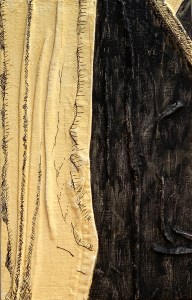
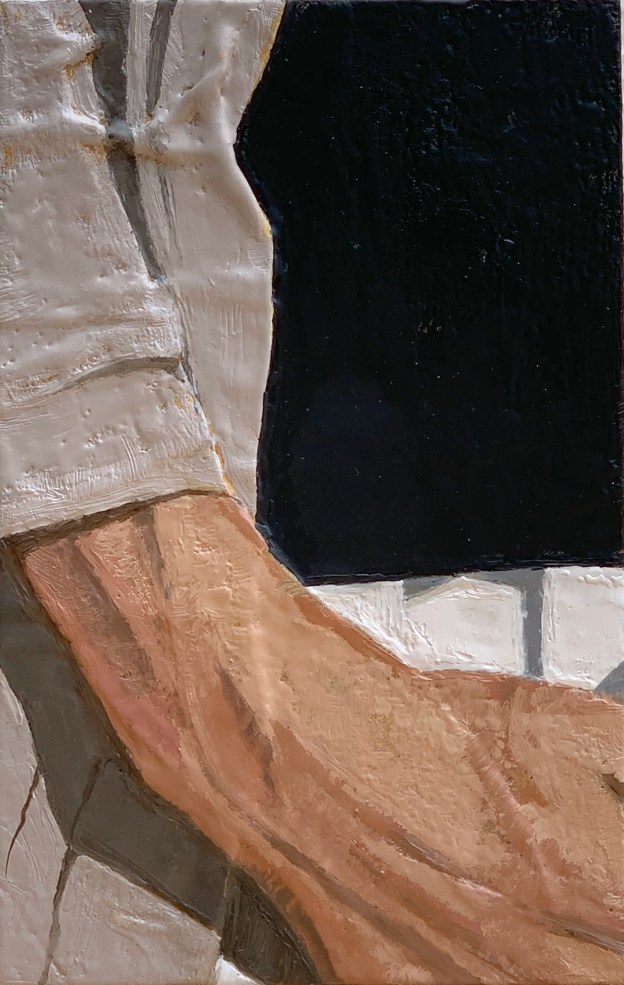
A Piece of Me #28, encaustic over collage on panel. 21 x 13.3 cm or 5 1/4 x 8 1/4 in.

A Piece of Me #28, encaustic

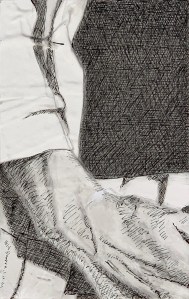
A Piece of Me #28, underdrawing in pen and ink.

A Piece of Me #28, underdrawing in pen and ink.

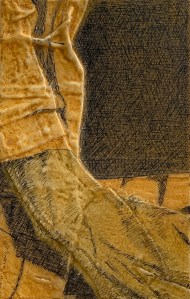
A Piece of Me #28, imprimatura and underpainting.

A Piece of Me #28, imprimatura and underpainting.

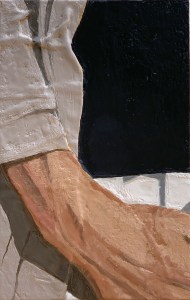
This is/was such an interesting panel to do! The design call-out for it was collage and encaustic. Two very textural and graphic media. You put the two together and the effect can be exponential. On top of that, it was a strong composition: strong contrasts of black (shirt) and white (pants). Gestural elements of a wavy linen coat flowing into a resting but sculpted hand. I enjoyed the result at each step along the way. The finished collage was enticing (no photo of that); the underdrawing phase, too (see above, left). I could almost feel that hand. Well, of course I could since it’s mine, still it was being objectified in black and white. So from the beginning his particular panel reinforced my goal for the overall project, I want it to speak viscerally to the viewer.

To begin the encaustic phase I laid in a coat of yellow ochre and proceeded to melt it back off. This had the effect of unifying everything in a golden imprimatura glow. Unsurprisingly the melt off accentuated the textures of the collage, creating white ridges. See the side-lit photograph above, right.  Then I painted a green tone to the skin and melted it back off, too. Again, see the hand in the photo above, right. This concluded my prep.

A Piece of Me #28, encaustic over collage on panel. 21 x 13.3 cm or 5 1/4 x 8 1/4 in.

A Piece of Me #28, encaustic over collage on panel. 21 x 13.3 cm or 5 1/4 x 8 1/4 in.

With the exception of the skin tone, the black shirt, white pants and linen jacket went quickly and were pretty straightforward. That was because so much textural variation had already been built into the under layers. However, achieving a variegated chiaroscuro skin tone of the hand in encaustic was more difficult than one might imagine. I opted for creating a sculpted, veined hand in variants of warm and cool tonalities. The result reads well enough for my purposes. Though I must say I had increased respect for those Fayum mummy painters of old.

Somewhat surprisingly, the biggest challenge arrived in the “burning-in” phase. This phase happens when you have completed your painting but you still need to rewarm/remelt the whole surface in order to fuse the paint to the panel. I use a hand held heating lamp for this step. However, because it is a collage, the surface is heavily sculpted: it is not flat. The wax melted and pooled in ways “retrograde to my desire”. Edges blurred. Contrasts merged. So I had some clean up to do after the burn-in. No problem, a small scraping tool along with the little encaustic pen (with its drawing and painting attachments) could be pressed into service. Once completed, I was ready to hang up my guns and call it a day (or two).

Technical write up of using encaustic for an indirect painting technique here.