Category Archives: Abstract

Avoidance of the depiction of mental objects, allowing the materials to speak for themselves, whatever they may have to say.

Casablanca-=Rosa, acrylic over silverpoint. 12" x 18.5" or 30.5cm x 47cm

Random Acts of Kindness and such

Random Acts of Kindness Series I, acrylic over silverpoint. 12" x 18.5" or 30.5cm x 47cm

Random Acts of Kindness Series I, acrylic over silverpoint. 12″ x 18.5″ or 30.5cm x 47cm.

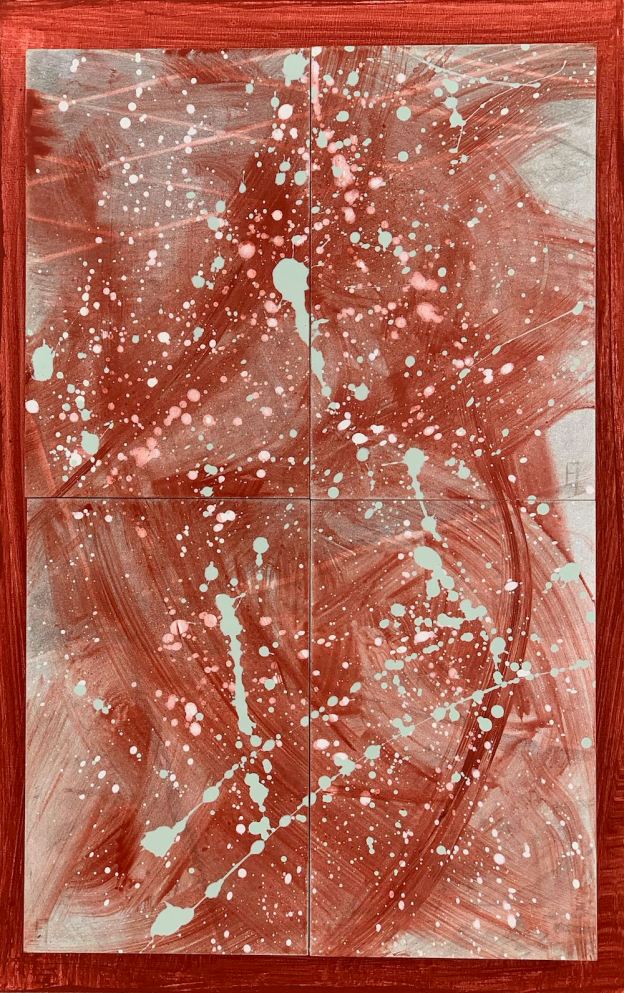
In January I experienced a flurry of creative activity. This was inseminated by an upcoming gallery exhibition themed around the colour red (for Valentine’s Day) – and in which I had hoped to participate. I realised that the sixteen leftover terra verte panels from my big silverpoint project could provide a great background for splashes of its complement: venetian red. Terre verte (consisting of celadonite and glauconite) and venetian red (iron oxide or hematite) are both ancient earth pigments with a long history of artistic usage. As stand alone colours or complements they evoke a deeply grounded reaction which is far more subtle than the bright cadmium reds and/or the phthalo greens of the modern palette. For myself, I don’t mind shocks of colour, but my temperament is generally interested in subtlety so I decided to give this little tryst a try.
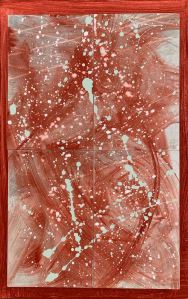
Casablanca-Rosa, acrylic over silverpoint. 12" x 18.5" or 30.5cm x 47cm

Casablanca-Rosa, acrylic over silverpoint. 12″ x 18.5″ or 30.5cm x 47cm

On each panel I transposed a design (from one of the sixty four panels of the silverpoint project) that I already thought had potential as a stand alone composition. I worked up these silverpoint drawings and washed in the titanium white highlights as usual. That was the realistic phase. After fixing this layer I began abstraction by spattering in dilutions of titanium white. After that dried I covered each panel with some acrylic transparent glaze/extender, dipped a large synthetic brush into some Venetian red and slashed across the underlying composition. In some cases I did this to each panel, that is, individually, in other cases I did it to groups of four which, when placed together, formed a deconstructed yet still realistic section of the original image.

I liked these red slashes yet, I also felt the need to reiterate/reintegrate the terre verte. So I mixed some of that up and spattered it across the panels. Nice, it created a complementary “pop/contrast” as well as the harmony that I was looking for. The panels were now done,  but still, I  was only halfway.

The next question: how to display them?
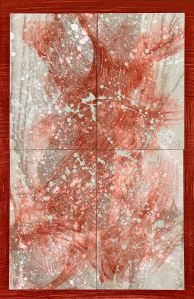
Let's get to the Heart of the Matter, acrylic over silverpoint. 12" x 18.5" or 30.5cm x 47cm

Let’s get to the Heart of the Matter, acrylic over silverpoint. 12″ x 18.5″ or 30.5cm x 47cm

I glued little wooden strips to the back of each (MDF) panel. This allowed me to staple in a piece of velcro. I then built some plywood backing boards to receive the companion side of the velcro. I washed these boards with white gesso (to reduce the visual contrast of the naked plywood). Nice, but ultimately I decided against white and coated the backing boards with a layer of venetian red. This supplied the superimposed panels with a solid warm border/base, allowing them to be spotlighted/ to shine.

I called the group of individual panels “Random Acts of Kindness”, while the groupings with four interrelated panels received a name appropriate to their original imagery, “Let’s get to the Heart of the Matter” and “Casablanca-Rosa”, respectively, see the illustrations above. Oh, and “no hard feelings but”, they were not selected for the galley exhibition. 😦 Still, I’m grateful for the stimulus and am sure they will find a happy home someday, somewhere.

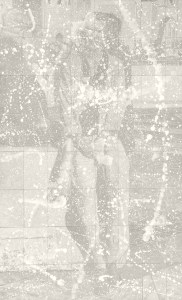
Pieces of Me/Pieces of Eight. Titanium white over silverpoint. Final size: 106.5 x 168 cm or 42" x 66"

Pieces of Me/Pieces of Eight/Pieces of White

Pieces of Me/Pieces of Eight. Titanium white over silverpoint.  Final size: 106.5 x 168 cm or 42" x 66"

Pieces of Me/Pieces of Eight. Titanium white over silverpoint. Final size: 106.5 x 168 cm or 42″ x 66″

I’ve recently been able to complete this silverpoint inspired project – which is intended as a mix of realism and abstraction.

The underdrawing stage illustrated and described here consisted of sixty four panels rendered in silverpoint over a terre verte toned acrylic ground, highlighted with titanium white. After applying appropriate fixative, the overlaying layers consisted primarily of titanium white (there was also a tidge of zinc white) – either sprayed or thrown – in alternating sessions until I was satisfied with the result.

It was fun doing this second phase yet also challenging: it’s my first experience with throwing paint since my college days. So  I had an internal image, but didn’t know exactly how to get there. It was a case of trial and error. My guiding principle was “circulation de la lumière” (the circulation of light). Naturally, that circulation had to take into account the highlights, quarter-tones and half-tones of the underdrawing. But the throwing itself involved a certain kind of chaos which I couldn’t really control, but rather at best, guide. The final size is approximately 3 1/2 feet x 5 1/2 feet. Basically, life size.

The final version displayed here is (of course) a photograph. As such it is a kind of compromise, not only because of my photography skills (but possibly anyone’s) to adequately represent this piece. The silverpoint layer reflects and resonates depending on the lighting conditions (and your position in the room) while the overpainted layer of titanium white, as a very opaque pigment, simply reflects.

With ambient lighting conditions more of the underdrawing softly comes through, while with strong overhead light the overpainted splashes become emphasised. My intention is/was to achieve an alternating balance between the two so that the viewer can receive alternating impressions. For all these reasons it’s important to cut this digital image some slack. So no, there will be no NFTs made available of this anywhere on the internet. 😉

With luck I hope to exhibit it somewhere, sometime in the relatively near future. TBD.


A Piece of Me #15 oil on panel. 21 x 13.3 cm or 5 1/4 x 8 1/4 in.

A Piece of Me #15, oils

A Piece of Me #15 oil on panel. 21 x 13.3 cm or 5 1/4 x 8 1/4 in.

A Piece of Me #15 oil on panel. 21 x 13.3 cm or 5 1/4 x 8 1/4 in.

Underdrawing for A Piece of Me #15.

Underdrawing for A Piece of Me #15.

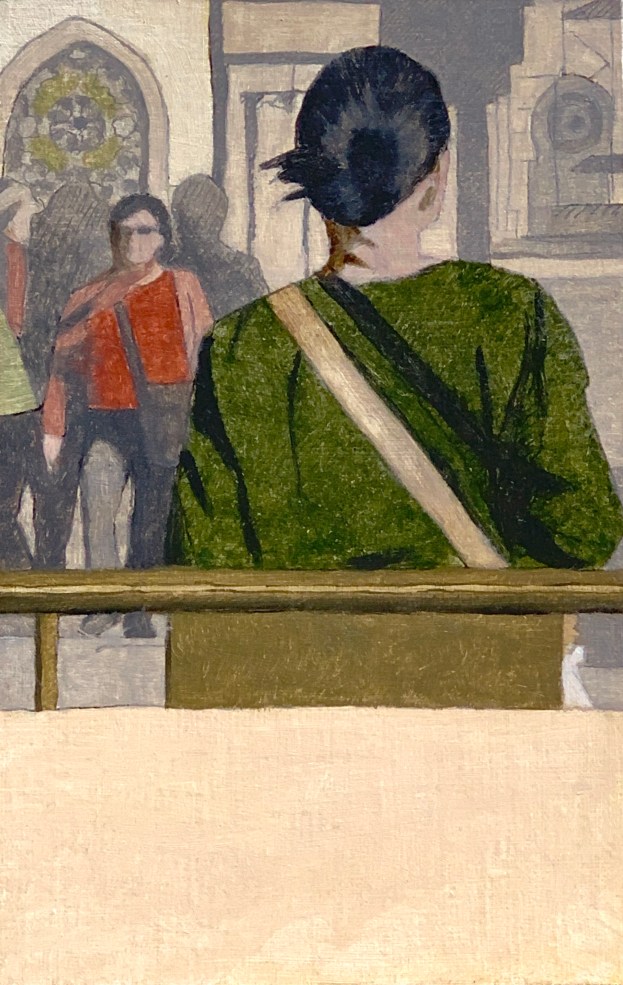
The original photographic image which was cut up into 64 sections for rendering separately contained a horizontal background swathe consisting of groups of small tourist figures receding into the far distance. So there ended up being five panels containing these figural groupings as well as the architectural backgrounds behind them. Because of the need to employ a sliding scale of finely tuned (gray) values to describe these distances, rendering these panels (in any medium) is proving to be one of the most challenging tasks of this whole project.

This panel then was no exception. I worked on it yesterday and a few hours today. In general, I’m happy now with the hues and the values that have been established. The distance reads well enough. There is a red/green complimentary colour contrast, too. I’m posting it now as a beta version. After it dries I intend to clean up some passages that became muddy. When that’s done (and I’m satisfied) I’ll update this page.

Another interesting challenge was my decision to change the hue for the guard-rail (that you see in front of the girl in the dark green sweater). In the original photograph it’s a bright viridian green, but since that guard-rail is the only element in the whole photograph requiring such a pigment – and because on this panel I wanted to create more distinction between the figure and the rail in front of her, I switched the hue to an olive-green. That means I’ll need to do some additional tweaking on two other guard-rail panels but that’s not a problem. Artistic license rules.

A Piece of Me #10 oil on panel over pre-sculpted relief. 21 x 13.3 cm or 5 1/4 x 8 1/4 in.

A Piece of Me #10, oils

Underdrawing over yellow ochre imprimatura for A Piece of Me #10.

Underdrawing over yellow ochre imprimatura for A Piece of Me #10.

A Piece of Me #10 oil on panel over pre-sculpted relief. 21 x 13.3 cm or 5 1/4 x 8 1/4 in.

A Piece of Me #10 oil on panel over pre-sculpted relief. 21 x 13.3 cm or 5 1/4 x 8 1/4 in.

This panel has been one of my favourites from the get-go. Back then I was pleasantly surprised by the serendipitous composition. Foreground, middle-ground and background all very well stated in a figurative sort of way. It felt like a comic strip panel from Archie and Jughead, evoking an untold story.

The call out for the panel then was oil over low sculpted relief. I prepared that relief with GOLDEN acrylic modelling paste, then primed it with a few layers of oil based (lead white) gesso and let that cure. (That curing turned out to be almost one year!). Not my  intention, just, what happened.

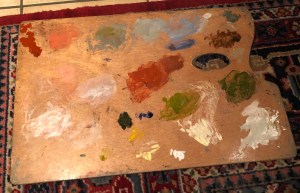
To begin I covered the whole panel with glaze, let it dry fifteen minutes and wiped it off. The surface was slightly tacky, receptive. Then I started painting, wet-in-wet. I began with the background primarily as gray values, progressing forward to the stronger, definitive, more colourful statements. Although I prefer to work with as limited a palette as possible, this particular panel required all the usual earth tones plus the main primary colours. I’ve included a photo of the palette below – just for fun. BTW: red and green are complimentary colors, which in their natural saturated state, are also of a similar value. So together they always create an interesting vibration in a painting. The two shirts of the two men then in this panel presents no exception.

The whole project took me about four to five hours to do. That’s longer than usual, but these panels with a more complex composition tend to require that. Nevertheless, I was happy to set my work aside and call it done when the dinner bell rang. Another curry for a hungry artist.

Palette for A Piece of Me #10

Palette for A Piece of Me #10


A Piece of Me #45, oil on panel, 21 x 13.3 cm or 5 1/4 x 8 1/4 in.

A Piece of Me #45, oils

Continuing with the series of oil panels in which (I’m hoping that) the underdrawing will be able to remain fully functional through its superimposed layers. Earlier, in the first four oil panels, I had some technical difficulties (now resolved). They were not show stoppers but they did set me back to the drawing board more than a little bit.  If interested you can read about it here.

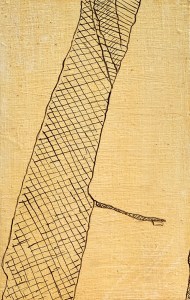
A Piece of Me #45, underdrawing in pen and ink (a mars black oil paint diluted to a dense yet flowable consistency).

A Piece of Me #45, underdrawing in pen and ink (a mars black oil paint diluted to a dense yet flowable consistency).

A Piece of Me #45, oil on panel, 21 x 13.3 cm or 5 1/4 x 8 1/4 in.

A Piece of Me #45, oil on panel, 21 x 13.3 cm or 5 1/4 x 8 1/4 in.

This panel then began with a strong pen and ink underdrawing over an already imprimatura-ed wash of yellow ochre diluted oil paint. I had such success with the yellow ochre as a staring point for my acrylic and encaustic panels, I decided to keep with it for the oil series. See right.

Similar to the last oil panel (#35) this was a relatively simple composition. There were three items to consider, the tip of my linen jacket above right, my white pants legs right and left and the intervening shadow. As with the last one, I glazed in the shadow and then followed it up with passages of opaque paint. The main challenge though was creating a visual distinction between the two linens, the white pants and the oatmeal jacket. Both had shadow and volume play to create interest. I’m really happy with the way it turned out. The forms are pretty delicious. Had to stop and eat lunch though instead of chowing down on it: the curry just had to be more nutritious 😉

A Piece of Me #35, oil on panel over linen. 21 x 13.3 cm or 5 1/4 x 8 1/4 in.

A Piece of Me #35, oils

A Piece of Me #35. Underdrawing in pen and ink (diluted black oil paint).

A Piece of Me #35. Underdrawing in pen and ink (diluted black oil paint).

A Piece of Me #35, oil on panel over linen. 21 x 13.3 cm or 5 1/4 x 8 1/4 in.

A Piece of Me #35, oil on panel over linen. 21 x 13.3 cm or 5 1/4 x 8 1/4 in.

A simple composition executed on a panel pre-treated with linen. The underdrawing (to the right) laid out the basic design, the oil level (to the left) gave the forms dimension. So, for forms: there was my linen jacket on the right, casting its shadow against the lightly coloured plaster wall on the left. That’s it.

The shadow area in the middle took shape rather quickly with a glaze of raw umber. I liked the tonality but the cross hatching of the underdrawing was too visible, so I added some white to my umber and worked back in passages of opaque paint. Much better. As much as I love glazing (and I do!) it’s equally important to balance it with passages of opacity.

The linen jacket was pure pleasure to render, softly dabbing in light and shadow, accentuating its dimensionality so that it almost completed itself. In painting, in creation, there is a point where the form starts to take shape as if by itself. As form-giver, you need to remain especially attentive, listening to what is happening on the page/panel, asking for what else is needed. Strengthening (or modulating) contrasts, tightening up (or softening) edges, adjusting hues. The light yellow wall on the left, for example, was quick work but adding in those spots (freckles) gave this wide open area just that little bit of extra.

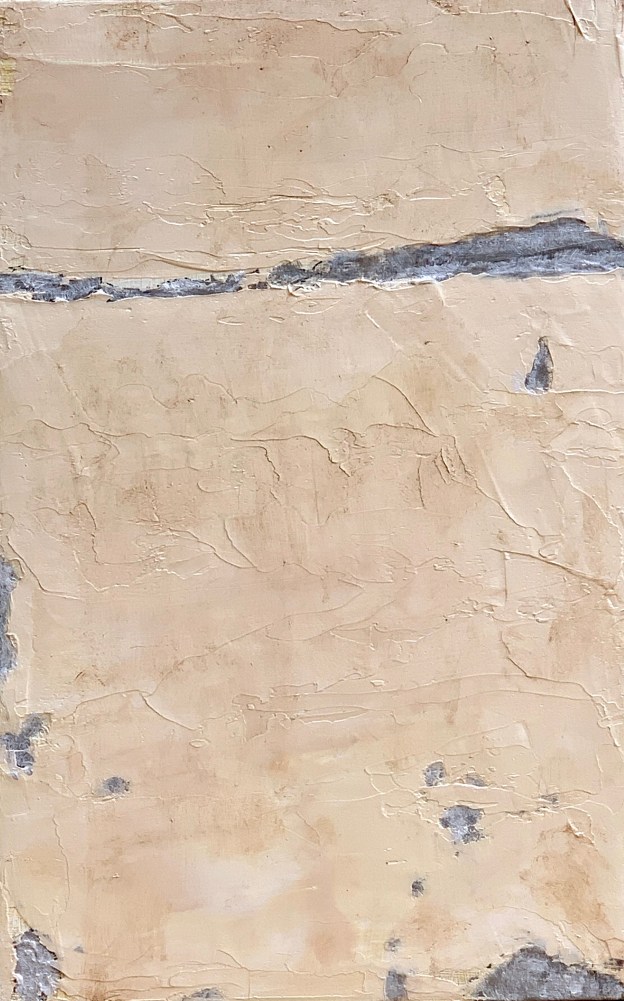
A Piece of Me #50, oil over pre textured acrylic modeling paste on panel. 21 x 13.3 cm or 5 1/4 x 8 1/4 in.

A Piece of Me #50, oils

A Piece of Me #50, oil over pre textured acrylic modeling paste on panel. 21 x 13.3 cm or 5 1/4 x 8 1/4 in.

A Piece of Me #50, oil over pre textured acrylic modeling paste on panel. 21 x 13.3 cm or 5 1/4 x 8 1/4 in.

A Piece of Me #50, the original photograph.

A Piece of Me #50, the original photograph.

Texture, texture and more texture. This panel was created with the painting knife, either during the modelling-paste-pre-painting-sculpting phase or during the painting phase, with thick slabs of light pastel coloured paint.

The grey areas were dug out from the paste as well as the paint in the attempt to mimic the cement behind the lightly coloured plastered wall. I don’t have a photograph of the underdrawing phase (was there even one??) so I’ll use this rare occasion to post the original photograph.

Except for the captions, can you tell the difference?

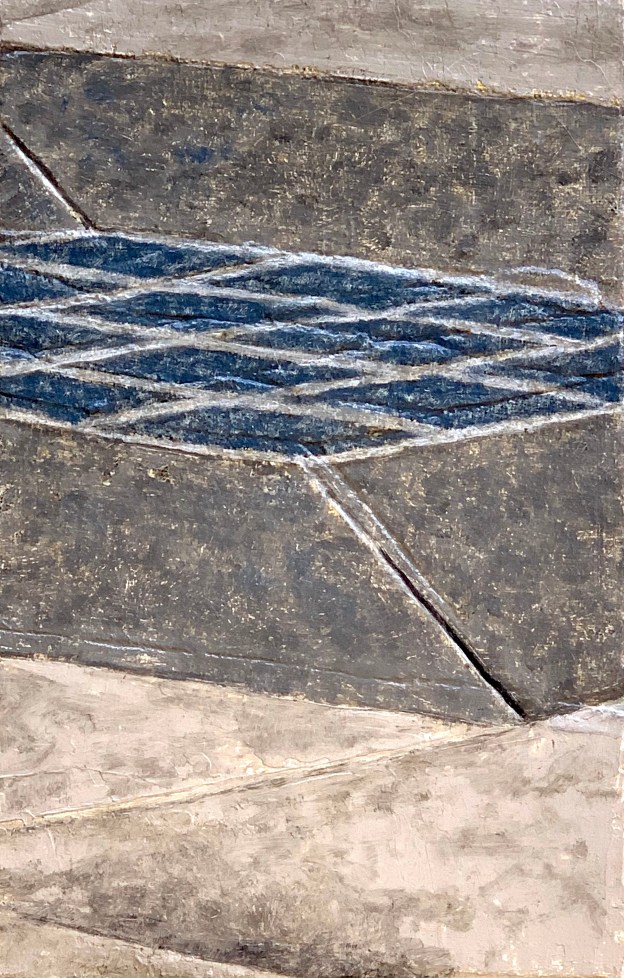
A Piece of Me #40, oil over collage on panel. 21 13.3 cm or 5 1/4 x 8 1/4 in.

A Piece of Me #40, oils

A Piece of Me #40, underdrawing over collage.

A Piece of Me #40, underdrawing over collage.

A Piece of Me #40, oil over collage on panel. 21 13.3 cm or 5 1/4 x 8 1/4 in.

A Piece of Me #40, oil over collage on panel. 21 13.3 cm or 5 1/4 x 8 1/4 in.

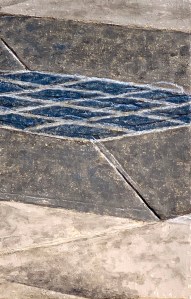
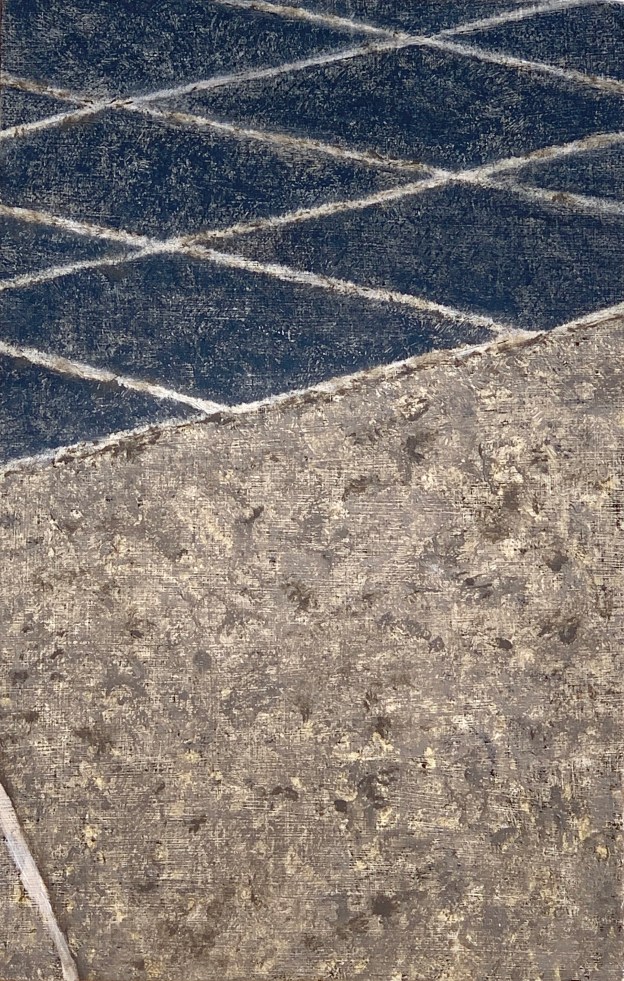
This panel had some particular challenges to it, both of which were my own creation. The first problem came from the lack of alignment of my collaged panel (created more than one year ago during the preparation phase) to my black and white transposed design. Although (I thought) I had used the same transfer process, my alignment was off by a few millimetres. Well, OK, I’ll live with that, knowing the texture of oil paint can mask things to a certain degree and also that I’m open to whatever happens in this multimedia process of creation. The only real accidents are lack of adhesion or longevity.

The second problem occurred with the absorbency of the black paint tinted underdrawing. Even after three or four days, it’s adhesion to the ground appeared to be insufficient. Parts of it came off when I used my kneaded eraser to erase the charcoal transfer lines (it was too heavily diluted). Since it’s an underdrawing this too is not a fatal error. Nevertheless I did go into this one with some caution, not sure I would be able to salvage it.

The photograph of the completed panel above left is side lit, so the textural pentementi of the misaligned collage are visible. Those (misaligned) highlights are visually fugitive so they don’t really bother me. Additionally, the lighter-than-I would-wish-for underdrawing did not pose a huge threat, either. I compensated by drawing in the white grouting lines for the blue tiles with white lead paint as an underpainting and let it dry. After a few days I was good to go. Thus, in this piece (and the whole project) I am not out to create perfection, but rather, a visually and tactilely attractive assemblage that ultimately will invite the viewer to unify for themselves. And hopefully experience aesthetic pleasure in doing so!

A Piece of Me #60, oil on panel over collage. 21 x 13.3 cm or 5 1/4 x 8 1/4 in.

A Piece of Me #60, oils

A Piece of Me #60, underdrawing over collage.

A Piece of Me #60, underdrawing over collage.

A Piece of Me #60, oil on panel over collage. 21 x 13.3 cm or 5 1/4 x 8 1/4 in.

A Piece of Me #60, oil on panel over collage. 21 x 13.3 cm or 5 1/4 x 8 1/4 in.

Second in the new series of panels executed exclusively in oil. The underdrawing on the right shows not only the layout of the design but also its intentional graphical harshness. It’s supposed to be that way! You want that firmness, those hard lines and clear contrasts. Then the oil level enhances, softens and sensuously mitigates these things – see left.

Thus, after the yellow imprimatura and the underdrawing dried, I started with the oil level. I covered the whole surface with a clear medium and after fifteen minutes wiped it off. The medium created a slightly tacky surface for working wet-in-wet, painting impasto paint into the clear glaze. I began by developing the highlights and quarter tones on the left first, then the strong shadow areas on the right. My goal was to cover the entire panel, to finish it in one working session. I reserved the strongest shadows and highlights for the end. Using the dry fan brush I could softly blend adjacent areas into one another without smearing. One of my favourite activities!

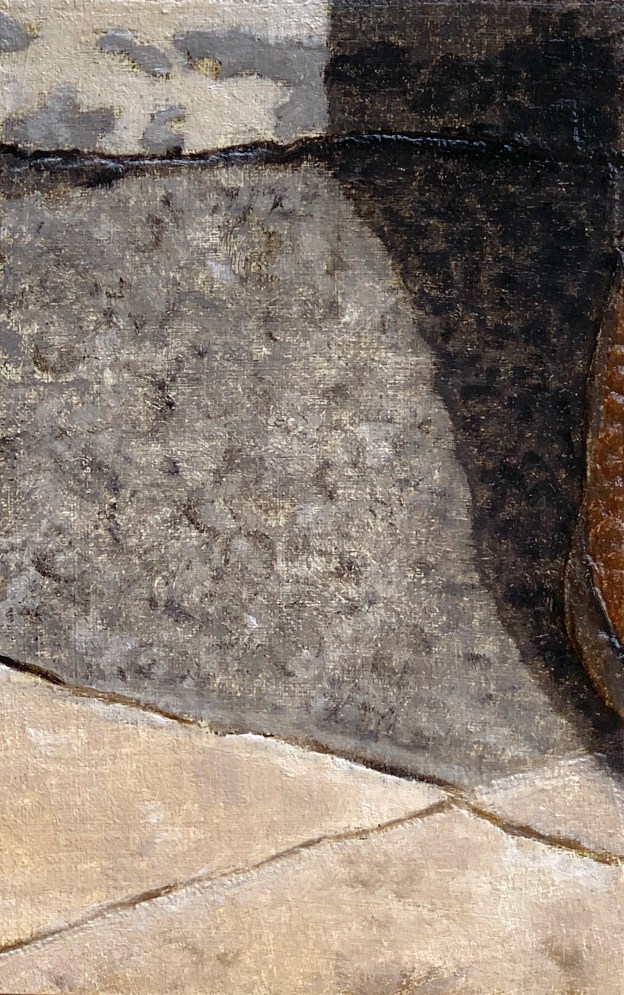
I’m pleased with the level of detail/interest in the shadows. The impasto paint there is not so thick so as to obscure the ground. And there is enough variation to allow the eye to wander. I did have to contend with the collage: the tip of the shoe on the right edge protrudes maybe two or three millimetres? It’s very tactile but difficult to paint. The side-lit photograph in the top spotlight (online display only ) illumines its 3D aspect. Some of the strong highlights you see in the photograph are not paint but rather fugitive reflections.

A Piece ofMe #55, oil on linen mounted on panel. 21 x 13.3 cm or 5 1/4 x 8 1/4 ".

A Piece of Me #55, oils

A Piece ofMe #55, oil on linen mounted on panel. 21 x 13.3 cm or 5 1/4 x 8 1/4 ".

A Piece ofMe #55, oil on linen mounted on panel. 21 x 13.3 cm or 5 1/4 x 8 1/4 “.

Finally the home stretch. This then is the first of twelve final panels: all panels in this series will be executed exclusively in oil on an oil ground. This particular panel was painted on linen mounted on panel previous to the application fo the oil ground. All these slight variations in pre-treatment to the grounds mean that there will always be a slightly different relationship between the ground and the application of the paint.

Additionally, because this is an oil ground it’s not receptive to the india ink that I used for the underdrawings in the egg tempera, mixed technique and/or encaustic panels. In those cases the ground was a traditional chalk gesso, which is water based and also very absorbent. So I had to switch to a heavily diluted black oil paint for my underdrawings. The imprimatura too, was a heavily diluted yellow ochre. And after both of these treatments I had to let the panel dry for a few days.

However, because I had laid in this groundwork, the thicker oil level proceeded quickly. It took just one working session to develop the main forms and textures – although I did have to let that dry before painting in the final contrasts. When using an indirect technique for oil in this way means that the waiting times are not for impatient temperaments. I’m pretty chill, but even so I do chafe at the bit sometimes. 😉