Tag Archives: Self portrait of Ellen Cathcart Trezevant

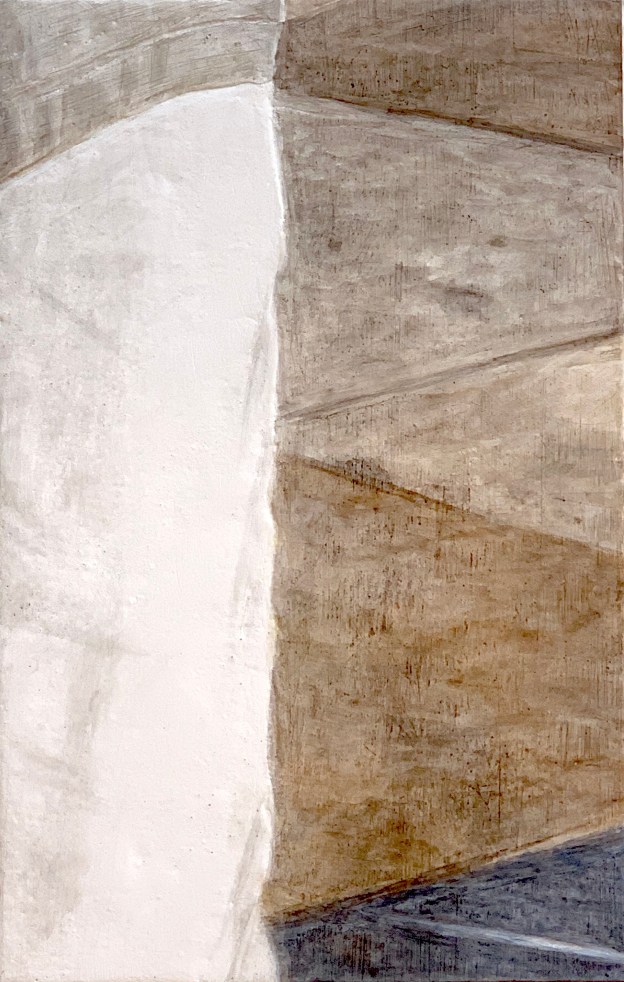
A Piece of Me #03 encaustic on panel. 21 x 13.3 cm or 8 1/4 x 5 1/4 in

A Piece of Me #03, encaustic

A Piece of Me #03 encaustic on panel. 21 x 13.3 cm or 8 1/4 x 5 1/4 in

A Piece of Me #03 encaustic on panel. 21 x 13.3 cm or 8 1/4 x 5 1/4 in

The newly revised higher contrast pen and ink underdrawing.

The newly revised higher contrast pen and ink underdrawing.

OK, today I completed the second of the encaustic series for the A Piece of Me project. Seen here on the left. Like yesterday’s it was another fairly abstract panel but this time the composition included more detailed shapes, forms and contrasts of light and dark. So after my experience with the first panel, I quickly decided to move away from an underdrawing done in light washes of india ink to a pen and ink drawing which has more contrast. I had already seen yesterday that whatever underdrawing there was (which in that first case was not much) the thick opacity of the encaustic paint quickly obliterated it, rendering it superfluous So, either you forgo the underdrawing altogether or you increase its intensity. I decided to go for the latter. Here to the right then is a photograph of the revised pen and ink underdrawing (completed over the original india ink wash). There are a lot of details which I know will not be seen in the completed painting, but, like the whiskers on a man’s cheek in a painting by Memling or Holbein, these strokes will still have a role to play in the final painting.

So I began my approach as I did yesterday, slapping on coats of white and yellow ochre. I quickly had a mess of nothing. Using paper towels and a hot iron I melted it all off and started over again. (This is common in encaustic.) Still, this melting left an overall tint of yellow to the panel. I mixed up a light tint of white and yellow ochre, which I began applying in small strokes to mimic the architectural forms of bricks, panels and arches. This allowed some of the underdrawing to show through in strategic places. Nice, this was going better now. Then I melted up a tint of burnt umber for the shadowed forms. Using a small brush I lay the shadows in. Again, nice. Taking up the infra red heat lamp I burned it all in. I stopped, satisfied, at least for the moment.

Technical write up of using encaustic for an indirect painting technique here.
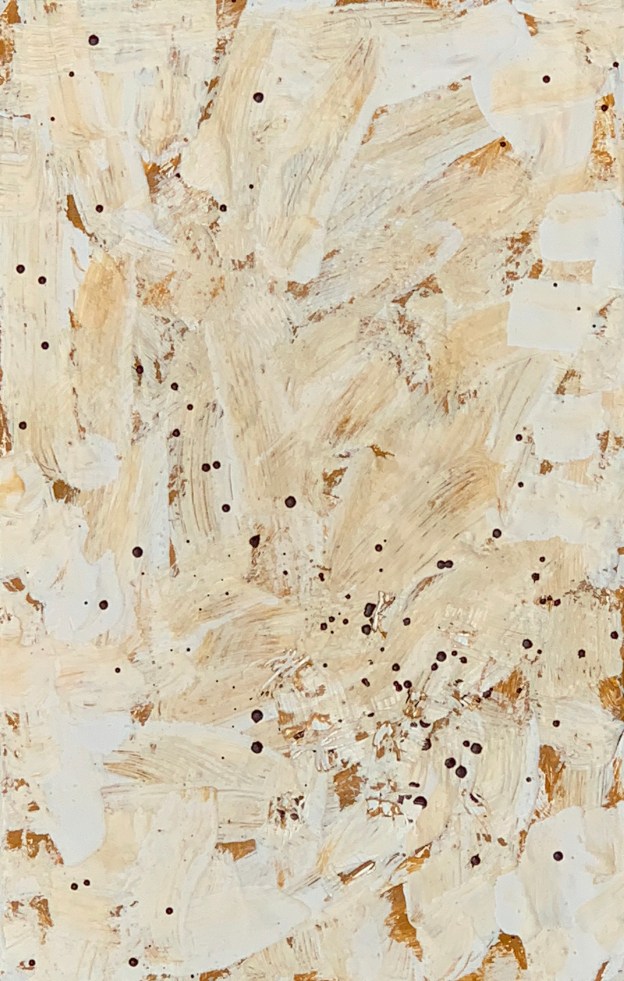
A Piece of Me #33, encaustic on panel. 21 x 13.3 cm or 8 1/4 x 5 1/4 in.

A Piece of Me #33, encaustic

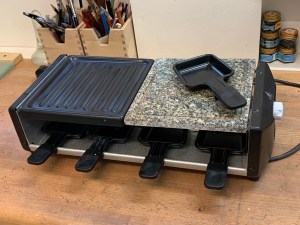
My super-duper thrift store find. Maybe originally intended for fondue? Temperature adjustment dial on the right. The metal and marble plates just above the burner radiate. The little black trays work great for keeping the colours warm above and below.

My super-duper thrift store find. Maybe originally intended for fondue? Temperature adjustment dial on the right. The metal and marble plates just above the burner radiate. The little black trays work great for keeping the colours warm above and below.

I’ve finally been able to return to an old mud-pie love: encaustic. It’s a really visceral hands on technique. Melted beeswax and damar varnish are melted together, then dry pigments are added to this molten medium. The pallet then consists of a metal plate suspended over a two burner electrical hot plate. In order to manipulate the paint, you have to keep it in this molten state. You can spend up to $500 buying fancy equipment but I’ve always managed with $5 finds from my local thrift store. See the image to the right.

All painting, that is the brush strokes, dry within a matter of seconds. So it’s really coarse and textural. You have to like that (I do). In comparison to many other media, encaustic is the mother of the “happy accident”. Additionally, or rather in contrast, it’s also quite difficult to manage, to control, to manipulate. There are many unhappy accidents. Realistic subject matter then, is possible, but if so, it’s never refined, which is also OK, as long as you are comfortable with that (I am).

A Piece of Me #33, encaustic on panel. 21 x 13.3 cm or 8 1/4 x 5 1/4 in.

A Piece of Me #33, encaustic on panel. 21 x 13.3 cm or 8 1/4 x 5 1/4 in.

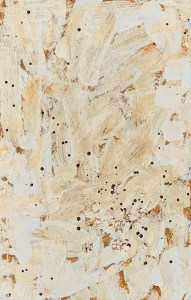
I began this series of encaustic panels for the A Piece of Me project with a purely abstract background composition. I reasoned that, for starters, this would be an easy subject matter, good for getting my feet re-wet. And it was. Swift strokes of titanium white to start, then a layer of yellow ochre, covered by another layer of titanium. After the burning in, where you hold a heat lamp (another $5 thrift store find) over the panel for a number of seconds to gently remelt the wax and fuse it to the panel, I decided to add some graphical contrast. I melted a tint of some burnt sienna and applied a quick spray of dots using a tooth brush. Eh voila!

Scale it up, 10 or 20 times and hang it on the wall. There’s your contemporary piece of art. Technical write up of using encaustic for an indirect painting technique here.
A Piece of Me, #12. The mixed technique over collage. 21 x 13.3 cm or 8 1/4 x 5 1/4 in

A Piece of Me #12, the mixed technique

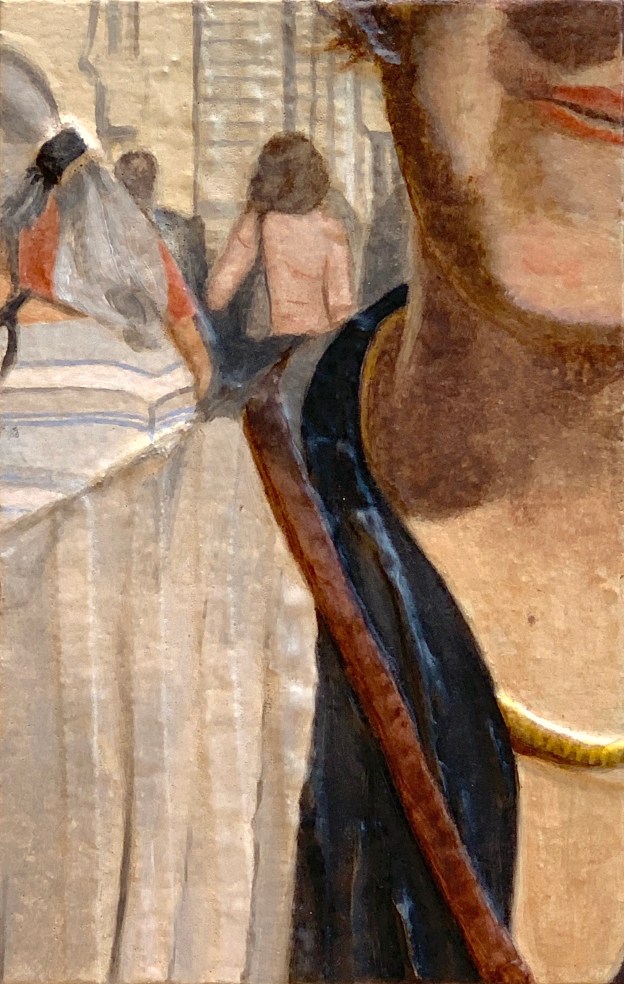
I’ve finally reached the last in this series of panels using the mixed technique. This last one, like the one previous to it, was a landscape composition containing elements of background, middle ground and foreground. In this case, the foreground and middle ground were figurative elements: the foreground was a quarter slice of my face; the middle ground contained a number of figures, four distinct ones and miscellaneous body-parts of two others. (Geez, this sounds like a post-mortem.) In addition, since the underpainting for the flesh tones was done in the standard convention of terre verte (green), it even looks ghoulish.

A Piece of Me #12, egg tempera over india ink on collaged substrate.

A Piece of Me #12, egg tempera over india ink on collaged substrate.

A Piece of Me, #12. The mixed technique over collage. 21 x 13.3 cm or 8 1/4 x 5 1/4 in

A Piece of Me, #12. The mixed technique over collage. 21 x 13.3 cm or 8 1/4 x 5 1/4 in

So I was interested to render these elements carefully in terms of hue and value. For example, the lady in the centre of the middle-ground had on a very pink shirt in the original photograph. I toned it down because I didn’t want it to attract too much attention. However since my face is strongly lit, I’m wearing a black shirt with an oatmeal coloured coat I wasn’t too worried about the contrasts of the foreground. The only challenge wasto render it well. In the end I’m pretty pleased with the result and of course, the underpainting, underdrawing and collage all play a formative role.

Full description of the whole project here. Write up on the mixed technique here.

A Piece of Me #02, the mixed technique. 21 x 13.3 cm or 8 1/4 x 5 1/4 in.

A Piece of Me #02, the mixed technique

After a long, partially self-imposed, partially corona-virus imposed hiatus (no, I was not sick, just stuck for awhile on Gilligan’s Island) – I have finally been able to return to the drawing board in my Bruges studio. Hooray!!!

A Piece of Me #02, the mixed technique. 21 x 13.3 cm or 8 1/4 x 5 1/4 in.

A Piece of Me #02, the mixed technique. 21 x 13.3 cm or 8 1/4 x 5 1/4 in.

A Piece of Me #02, egg tempera over underdrawing.

A Piece of Me #02, egg tempera over underdrawing.

This then, is one of the last panels executed in the mixed technique. The composition for this and the final one (still yet to come) are both challenging and interesting at the same time. They contain elements of a traditional landscape layout, that is, foreground, middle-ground and background. So for me, as a painter, that primarily means I want to control both my chromatic and value contrasts: the foreground can contain the warmest hues and the strongest values; while the middle ground less and the background even less.

Actually during the oil level I rendered each of these elements separately, then balanced them up at the end. The man with the cap in the foreground came last. The figure in the centre (I call him Joe Biden), was  a quick fix, following the architectural background, which also happened relatively quickly (due to the work up of my previous layers). My interest has always been in having each panel function on its own as well as having the capacity to integrate itself into the finally completed whole. Due to their landscape elements these panels should be able to do both rather well? So, of course, I’m looking forward to putting it all together at the end!

Full description of the whole project here. Write up on the mixed technique here.


A Piece of Me #46, egg tempera over pastiglia on panel. 21 x 13.3 cm or 8 1/4 x 5 1/4 inn.

A Piece of Me #46, egg tempera

A Piece of Me #46, egg tempera over pastiglia on panel. 21 x 13.3 cm or 8 1/4 x 5 1/4 inn.

A Piece of Me #46, egg tempera over pastiglia on panel. 21 x 13.3 cm or 8 1/4 x 5 1/4 inn.

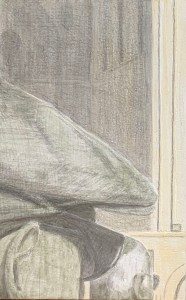
I completed this panel, #46, in the egg tempera series yesterday. It was an intriguing piece to paint since I was applying lightly tinted washes over an already sculpted pastiglia surface – that had also received its preparatory black and white underdrawing in india ink. So in one sense, I had my work already cut out for me. But in another sense I had colors to coordinate and to balance, as well as textures to enhance. Compositionally, the design of the piece is quite strong, an almost white, emphatic vertical thrust on the left (the leg of my linen pants) which needs to balance with a series of tinted trapezoids (floor tiles) on the right. Luckily, there was some drapery top left whose hues and values echo some of the  shapes on the right. The pastiglia quickly and easily enhanced the chiaroscuro I wanted to add to my pants leg. I’m happy: this stands alone and, I think, will integrate well in the final assemblage. You can read a description of the full project here. A technical write up of the lessons learned about egg tempera in this series of panels here.

A Piece of Me #41, egg tempera on panel. 21 x 13.3 cm or 8 1/4 x 5/1/4 in.

A Piece of Me #41, egg tempera

A Piece of Me #41, egg tempera on panel. 21 x 13.3 cm or 8 1/4 x 5/1/4 in.

A Piece of Me #41, egg tempera on panel.

I have been doing underdrawings for the other panels (of this big 64 panel project that you can read about here) earlier this week, thus yesterday I was able to return to the egg tempera series. Here on the left then, is the second in that group. Strangely enough, I’ve been somewhat apprehensive about this one. For the source image is a plastered wall covered with a light warm yellow wash of paint. Otherwise, not much there. Boring. So the challenge was how to reproduce that well enough so as to integrate the panel into the final assembled painting but also create something that could stand alone as an image for the roving eye to enjoy.

painting tools: toothbrush, calligrapher’s brush, cosmetic sponges

In this case, I was able to press a few “new” tools into service as you will see on the left: an extremely fine mesh cosmetic sponge  for the very light tonal washes (bottom, right), a calligrapher’s brush for the local washes and a tooth brush for the gray speckles. I’m pretty pleased with the result.

A technical write up of the lessons learned about egg tempera in this series of panels here.