Tag Archives: artist in Bruges Belgium

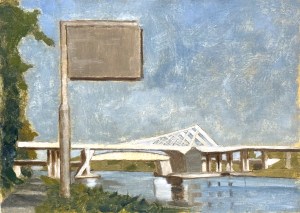
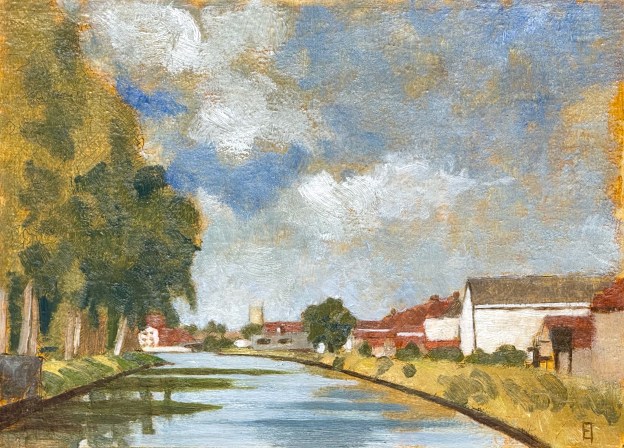
Langs de Vaartdijk II. Oil on panel. September 2025. 9 x 12.5" or 23 x 32 cm.

Langs de Vaartdijk II, September 2025

Langs de Vaartdijk II. Oil on panel. September 2025. 9 x 12.5" or 23 x 32 cm.
Langs de Vaartdijk II. Oil on panel. September 2025. 9 x 12.5″ or 23 x 32 cm.

It’s early September, the last days of summer are upon us. I went out last Sunday, prospecting for a new painting, and ended up choosing this scene along the Vaartdijk, looking back towards Brugge. I had already done one along this canal about ten years ago, different location, different view. In this scene you can just see the tower of the Gentpoorte rising in the distance, a little to the left of center.

I set up with my chair, paintbox and tripod, situated upon a dijk, rising to the left of the bicycle path. It was about four feet wide. I knew: any wrong move would land me in the water, swimming around with the little duckies. (Didn’t happen, but could have been refreshing if it did.)

I spent about three hours sketching in the scene using silverpoint, until I began inking it in with my black pen nibs. After a few lines, both pens dried out(!). Yes, it was a 30 degree centigrade day out there, but still, maybe time to buy some new ones? So I closed up shop and replaced them the following day. I completed my B/W drawing at home, anticipating going out as soon as possible to render the scene in oil en plein air.

The weather on Tuesday was clear enough and warm enough to give it a shot. As I worked, the shadows lengthened, making the reflections in the water more and more and more interesting. By five pm, as I packed up, I knew how I wanted to handle the water but also knew that it would have to wait until its painted surface had dried enough to do what I felt was still needed.

I ended up using five pigments plus white for this one: ultramarine blue, raw umber, yellow ochre, cadmium yellow light, plus cadmium orange. I used bristle brushes to block in my underpainting and sables to render the details. I made the wished for changes to the water yesterday, which means that I can post this today, chalking up yet one more for this summer season in Bruges. I love singing its praises.

If you are interested in hanging this on your wall, please contact me.

Afternoon light on the A11 bridge over the Zeebrugge Canal. September 2025 Oil on panel. 9 x 12.5' or 23 x 32 cm.

Afternoon light on the A11 bridge over the Zeebrugge Canal

We’ve ridden our bikes up to Lissewege a few times this summer. Every time we turn north onto the Zeebrugge canal, I’ve been struck by the span of a big, white bridge, just as the canal widens towards the sea. So even though it’s a half hour bike ride from home, last Monday I decided to try my luck in capturing it.

Study for the A11 bridge over the Zeebrugge Canal. September 2025  Silverpoint and India ink on gessoed panel.  9 x 12.5' or 23 x 32 cm.
Study for the A11 bridge over the Zeebrugge Canal. September 2025 Silverpoint and India ink on gessoed panel. 9 x 12.5′ or 23 x 32 cm.

I biked out on a sunny day and spent about four hours getting down a relatively detailed drawing – directly onto my gessoed panel. I moved through the free sketch of a charcoal pencil, to the more decisive silverpoint nib and finally committed myself to a finished design using India ink. By that point it was both a composition and a value study. When you spend four hours on location, studying shapes and light, you learn to read the three dimensionality of the scene before you, so that whatever values you end up placing there need to tell that story. See image to the left.

Friday the forecast was for warm and clear skies. I decided to go out. I also wanted to test out my new $$ tripod(!). Its connection to the bracket on the underside of my painting box was solid (no more wobbles) plus the legs themselves were very sturdy. Worth the upgrade (but I do need to sell more paintings to cover that expense! πŸ˜‰ ).

Afternoon light on the A11 bridge over the Zeebrugge Canal. September 2025 Oil on panel. 9 x 12.5' or 23 x 32 cm.
A11 bridge over the Zeebrugge Canal. September 2025 Oil on panel. 9 x 12.5′ or 23 x 32 cm.

I spent another four hours laying in color, moving through a lean, mid-value underpainting to the definitive highlights and shadows of the final piece you see here. The strong white values of the central bridge dominate the composition while the interstices of the upper supports were defo an exercise for MC Escher himself (!). I couldn’t have rendered them in white paint without having already done my homework in the preparatory drawing stage. Despite their long horizontal slants the (two) bridges balance out compositionally by the path and the water. I like it.

As it turns out, I worked with a limited palette: lead white, yellow ochre, cadmium yellow light, raw umber and ultramarine blue. That’s it! Whenever possible it is good to work with a limited palette, it reduces the choices plus assists in creating a visual harmony. In the end, a success. A completed painting – and yes, in just one session. That’s the third one of this season: hooray! I might finally be on to something. πŸ˜‰

If you are interested in hanging this on your wall, please contact me.

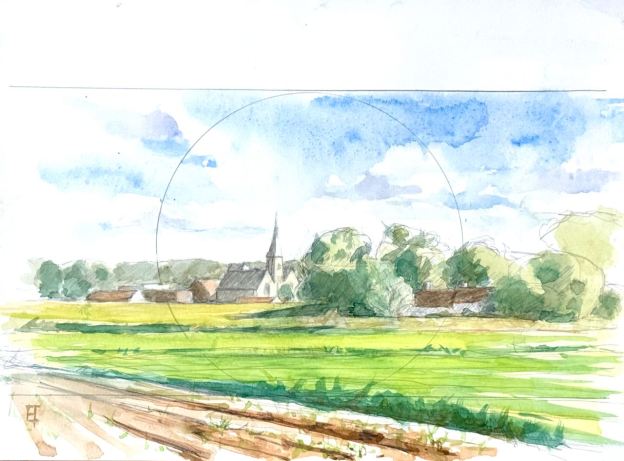
Watercolor of Koolkerke, Belgium. 23 x 31 cm or 9" x 12".

Koolkerke Watercolor, September 2024

Watercolor of Koolkerke, Belgium. 23 x 31 cm or 9" x 12".
Watercolor of Koolkerke, Belgium. 23 x 31 cm or 9″ x 12″.

Late in the summer en-plein-air season I discovered this view of the church at Koolkerke near Bruges. I had just designed a new traveling pochade box, exclusively for watercolors, so I was happy to try it out in this new-to-me location. Two birds. One stone.

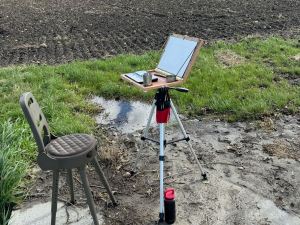
The box worked out well enough, though I always can’t help but tweak a few things. My interest was in having a sturdy but lightweight box that could exactly fit a standard watercolor block within its lid. Check. Piano hinges gave me a good easel angle. For the inside of the palette base I attached adhesive magnetic discs so my metallic watercolor pan and pots would stay put and not fall over. Underneath I attached a bracket that would take a 1/4″ 20 thread standard camera tripod mount. Check. Everything fit into my bike bag. Check, check, check. The only problem was the lateness of the season: it was very cold!

Pochade box for watercolors attached to a camera tripod.

Still, I was able to manage a session or two, enough to lay in this watercolor as a study for an oil next summer. I really love the afternoon light playing on the buildings in the far middle ground. Luckily the farmer’s fields in the foreground gave me something to work with compositionally. As a study I’m happy and have my fingers crossed for next summer.

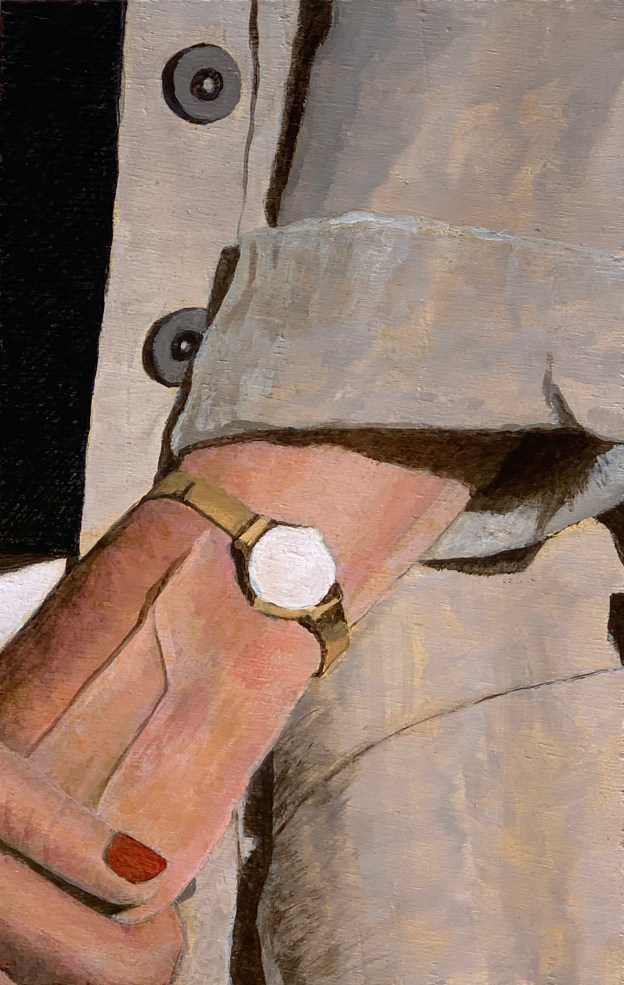
A Piece of Me #26, acrylic on panel. 21 13.3 cm or 5 1/4 x 8 1/4 in.

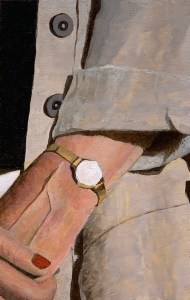
A Piece of Me #29, acrylics

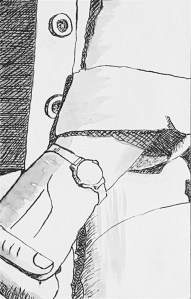
A Piece of Me #26, underdrawing in pen and ink.

A Piece of Me #26, underdrawing in pen and ink.

A Piece of Me #26, acrylic on panel. 21 13.3 cm or 5 1/4 x 8 1/4 in.

A Piece of Me #26, acrylic on panel. 21 x 13.3 cm or 5 1/4 x 8 1/4 in.

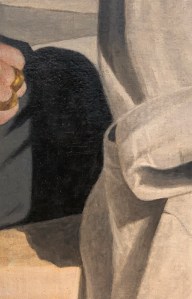
This panel presented an interesting contrast of values and hues. Strong black shirt and effects of light and shadow contrasted to a muted linen jacket and nuanced flesh tones. Additionally, the panel was untreated. I am coming to recognise this treatment (or lack thereof) presents a particular challenge to the painter. The paint is simply more difficult to manipulate.

Given all that I am pleased with the outcome. The jacket undulates, the shadows read, the flesh pulses. I wonder what time it is on that watch?

Overview of the entire project here. Technical write up of my use of acrylics for indirect painting in this project here.

A Piece of Me #44, acrylic over collage on panel. 21 x 13.3 cm or 5 1/4 x 8 1/4 in.

A Piece of Me #44, acrylics

A Piece of Me #44, underdrawing in ink wash.

A Piece of Me #44, underdrawing in ink wash.

A Piece of Me #44, acrylic over collage on panel. 21 x 13.3 cm or 5 1/4 x 8 1/4 in.

A Piece of Me #44, acrylic over collage on panel. 21 x 13.3 cm or 5 1/4 x 8 1/4 in.

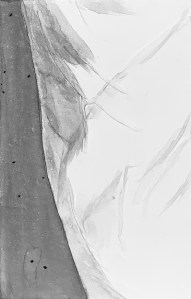
A foreground composition fromΒ the whole assemblage. It happened very quickly, but that was because I had already done so much preparatory work.

At the substrate stage I had glued in a collage to reflect the movements and folds of my pants leg. That was a lot of fun and ended up being one of my favourite collages. Then at the underdrawing stage I laid in some black and white washes to reflect the strong value contrasts of the composition, see top right. I covered the whole panel with a coat of yellow ochre imprimatura Β and set to work.

I mixed up three tints of gray in addition to the titanium white and began filling in the chiaroscuroed pants. I mixed up raw umber with a touch of ultramarine blue for the deep shadow, then laid it in with a brush and a small celled sponge. I increased the value-intensity-depth of the shadowed side pock-marks to enhance visual interest. After about a half hour I had what I was looking for.

Amazing what a little suggestion can do. Technical write up of my use of acrylics for indirect painting in this project here.

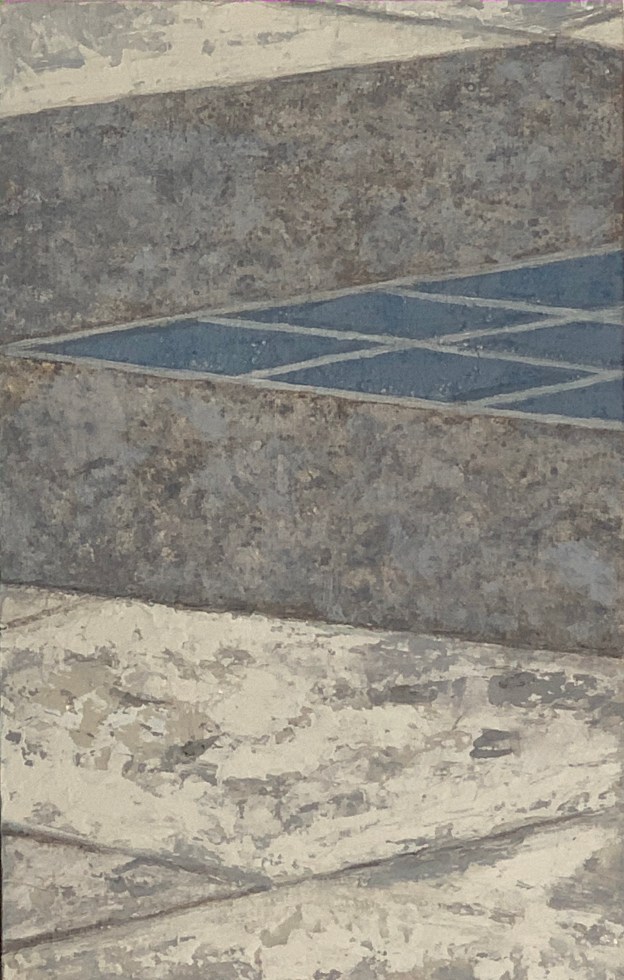
A Piece of Me #39, acrylic over linen on panel. 21 x 13.3 cm or 5 1/4 x 8 1/4 in.

A Piece of Me #39, acrylics

The muted tonalities and textures of a pattern of floor tiles. Located somewhere in the middle ground of the overall composition.

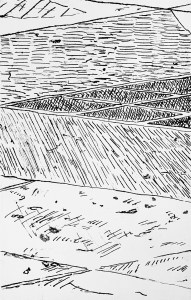
A Piece of Me #39, underdrawing in pen and ink

A Piece of Me #39, underdrawing in pen and ink

A Piece of Me #39, acrylic over linen on panel. 21 x 13.3 cm or 5 1/4 x 8 1/4 in.

A Piece of Me #39, acrylic over linen on panel. 21 x 13.3 cm or 5 1/4 x 8 1/4 in.

Perhaps the most interesting aspect of creating this panel was the extent to which I did not use the brush. The lighter sections above and below were done with a highly flexible painting knife, while the dark grey and blue tiles were created though the sequential dabbings of a small celled sponge. It was only the grouting lines (and small touch ups) that necessitated the use of a brush.

So, open textures broken by linear graphical shapes, while neutral grey forms a pretty steady through line. From a purely chromatic point of view some people might feel that grey element to be a bit too somber for their tastes. I get it, but as a tonalist, I feel it creates a peaceful serenity – so I really like it.

Technical write up of my use of acrylics for indirect painting in this project here.

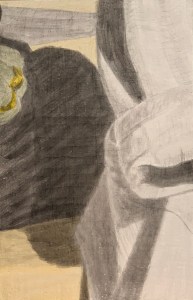
A piece of me #27. the mixed technique on panel, 21 x 13.3 cm or 8 1/4 x 5 1/4 in.

A Piece of Me #27, the mixed technique

A piece of me #27, the egg tempera underpainting.

A piece of me #27, the egg tempera underpainting.

A piece of me #27. the mixed technique on panel, 21 x 13.3 cm or 8 1/4 x 5 1/4 in.

A piece of me #27. the mixed technique on panel, 21 x 13.3 cm or 8 1/4 x 5 1/4 in.

This panel represented a few challenges mostly due to the very dark shadow of the man’s gray/black pants leg. It’s a strong element, front-and-center, commanding attention. So I wanted to represent it accurately, but also I wanted to depict enough other dark accents surrounding it to encourage the circulation of light (or lack thereof). The ring and the shadow of my linen coat work rather well for that. But is it enough? The shadow is strong and also uniform. So I still may try to introduce some scumbled detail into those deepest leg-shadows after this level dries.

However, that is or will be complicated by another, technical complication. After I had started laying in some very dark gray pigment into the medium/glaze (in the pants leg), I found that the paint dried almost immediately (!) – too quickly to manipulate. In painter’s parlance this is called “sinking in”. This happens when the ground is too absorbent. In this case, I think the absorbency was caused by the combination of the linen fabric that I had glued onto the HDF panel as part of my substrate preparation as well as the siccative nature of the particular pigment (Payne’s Gray) that I had used in that area. “Sinking in” is remedied by a localized treatment of retouch varnish, which I applied before reworking that area yesterday. Though improved, when this area thoroughly dries I still may try to supply more balancing nuance (the scumble mentioned above). However, I am not dissatisfied with the result. I think the treatment of the linen jacket, the tile work upper left, the plaster wall lower left as well as the ringed fingers are delicious. So these are the comments of the-always-critical-chef.

BTW: sorry for the glare – that’s only in the photograph – not the image.

Full description of the whole project here. Write up on the mixed technique here.

A Piece of Me #17, mixed technique on panel. 21 x 13.3 cm or 5 1/4 x 8 1/4 in.

A Piece of Me #17, the mixed technique

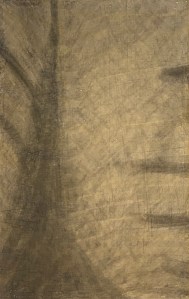
A piece of me, #17, the egg tempera underpainting over the india ink underdrawing.

A piece of me, #17, the egg tempera underpainting over the india ink underdrawing.

A Piece of Me #17, mixed technique on panel. 21 x 13.3 cm or 5 1/4 x 8 1/4 in.

A Piece of Me #17, mixed technique on panel. 21 x 13.3 cm or 5 1/4 x 8 1/4 in.

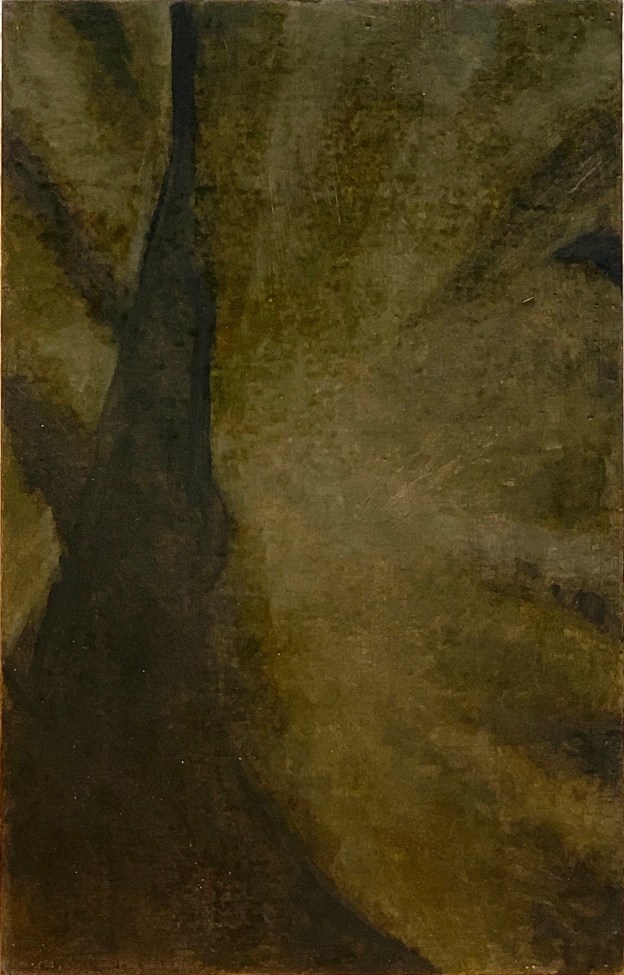
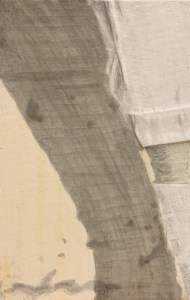
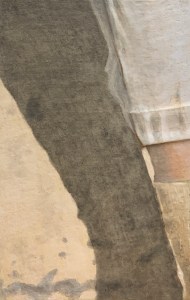
This panel was pure painter’s delight. Took me about an hour to do. My challenge: how to make a field of dark green with some slight shadowed undulations interesting

So I mixed up five shades from the deepest shadows to the highest highlights and set to work. And though I did use some lead white for the tints, I was also careful to make use of the white of the gesso substrate, too. This was done by using a fan shaped dry brush to brush the pigmented paint into its neighbor. When the manipulation was vigorous enough the dry brush tended to reveal the substrate – which made the whole panel more luminous. Finding light in the shadows. And relative to the composition, I was careful to introduce whatever hard lines it offered as a counterpoint to the amorphous fields of green.Β This is the result.

The whole is already more three dimensional than its underpainting. I’ll take it.Full description of the whole project here. Write up on the mixed technique here.

A piece of me, #52, the mixed technique over collage on panel, 21 x 13.3 cm or 8 1/4 x 5 1/4 in.

A Piece of Me #52, the mixed technique

A piece of me #52, egg tempera over collage

A piece of me #52, egg tempera over collage

A piece of me, #52, the mixed technique over collage on panel, 21 x 13.3 cm or 8 1/4 x 5 1/4 in.

A piece of me, #52, the mixed technique over collage on panel, 21 x 13.3 cm or 8 1/4 x 5 1/4 in.

One of the most interesting aspects of this particular collaged panel was my pants cuff. It projects a few millimeters from the rest of the composition (!). Really. During the oil level, I found that balancing the warm whites of my pants, socks and the plastered wall with my skin tone was all made possible by the value adjustments inherent to the composition (and the judicious use of a warm-gray pigment from the tube). BTW: I prefer my grays warm and I don’t mix them on the palette. It’s too difficult to consistently achieve an elusive neutrality (which may not exist anyway). Full description of the whole project here. Write up on the mixed technique here.

A piece of me #22, the mixed technique over pastiglia on panel, 21 x 13.3 or 8 1/4 x 5 1/4 in.

A Piece of Me #22, the mixed technique

A piece of me #22, the egg tempera underpainting over pastiglia

A piece of me #22, the egg tempera underpainting over pastiglia

A piece of me #22, the mixed technique over pastiglia on panel, 21 x 13.3 or 8 1/4 x 5 1/4 in.

A piece of me #22, the mixed technique over pastiglia on panel, 21 x 13.3 or 8 1/4 x 5 1/4 in.

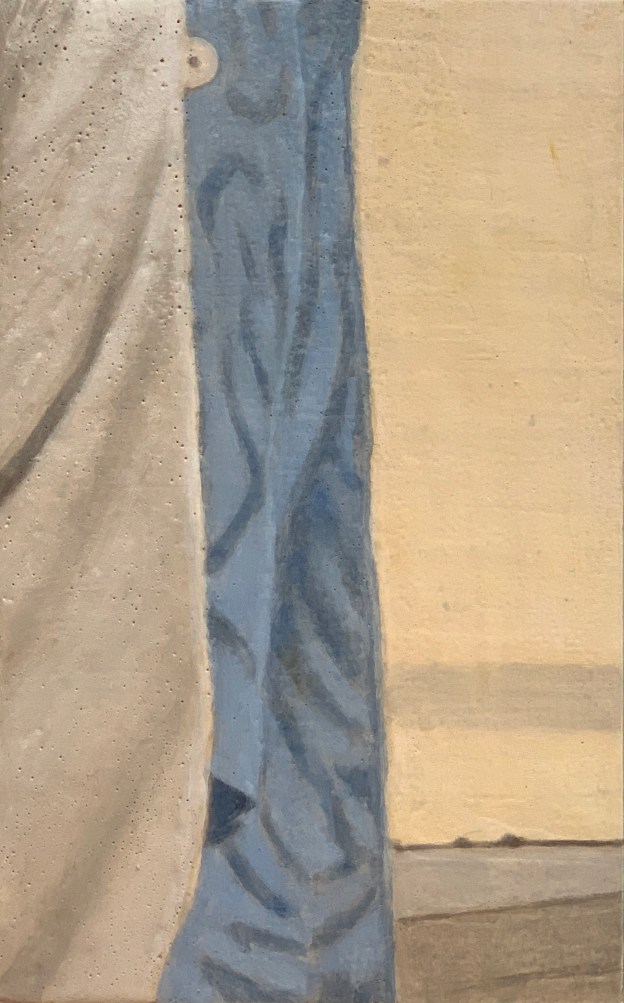
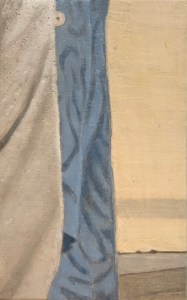
This panel was executed over a pre-prepared lightly sculpted pastiglia. On the pastiglia level I tried to create the effect of folds of clothing: the bends of my linen jacket and the flowing shirt of the lady standing behind me to the right. Unfortunately, due to my method of creating the pastiglia, a number of pinholes appeared in the gesso of the linen jacket. The oil was able to hide some, but otherwise it’s not an ideal situation, kinds like acne, you learn to live with the scars. The light jacquard pattern of the lady’s blue blouse was a nice surprise for me as I began to work on the enlarged image. Fun to render! Full description of the whole project here. Write up on the mixed technique here.