Category Archives: Acrylic

Paintings executed exclusively in acrylic.

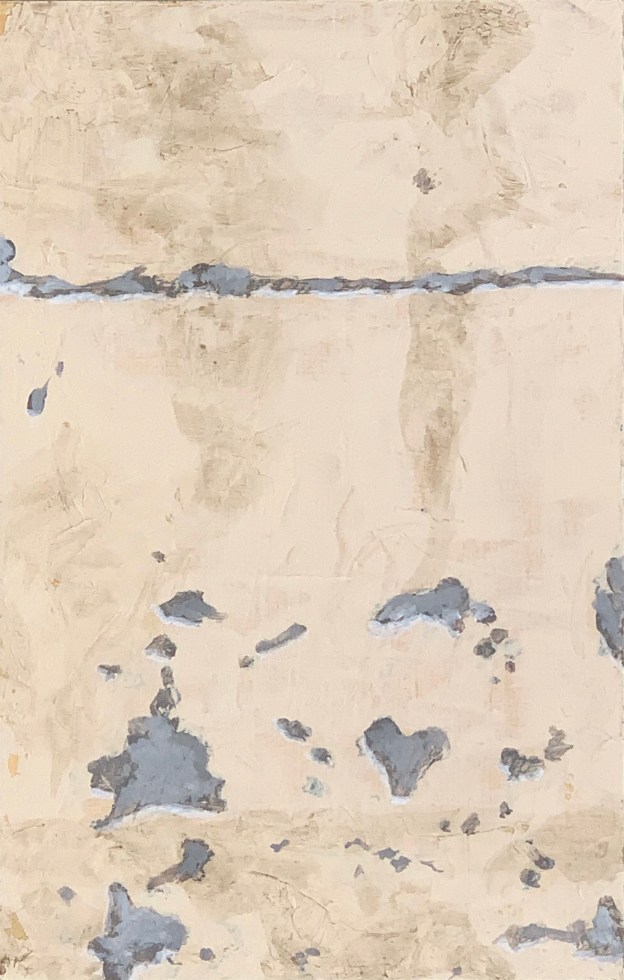
A Piece of Me #64, acrylic over collage on panel. 21 x 13.3 cm or 5 1/4 x 8 1/4 in.

A Piece of Me #64, acrylics

Fifth in the acrylic series. An abstract composition of floor tiles. The painting was executed over a collage that already reflected the design of the panel.

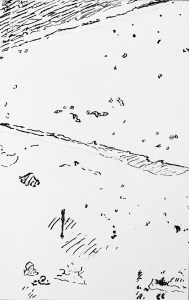
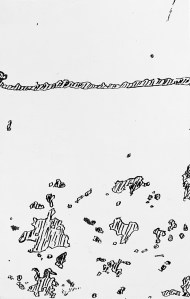
A Piece of Me #64 pen and ink underdrawing.

A Piece of Me #64 pen and ink underdrawing.

A Piece of Me #64, acrylic over collage on panel. 21 x 13.3 cm or 5 1/4 x 8 1/4 in.

A Piece of Me #64, acrylic over collage on panel. 21 x 13.3 cm or 5 1/4 x 8 1/4 in.

My palette consisted of titanium white, medium grey, yellow ochre, burnt sienna and raw umber. I used lots of extra tools to assist in creating texture: a coarse sponge (large and small chunks of it), the painting knife and a piece of paper towel (to soak large areas of wash off the lighter tiles).

One of the most enjoyable aspects of doing these panels is that because they are bite-size (basically the size of an A5 or half of 8 1/2 by 11 U.S. letter), each one can be an open experiment in terms of execution. I can create a small unity using a variety of means. This would not be possible if the panel was, say 8 feet by 10 feet. If that were so I would have had to devise special brushes or sponges on wheels and pulleys. The scale then makes this freedom possible. The question then is how the final assemblage will function (also as a unity). But since I’ve done this before I’m not really worried – just curious.

Technical write up of my use of acrylics for indirect painting in this project here.

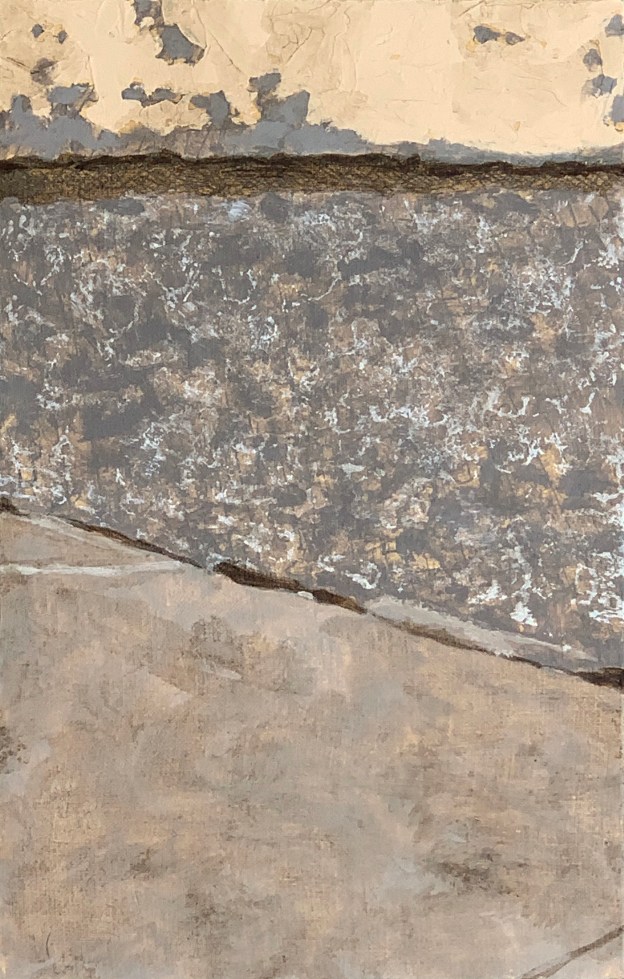
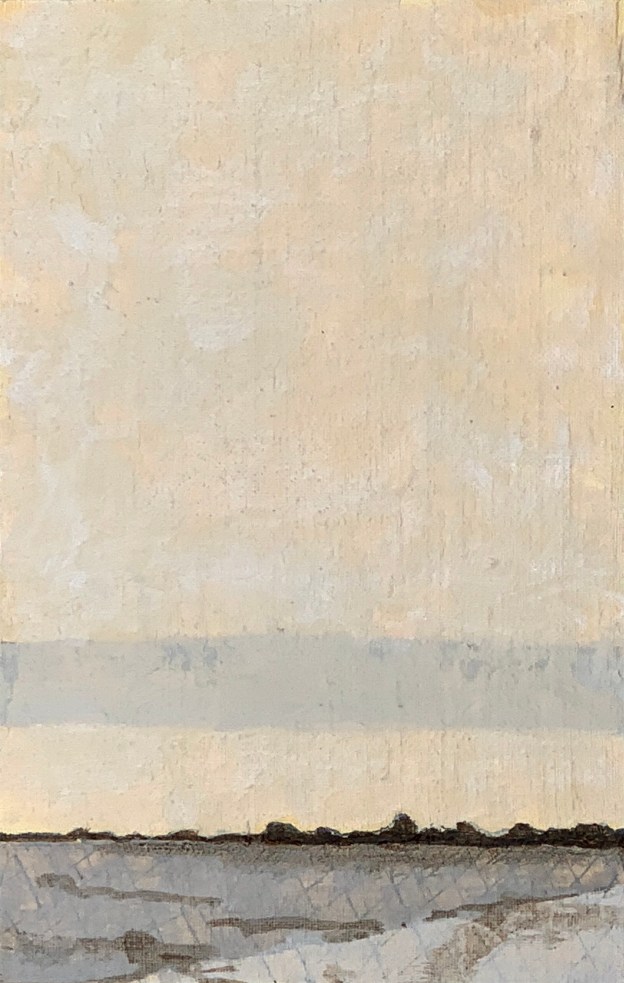
A Piece of Me #59, acrylic on linen over panel. 21 x 13.3 cm or 5 1/4 x 8 1/4 in.

A Piece of Me #59, acrylics

Fourth in the series. Muted earth tones of yellow plaster and tile, gray mottled or a light umber.

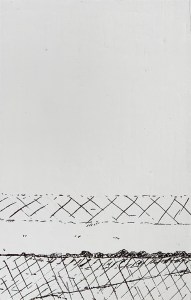
A Piece of Me #59, pen and ink underdrawing

A Piece of Me #59, pen and ink underdrawing

A Piece of Me #59, acrylic on linen over panel. 21 x 13.3 cm or 5 1/4 x 8 1/4 in.

A Piece of Me #59, acrylic on linen over panel. 21 x 13.3 cm or 5 1/4 x 8 1/4 in.

At this point I think it’s important to say something about palette. I think a reduced palette creates an aesthetically satisfying painting (whatever the subject matter, or no subject matter at all). In this case I restricted myself to yellow ochre, titanium white, neutral gray and raw umber. I had used the same pigments for the last panel (#49) too. OK, so the composition in either case was not very complex, nevertheless you still want to think about how to create  a unity from the contrasts of hue and value while using a minimum of means.

From a texture point of view, I used the painting knife once again for the light plaster wall. Then I picked up a small piece of sponge to create the mottled gray tile work below it. The first pass was in neutral gray and the second pass was in white. Immediately I had a touchy-feely texture that just needed a little subduing and integration. The darker value of the raw umber gave me a solid horizontal line across the wall/floor crease. I used the same pigment as an echo in the broken line of the front diagonal. Of course, the underdrawing and the imprimatur work to provide a solid foundation, adding interest and depth, kinda like the bass line in a popular song.

Nice. Done.

Description of the overall project here. Technical write up of my use of acrylics for indirect painting in this project here.

A Piece of Me #49. acrylic on panel. 21 x 13.3 cm or 5 1/4 x 8 1/4 in.

A Piece of Me #49, acrylics

A Piece of Me #49, pen and ink underdrawing.

A Piece of Me #49, pen and ink underdrawing.

A Piece of Me #49. acrylic on panel. 21 x 13.3 cm or 5 1/4 x 8 1/4 in.

A Piece of Me #49. acrylic on panel. 21 x 13.3 cm or 5 1/4 x 8 1/4 in.

Third in the series. Still concentrating on background abstract compositions. This one, a plastered wall in the foreground of the overall composition. It’s heavily chipped providing a nice contrast between the yellowish plaster and the gray stonework beneath it.

I began, as I do with most panels in this series, with an imprimatur wash of yellow ochre. Then after mixing up a much lighter tint I used the painting knife to pretend I was a plasterer laying on plaster. I avoided the gray areas as indicated by the underdrawing. Then I lay in the gray cement. The whole design took shape rather quickly: some might have called it done. I set it aside to dry.

The next day I added some white highlight to the plaster edge, giving it dimensionality. Then I added some lighter gray areas to add interest to the concrete. The final touch was light washes of raw umber to reflect the weathering stains on the wall.

Amazing how something so simple can be so satisfying. Technical write up of my use of acrylics for indirect painting in this project here.

A Piece of Me #24, acrylic over collage on panel. 21 x 13.3 cm or 5 1/4 x 8 1/4 in.

A Piece of Me #24, acrylics

Second in the series of acrylic panels. This one was executed over a textured collage, which essentially consisted of two planes of fabric. The paint however flows quite different over a heavily textured weave than over a modelled surface of acrylic gel (as it did in the previous panel).

A Piece of Me #24, underdrawing in pen and ink.

A Piece of Me #24, underdrawing in pen and ink.

A Piece of Me #24, acrylic over collage on panel. 21 x 13.3 cm or 5 1/4 x 8 1/4 in.

A Piece of Me #24, acrylic over collage on panel. 21 x 13.3 cm or 5 1/4 x 8 1/4 in.

The composition is quite simple with very basic geometric shapes. Actually, it’s almost identical to its companion piece (#23) that I recently completed in encaustic. Both paintings are quite similar yet also quite different. It will be interesting to place them side by side in the final assemblage: to feel the simultaneous vibration of similarity and difference.

BTW: I did not expose the underdrawing at all in the horizontal wall stripe but I did leave some of the pen and ink detail exposed for the crease and floor tiles. I expect to continue to take advantage of the underdrawing in this way in the future. Otherwise, why do it?

Technical write up of my use of acrylics for indirect painting in this project here.

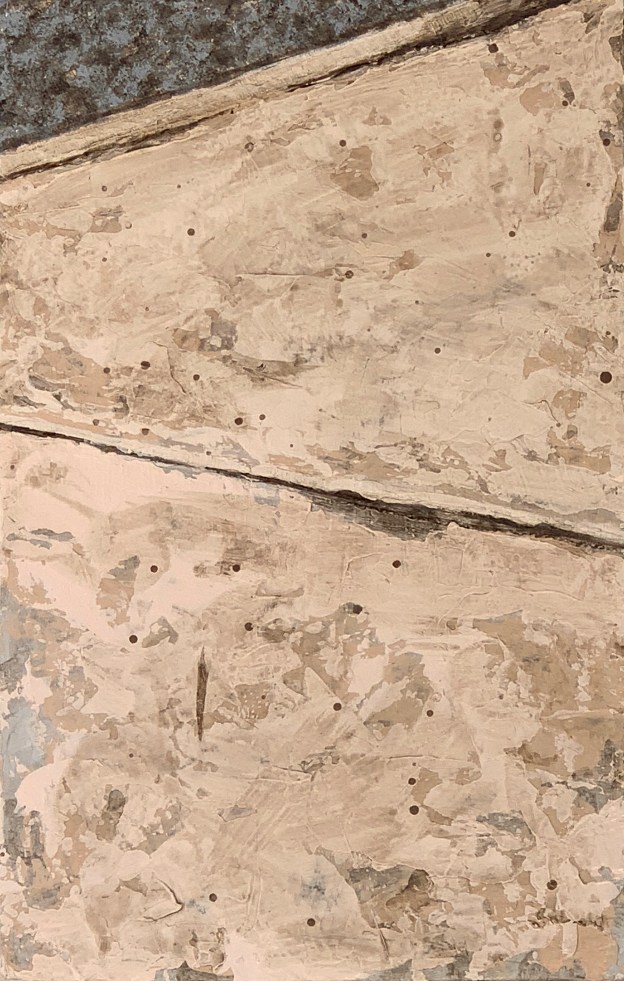
A Piece of Me #34, acrylic on panel over acrylic molding paste. 21 x 13.3 cm or 5 1/4 x 8 1/4 in. Final version.

A Piece of Me #34, acrylics

Started on the acrylic series today. Had to stop the encaustic series because of the summer’s heat and the new mask I had ordered (but not yet received) to protect myself against the toxic fumes arising from the (heated) encaustic paint.
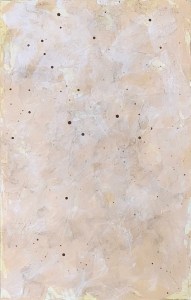
A Piece of Me #34, acrylic on panel over acrylic molding paste. 21 x 13.3 cm or 5 1/4 x 8 1/4 in. Version #1
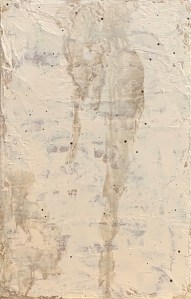
A Piece of Me #34, acrylic on panel over acrylic molding paste. 21 x 13.3 cm or 5 1/4 x 8 1/4 in. Version #1

A Piece of Me #34, acrylic on panel over acrylic molding paste. 21 x 13.3 cm or 5 1/4 x 8 1/4 in. Final version.

A Piece of Me #34, acrylic on panel over acrylic molding paste. 21 x 13.3 cm or 5 1/4 x 8 1/4 in. Final version.

Ah bon, so acrylic. Most people learn to paint with it. Some never leave. It dries fast, it’s cheap, and easy to manipulate. What’s not to like? Well, for me, it’s plastic. And for that reason alone I’ve avoided it like the plague ever since my college days. That may seem like an irrational reason – which it is – but since the tactile quality of the substrate, the gesso, the medium and the  pigments has always been my navigational compass I’ve heeded this aversion. So now this project offers me the chance to dive back in and re-examine my distaste.

I began with this panel. It’s an open field of a plastered wall in the foreground of the overall assemblage. The original composition then is: nothing, a blank canvas. These kinds of open compositions are a lot of fun and a great way to acquaint myself with any particular medium (which in this case, is acrylic). There was no underdrawing, so I began with an imprimatura in yellow ochre to set the tone and began slashing in paint. Because this panel called for modelling in the prep phase, the surface was already modelled to reflect the movement of a plasterer’s trowel. I used the painting knife to increase this tactile movement. When I was satisfied that there was enough variation in the surface, I splashed on some toothbrush dots for graphical and value contrast. I was done – or so I thought.

Yet after I had completed the whole series I returned to this one. The main reason was hue. I noticed that this one was too pink. It might work fine as a stand alone painting but if I wanted these panels to integrate into one vibratory whole without TOO much dissonance then it seemed best to alter the hue. I mixed up some titanium white with a pinch of yellow ochre and troweled it on using the painting knife. Much of my subtle modulation disappeared. No problem. I mixed up some raw umber with clear glazing gel and water to create a light wash. I drizzled it down from the top, allowing gravity to imitate the stains on the original wall. When that dried, I tooth-brushed on a tint of dots and was done. You can compare the original panel above right with this new one above left (as well as spotlighted above). I think the new version is an upgrade, don’t you?

In both cases, the whole process took me maybe an hour. That’s acrylics. Technical write up of my use of acrylics for indirect painting in this project here.