Category Archives: Landscape

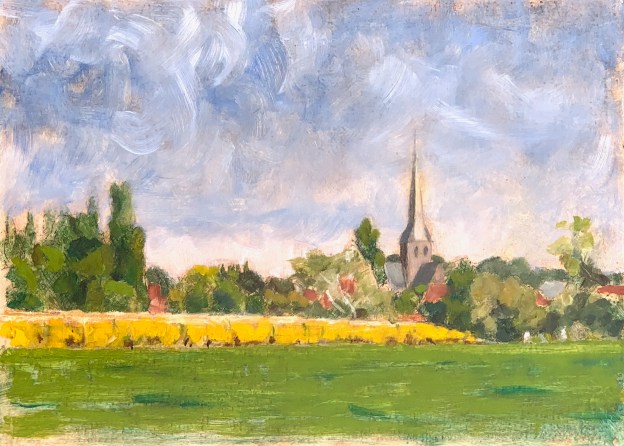
I experience landscape as a doorway, an invitation to eternity, shimmering with light. Sometimes, when that sentiment makes it onto paper or panel, I am grateful.

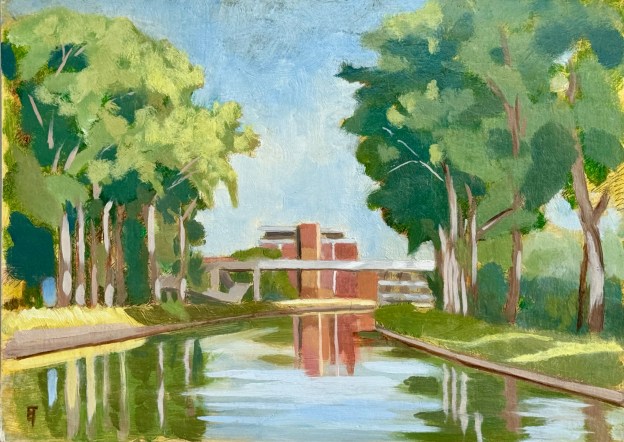
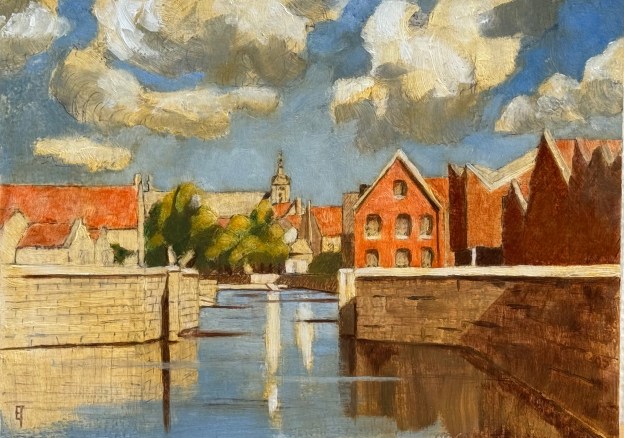
July, 2024, Avond aan de jachthaven, Brugge: "there is a light, never goes out"

July 2024, Avond aan de Jachthaven I, Brugge: “There is a light, never goes out”

July, 2024, Avond aan de jachthaven, Brugge: "there is a light, never goes out" 9 x 12" or 23 x 30 cm

July, 2024, Avond aan de jachthaven, Brugge: “there is a light, never goes out” 9 x 12″ or 23 x 30 cm

Last night I completed the third “on location” painting session for this little piece. It felt a bit like (finally) pulling a rabbit out of a hat.

It’s been a struggle primarily because of the summer Belgian weather (or lack of it). Secondly, because I’ve been navigating various tweaks to my newly self-designed and self-created pochade box. For example, at the start of session #2, the bracket attaching the box to my tripod fell off. 😦 So I had to sit on the ground for two hours. It was OK, but for the physical activity of painting, suboptimal. Thirdly, because I’m still (always) refining my technique.

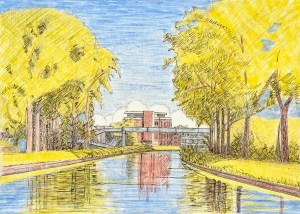
aan de jacht haven Brugge/ the marina in Bruges. Watercolor on hot pressed paper. 9" x 12" or 23 x 30 cm.

aan de jacht haven Brugge/ the marina in Bruges. Watercolor on hot pressed paper. 9″ x 12″ or 23 x 30 cm.

Thus, in part because of my temperament, and in part because of the weather, I worked up the initial layers in the studio. I already had the composition since it was based on a watercolor I had completed last summer: I loved the receding canal, the light on it at the end of the day, plus the glowing red brick building in the middle distance.

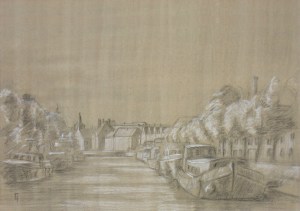
Aan de jacht haven Brugge/ the marina in Bruges. Underdrawing and underpainting on panel, touched up by India ink. 9" x 12" or 23 x 30 cm.

Aan de jacht haven Brugge/ the marina in Bruges. Underdrawing and underpainting on panel, touched up by India ink. 9″ x 12″ or 23 x 30 cm.

So I used that study to create an underdrawing (with silverpoint) and on that lovely, soft drawing, an underpainting (with egg tempera). After a light coat of shellac (to seal the panel off from the absorptions of the oil phase to come) I used a pen nib loaded with India ink to emphasize the composition’s darker values. All this was possible in the studio – and it laid down a solid, graphical foundation before all the accidents I knew painting “on location” would bring.

Both silverpoint and egg tempera are well suited to a panel prepared with true gesso (rabbit skin glue and chalk), however as techniques they cannot be used on a flexible canvas (the substrate of choice by painters since the 16th-17th century) primed with acrylic gesso (the ground of choice by painters since about the 1950’s). The record of my experiments in these against-the-current techniques is on my companion blog site atelierartisanal.com .

Why I have chosen this anachronistic technical direction is perhaps best examined from a therapist’s couch: it’s been the subject of much failure as well as heart-ache, but alas, it is the choice of my gevoelsmatig-bewustzijn (feeling-consciousness). And even though many of my experiments over these decades have not been successful, some have. There is a kind of internal mind’s-eye light I’ve been chasing. And I would also say that, thankfully, my batting average is beginning to improve! There is light at the end of this tunnel!

Additionally, I’m not sure if it’s even appropriate to call this an “en plein air” painting. The reason being, it was not painted “alla prima”, that is, all at once, in one session. For, besides the studio levels of image development described above, there were also the three “on location” evening sessions. So, if “alla prima” is an essential element of a definition of an “en plein air” painting, my work in general and this one in particular doesn’t fit. And relative to those three evening sessions, I’m hoping to whittle them down to just one or two (as long as the weather and my pochade-box holds ;-)). We’ll see what the future brings. 😉

If you are interested in this pieces please email me.

Schaarstraatbrug, Right. Oil on panel. June 10, 2024. 9 x 12" or 23 x 30.5 cm

Schaarstraatbrug, middag, kijkend naar het weste/Schaarstraat bridge, noon, looking (mostly) west

Schaarstraatbrug, Right. Oil on panel. June 10, 2024. 9 x 12" or 23 x 30.5 cm

Schaarstraatbrug, Right. Oil on panel. June 10, 2024. 9 x 12″ or 23 x 30.5 cm

For years I’ve been entranced by the view from the Schaarstraat bridge. I knew the time of year and time of day I wanted to capture for it offers a great opportunity to explore the complimentary colors of blue and orange. Last summer I was able get down a watercolor that I liked. Compositionally, it had what I was looking for, so I decided it could be a good start for an oil. The best part about that study was that I could work up the underdrawing in the studio and, so I imagined, finish it en plein air.

I know that most of the activity that goes by the name “en plein air” refers to an alla prima painting technique, which means the whole painting from start to finish is executed on location. (Of course, small touch ups in the studio are OK, but principally, the immediacy of painting “en plein air”, means painting in the moment, with (hopefully) a zen-like aesthetic insight and accuracy). I’ve got nothing against that, it’s just that I’ve come to realize that my aesthetic interests are a little different. The kind of color statements I want to make appear to be best supported by an indirect technique(!). Which means working up a painting, through layers – and these take time to dry.

Schaarstraatbrug, Right. Watercolor on hot pressed paper. July 2, 2023. 9 x 12" or 23 x 30.5 cm

Schaarstraatbrug, Right. Watercolor on hot pressed paper. July 2, 2023. 9 x 12″ or 23 x 30.5 cm

So, back to this piece. In the studio I worked up a drawing using silverpoint (it’s a very soft way to lay out the composition and make preliminary value statements). Then I lay in the basic color statements using egg tempera (it too, is a light and soft medium and, relative to oil, quite siccative). After the ET dried (about a week) I realized I might as well go ahead and do the first oil session indoors (since the weather was so bad!).

That first oil session was a return to the starting value statement but this time, stronger and more extreme, I used white, burnt umber and ultramarine blue. Woah, the result was more like a solarized photo, but promising. After it dried, I wanted to go out to finish it on site, but again the weather frustrated my building creative momentum: I just couldn’t wait. So I thought, heck, forget the men’s finals of the French Open, let’s see what can happen in the studio.

Surprisingly after a few hours of judicious glazing (the yellow ochre starting glaze was definitive), I saw what I had been looking for emerge on the panel. Nice! It’s so important to know when to stop when – beside the dinner bell – it’s time to lay down your brushes.

Watercolour from Dinant looking south. October 2023. 23 x 31 cm or 9 x 12" on hot pressed paper.

Watercolour, Dinant, looking south

Watercolour from Dinant looking south. October 2023. 23 x 31 cm or 9 x 12" on hot pressed paper.

Watercolour from Dinant looking south. October 2023. 23 x 31 cm or 9 x 12″ on hot pressed paper.

We travelled to Dinant last weekend. It turned out to be the last blast of Indian Summer for this fall season. Perfect weather for biking along the Meuse. I quickly fell in love with this view and determined to get a good sketch of it down before we went home.

Which I did.

It took me a few hours (as it usually does) to get the composition down right, to select the important shapes, guiding the eye to them, but not abandoning the viewer there. I already knew that late afternoon light provided a fantastic spotlight on the buildings south of town. I also knew that compositionally, I wanted to include the rock ledges framing those buildings, right and left. The water, too, disappearing round the bend in the distance.

But besides the basic composition, there was also the value study to consider. It enhances a good composition. Also knowing where the paper would need to remain white was essential before making any stroke of colour. That late afternoon light on the buildings, rock silhouettes and water would be a challenge to retain in watercolour but I wanted to try. I also decided to make that attempt without applying any liquid frisket(!!) – because frisket usually ends up destroying the surrounding drawing so I have to redraw it anyway.

For the drawing phase I always use .5 thickness mechanical pencils. This time I reconfirmed to myself that I definitely do not like using an HB lead but rather an H. An HB is not only too dark, but it also tends to rough up the surface of the paper. That’s retrograde to our desire.

So I took a few photos of the light and stillness of the water on the first evening (not replicated on the second). No problem. With my drawing, I had enough to work with. The most important thing is always staying connected to how I felt and could still feel – in my mind’s eye.

If we were still in Dinant (and conditions were favourable), I would have tried to finish it up en-plein-air. But when you travel it’s just not always possible. As it is, one week later, back at home, this is what I have been able to come up with. I like it and also feel that if I did anything more it would begin to veer towards becoming overworked.

It’s so important to know when to stop. My mantra (particularly in watercolour): Less is more.


Vivenkapelle. September 2023. Oil on panel. 9 x 12 Inches or 23 x 32 cm.

Vivenkapelle, Oil

Vivenkapelle. September 2023. Oil on panel. 9 x 12 Inches or 23 x 32 cm.

I biked out yesterday, late afternoon, to my current favourite spot along the Legeweg outside of Bruges. Besides my light-weight field easel and folding chair, I was equipped with brushes, an apron, painting rags, oils and my three small bottles of potions (medium, emulsion and turps). This was intended to be my second and (hopefully) final en-plein-air painting session of Vivenkapelle.

I had completed a watercolour there in late August. I liked it well enough to decide to attempt an oil of the same view, so I laid in the design onto a true-gesso panel, first in silverpoint, subsequently in fine-tipped lines of india ink.

Vivenkapelle. First session. Early September.


In early September I ventured out with my abbreviated field equipment (as described above). It had been more than ten years since I had tried to paint en plein air in oils(!!!). In fact (for numerous reasons) I had kinda given up on it. So this time I truly felt las though I had nothing to lose (which for artistic creation is a very good place to be). In addition, I had decided to try out a new recipe for my emulsion (one whole egg instead of the usual methyl-cellulse glue component). The first session went OK. I blocked in the main shapes and colours. But it all dried so fast (too much egg white in the emulsion!). Nevertheless, I was glad to get something down and was hopeful that the painting could be concluded before the weather changed and/or the corn got mowed.

Three weeks later I tried my luck (hooray! the corn was still there!). This time I adjusted my emulsion recipe to include just the yolk of one egg, deleting the watery white. It had the effect I was looking for: it allowed the wet oil strokes to stick to the substrate/ground (which had been lightly-covered-and-wiped-with-medium) as well as allowing the wet strokes to retain their integrity when gently dry brushed. In this way, the perennial smearing, smudging, dirty-colour problem of oil painting can (for the most part) be avoided! I already knew that whenever small corrections needed to be made, a small dry brush dipped in medium can function like an eraser, allowing the corrected stroke to be placed on top (and dry brushed in as needed).

Because I was painting over an underpainting, the decisions I had to make were greatly reduced. (Hooray!!!) Also, all those previous decisions enhanced the further development of the image. With the scene in front of me, I kept to my original mind’s-eye image, playing back and forth between the two. The cows stopped by to say hello. A number of passers-by, too. The evening lengthened. Weather-wise I was in luck; it was full-on Indian Summer glory. After approximately two hours, I was done: not too much; not too little; just right. Perhaps just enough to invite the viewer to join in the dance.

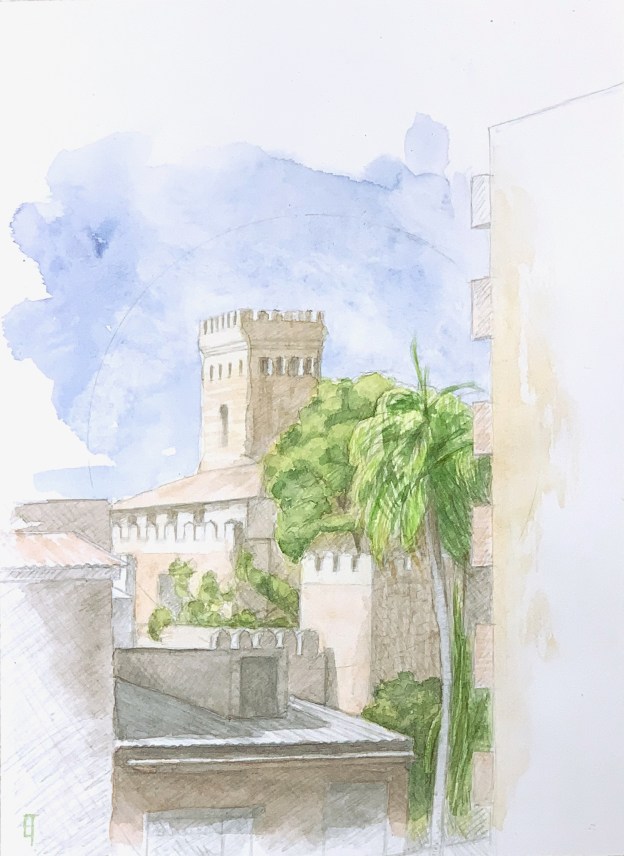
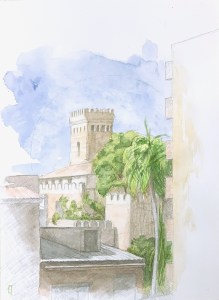
Benisanó, view of the Castle from the terrace, noon. Watercolor on hot pressed paper. 9 x 12" or 23 x 30.5 cm. September 2023.

Postcards from Benisanó

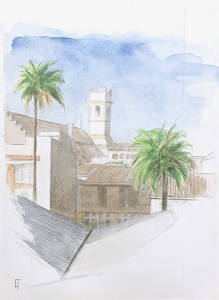
Benisanó, view of the Catholic church, morning light. Watercolor on hot pressed paper. 9 x 12" or  23 x 30.5 cm. September 2023.

Benisanó, view of the Catholic church, morning light. Watercolor on hot pressed paper. 9 x 12″ or 23 x 30.5 cm. September 2023. SOLD

We recently returned home from a road trip to Spain where we visited with friends of ours who live in Benisanó, a small village outside of Valencia. I had brought my watercolours with me, imagining I would have lots time to create images of the places we visited along the way. That didn’t really turn out to be the case, because traveling is its own adventure which certainly has its own demands.

However during the five days we visited with our friends, I did have plenty of leisure time to capture views of their environment. In particular, from the upstairs back terrace of their house I found great views of the Catholic church as well as the Medieval castle. Both are very beautiful when illuminated at night – but also in the morning.

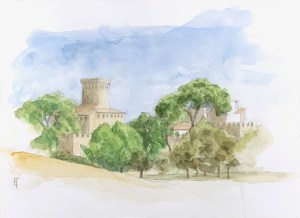
Benisanó, view of the Castle from the west, late afternoon light. Watercolor on hot pressed paper. 9 x 12" or  23 x 30.5 cm. September 2023.

Benisanó, view of the Castle from the west, late afternoon light. Watercolor on hot pressed paper. 9 x 12″ or 23 x 30.5 cm. September 2023. SOLD

For the church, I chose a composition (of buildings, vegetation and light) which peaked at about 10:00 a.m.; while for the Castle, I found a similar composition but which peaked at about noon. So while most everyone was still sleeping (it was Spanish time) I sipped my tea and created value studies of these two different scenes. In addition, I biked over to a field on the other side of the Castle and tried out a quick study of that perspective, too. Luckily, I had a few watercolour blocks with me so I could switch from one to the other without tearing off the page. (Blocks which are glued on all four sides allow for working wet-in-wet while still drying out flat. That’s important!)

Benisanó, view of the Castle from the terrace, noon. Watercolor on hot pressed paper. 9 x 12" or  23 x 30.5 cm. September 2023.

Benisanó, view of the Castle from the terrace, noon. Watercolor on hot pressed paper. 9 x 12″ or 23 x 30.5 cm. September 2023. SOLD

I was able to finish the Catholic-church-terrace piece while there but the Castle-terrace one had to wait until we returned home. In both cases I did the value study from the patio, while snapping photos of the light I wanted to capture. As I continue to develop my own process, I am no longer hesitant to make use of photographs (I used to be terrified of being trapped by their visual dictates!). But what is incredibly important to me still is to feel the immediacy of any particular landscape, what it is saying to me, how I feel about it, how I wish to interpret it. When that stays in the foreground (whether assisted by photos or not) the drawing, watercolour or oil painting usually turns out fine.

So here are my three postcards from Benisanó. The Church (from the terrace), The Castle (from the terrace) and The Castle (from the field).  I think the terrace ones worked out better simply because I had the time to get the compositions right.

All three watercolors have now been sold.

Vivenkapelle watercolour on hot-pressed paper. August 2023. 23 x 31 cm or 9 x 12.5 "

Vivenkapelle, Watercolor

New field easel with painting tray, water cups, hanging brush holders and painting rag. Very uncomfortable folding chair. Customised pochade box (for upcoming wet oils) on the ground.

New field easel with painting tray, water cups, hanging brush holders and painting rag. Very uncomfortable folding chair. Customised pochade box (for preserving the upcoming oils when wet) on the ground. Day pack to the left. Electric bike not pictured. 😉

The weather in August finally turned nice, (July BTW was a disaster), so I headed out to the fields. I had purchased a new light weight field easel – for which I had constructed a small painting tray. I was anxious to test out my new rig. I had remembered experiencing a breath-taking mid-afternoon-light view of a very Belgian chapel somewhere out side of Brugge. But where? So, it took me awhile to find it and then to determine the best spot for a drawing/watercolour. 

I concentrated the first session on getting down an accurate drawing. Weighing the accents of the composition and adjusting to their placement on the page. Feeling the light that I wanted to capture. Took about two hours. I had already determined that I wanted to add in a few cows later, so I snapped a few photos of those meandering munchers.

At home I placed carefully cut pieces of masking tape to save the whites for those creatures before the next session. The second foray consisted of laying in washes of the colour relationships: red tile roofs contrasted to waving trees of green, the organic yet gentle shock of complements to be seen everywhere in Belgium in the summer. Add to that blue skies and long horizontal slashes of yellow corn fields, accented by pops of whitewashed farm buildings. Belgium, what a delight. After another two hours I had the chromatic start that I wanted, but since dinner called, I packed up and went home.

That second session was a nice start but my values were still too light (defo a weakness of mine). In watercolour, the eloquence of the paper needs to be reserved for the highlights and quarter tones. So of course it’s important to preserve them, but their impact only truly resonates by their contrast to well placed shadows. So I headed out for the third and final session – to intensify the saturation of my hues as well as to darken the values in the shadows. Later, back home, I removed my masking tape and drew in those sweet cows, touching them up with watercolour washes. 

Vivenkapelle watercolour on hot-pressed paper. August 2023. 23 x 31 cm or 9 x 12.5 "

Vivenkapelle watercolour on hot-pressed paper. August 2023. 23 x 31 cm or 9 x 12.5 “

I’m happy with this one and feel like I am finally finding my groove(!). Less is always more: saying whatever you want to say with a minimum of means, allowing light, colour, lines, shapes and form to speak for themselves.

In this case, “moo”…


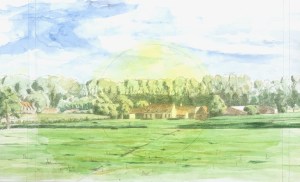
Farm on the Damse Vaart. Watercolour on hot pressed paper. 30 cm x 60 cm. 2023

Farm on the Damse Vaart – watercolour

Farm on the Damse Vaart. Watercolour on hot pressed paper. 30 cm x 60 cm. 2023

Farm on the Damse Vaart. Watercolour on hot pressed paper. 30 cm x 60 cm. 2023

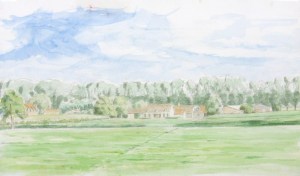
I finally completed this watercolour (online, in the spotlight above and to the left in the email) which I began about ten years ago en plein air. It had always been intended as a study for an oil, so even though at the time it was quite light in tonality (see small image here to the right), I felt that I had what I needed for the oil. I laid the watercolour to one side and commenced with the oil (in the studio). But the oil, too, ended up getting interrupted by my years of studying philosophy @ KULeuven. I completed the oil then in 2019. All this time the watercolor languished.

original watercolor of a farm on the Dammevaart 2014

original watercolor study of a farm on the Dammevaart 2014

I liked it, but at the same time, felt it to be insufficient, incomplete. Both projects then stretching out over such long periods of time would seem to indicate a lack of interest/passion on my part. But that was not the case, mostly, it was simply frustration. Frustration with my skill to convey what I felt about that particular scene. It’s a group of farm buildings to the right of the Damse Vaart as you head out of town (from Brugge towards Damme). At about three in the afternoon, on a summer’s day the light plays so beautifully.

As a composition it’s a long horizontal landscape. The main attraction is the farm buildings in the middle-ground. Also, as a composition, the line of trees in the far distance present no problem. The visual challenge lay in the foreground: there was a large field of green pasture, out of which I wanted to extract some interest, leading the viewer in. I did locate a diagonal line there which I exploited, and in the oil, scattered in a few grazing cows. Still, to my eye the watercolour remained too light and insufficient.

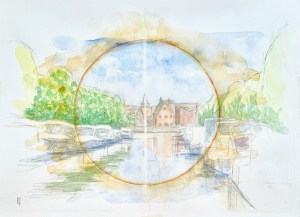
Fast forward to last summer, as well as this one. I have found that imposing a circle in the centre of a watercoloured landscape can be helpful. It may or may not end up being visible in the final painting: doesn’t matter. For me, it helps to focus the elements without being formulaic, though last summer it defo veered in that direction. So I decided to try something like that with this one. I truly felt I had noting to lose: improve it or toss.

The result is, I think, an improvement. Also I kept in some pencil lines. To me they don’t detract. What do you think?


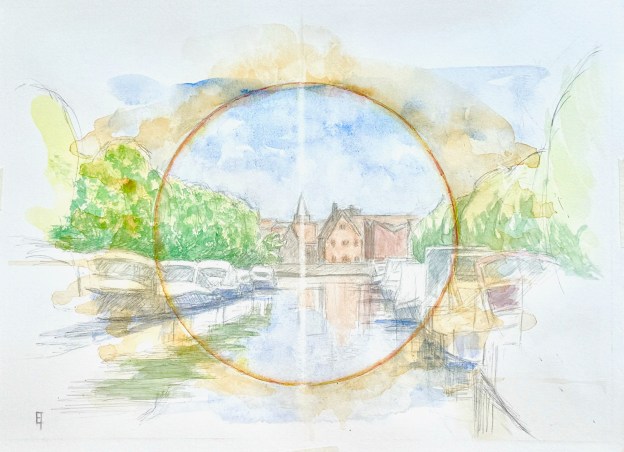
aan de jacht haven Brugge/ the marina in Bruges. Watercolor on hot pressed paper. 9" x 12" or 23 x 30 cm.

avond aan de Jachthaven/ evening at the marina

aan de jacht haven Brugge/ the marina in Bruges. Watercolor on hot pressed paper. 9" x 12" or 23 x 30 cm.

aan de jacht haven Brugge/ the marina in Bruges. Watercolor on hot pressed paper. 9″ x 12″ or 23 x 30 cm.

Most of this drawing/watercolor was done en plein air, but in two sessions. First the drawing. I really like spending time getting the forms: the movement, the proportionality, the composition, right. Light and shade play a role in this but if the composition is too dependent upon the play of light, that light will be gone before I can get pencil or brush to paper. Too much changing light. Vague composition. Vague statement.

So I like to spend time with a chosen spot, feel the impulses as they present themselves, feel the shapes, the play of light, feel nature whispering and dancing through the trees while the ducks quack. And because the project is en plein air, as I’m exposed to such changes, I’m making choices.

I snap various photos along the way. One of them will capture the light I’m now intending.

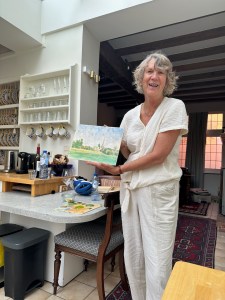
the equipment of an en plein air painter

the equipment of an en plein air painter

At home I refine the edges of my proposed fields of colour, and at the next (and final) session I lay in my washes. Working wet-in-wet in nature is tricky, it’s much easier to control at home, so I’m still getting the hang of it. As for the en plein air equipment: I had a very funky tripod-converted-to-a-drawing easel along with a tri-legged folding stool all of which strap to the back of my bike. It makes exploration and discovery a whole lot easier. (Thankfully the tripod part has since been upgraded 😉 ). In any case, the image here above is what I came up with.

And now, time to move on to the next…

Schaarstraatbrug, Right. Watercolor on hot pressed paper. July 2, 2023. 9 x 12" or 23 x 30.5 cm

de Coupurebrug, Right, July 2, 2023

Coupurebrug, Right. Watercolor on hot pressed paper. July 2, 2033. 9 x 12" or 23 x 30.5 cm

Coupurebrug, Right. Watercolor on hot pressed paper. July 2, 2033. 9 x 12″ or 23 x 30.5 cm  SOLD

After creating a watercolor of the view to the left from the Coupurebrug, I decided to create its companion piece, the view to the right.

Pictured here is a watercolour created in three stages: first an on site drawing, capturing the composition, proportions, viewpoint and conditions of light. It was done late morning on a very calm, sunny day. Perfect. I snapped a few photos for backup and went home. Soon, the weather turned windy, rainy and cold, so I decided to work from my photos for my beginning washes.

Some exciting stuff began to happen, particularly in the sky – which had been cloudless but suddenly had clouds. Fine, I’ll take that. Things continued this way until I had something I really liked but also knew it was unfinished.

I waited until a morning presented itself in which the light was good. Principally, I wanted to be on site again, feel what I feel and make the final choices principally to punch up the foreground. Today presented itself as a possibility. I rushed out for a quick session. The wind was very active and blew my stuff around. No matter. I got what I wanted, so this is the finished piece.

Both watercolours are for sale. $100 each, unmatted, unframed. Shipped anywhere for an additional $30 (approximately). Proceeds go the the Vrienden der Blinden.

Coupurebrug, Left. Watercolor on hot pressed paper. June 15, 2033. 9 x 12" or 23 x 30.5 cm

de Coupurebrug, Left, June 15, 2023

Coupurebrug, Left. Watercolor on hot pressed paper. June 15, 2033. 9 x 12" or 23 x 30.5 cm

Coupurebrug, Left. Watercolor on hot pressed paper. June 15, 2033. 9 x 12″ or 23 x 30.5 cm

Our trip to Australia re-whet my whistle for exploring landscape using watercolour. I had begun re-exploring watercolour a bit last summer in the studio, but otherwise, it’s been awhile.

So on returning to Bruges, my thirst has been excentuated by the height of the summer solstice. Here, the days are long and warm, the nights are even longer. The effects of sunlight playing over the flat land with its canals, paths, bridges, trees and fields leads to endless sources of delight.

As I explore, I find I am refining my taste in tools and working methods. For example, I consistently find myself choosing a hot-pressed satin-finished paper in contrast to cold-pressed textured ones. Art shops these days stock mostly cold-pressed paper; it appears to be in style? I’m thinking that’s because spontaneous brush strokes, evoking grand abstracted images do very well on such a surface. But for me, because I enjoy rendering the fine details of a light soaked landscape, hot pressed paper wins. Hands down.

Then there’s the wcblocks themselves. Watercolor pads can be glued down on one side only, resulting in curving and buckling when the paper gets wet. Again, that may be OK for quick, vital brush strokes on cold pressed paper, but hot-pressed paper possesses not only the capacity to render fine detail, it also possesses the capacity to receive multiple washes. It’s important, especially when working wet-in-wet, to avoid that buckling, if possible. Buying watercolour blocks that are already glued down on all four sides instead of “pads” glued on just one side is yet another fine point.

The landscape imaged here is an early summer’s evening over the Coupure. It’s from a bridge near to our house. I pass by almost every day and have noticed that looking right (see watercolor created a few weeks later) or left are equally exciting, depending on the time of day and conditions of light. So I finally took my pad and pencils out last week to capture the composition seen here. I knew from experience, that the boat arrangement along the canal changes every day, so in that first session I spent time getting down a realistic drawing, trying to get the proportions right, and feeling the light that I wanted to capture. I took a few photographs so I could finish it in the studio if the boats changed. Sure, enough, when I went back the next day, the arrangement was different, so I finished with my watercolour washes in the studio.

If you want to achieve a subtle sense of light within a realistic motif and in watercolor, as I tend to want to do, it works out better to finish such a painting in the studio. And hot-pressed paper lends itself to that: fine details, multiple washes, gentle refinement. I do enjoy an en plein air approach to painting when the conditions warrant. This just wasn’t one of them.