Category Archives: Oils

Paintings executed exclusively in oils – often but not always without the use of egg tempera either as an underpainting or in an emulsified solution for painting. In such a case, the oil may be applied either indirectly through a series of thinned layers or directly, that is, alla prima, sometimes with a palette knife.

A Piece of Me #45, oil on panel, 21 x 13.3 cm or 5 1/4 x 8 1/4 in.

A Piece of Me #45, oils

Continuing with the series of oil panels in which (I’m hoping that) the underdrawing will be able to remain fully functional through its superimposed layers. Earlier, in the first four oil panels, I had some technical difficulties (now resolved). They were not show stoppers but they did set me back to the drawing board more than a little bit.  If interested you can read about it here.

A Piece of Me #45, underdrawing in pen and ink (a mars black oil paint diluted to a dense yet flowable consistency).

A Piece of Me #45, underdrawing in pen and ink (a mars black oil paint diluted to a dense yet flowable consistency).

A Piece of Me #45, oil on panel, 21 x 13.3 cm or 5 1/4 x 8 1/4 in.

A Piece of Me #45, oil on panel, 21 x 13.3 cm or 5 1/4 x 8 1/4 in.

This panel then began with a strong pen and ink underdrawing over an already imprimatura-ed wash of yellow ochre diluted oil paint. I had such success with the yellow ochre as a staring point for my acrylic and encaustic panels, I decided to keep with it for the oil series. See right.

Similar to the last oil panel (#35) this was a relatively simple composition. There were three items to consider, the tip of my linen jacket above right, my white pants legs right and left and the intervening shadow. As with the last one, I glazed in the shadow and then followed it up with passages of opaque paint. The main challenge though was creating a visual distinction between the two linens, the white pants and the oatmeal jacket. Both had shadow and volume play to create interest. I’m really happy with the way it turned out. The forms are pretty delicious. Had to stop and eat lunch though instead of chowing down on it: the curry just had to be more nutritious 😉

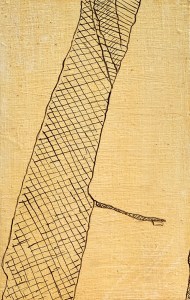
A Piece of Me #35, oil on panel over linen. 21 x 13.3 cm or 5 1/4 x 8 1/4 in.

A Piece of Me #35, oils

A Piece of Me #35. Underdrawing in pen and ink (diluted black oil paint).

A Piece of Me #35. Underdrawing in pen and ink (diluted black oil paint).

A Piece of Me #35, oil on panel over linen. 21 x 13.3 cm or 5 1/4 x 8 1/4 in.

A Piece of Me #35, oil on panel over linen. 21 x 13.3 cm or 5 1/4 x 8 1/4 in.

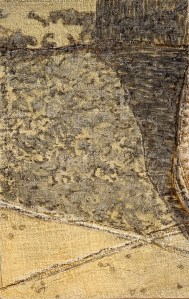
A simple composition executed on a panel pre-treated with linen. The underdrawing (to the right) laid out the basic design, the oil level (to the left) gave the forms dimension. So, for forms: there was my linen jacket on the right, casting its shadow against the lightly coloured plaster wall on the left. That’s it.

The shadow area in the middle took shape rather quickly with a glaze of raw umber. I liked the tonality but the cross hatching of the underdrawing was too visible, so I added some white to my umber and worked back in passages of opaque paint. Much better. As much as I love glazing (and I do!) it’s equally important to balance it with passages of opacity.

The linen jacket was pure pleasure to render, softly dabbing in light and shadow, accentuating its dimensionality so that it almost completed itself. In painting, in creation, there is a point where the form starts to take shape as if by itself. As form-giver, you need to remain especially attentive, listening to what is happening on the page/panel, asking for what else is needed. Strengthening (or modulating) contrasts, tightening up (or softening) edges, adjusting hues. The light yellow wall on the left, for example, was quick work but adding in those spots (freckles) gave this wide open area just that little bit of extra.

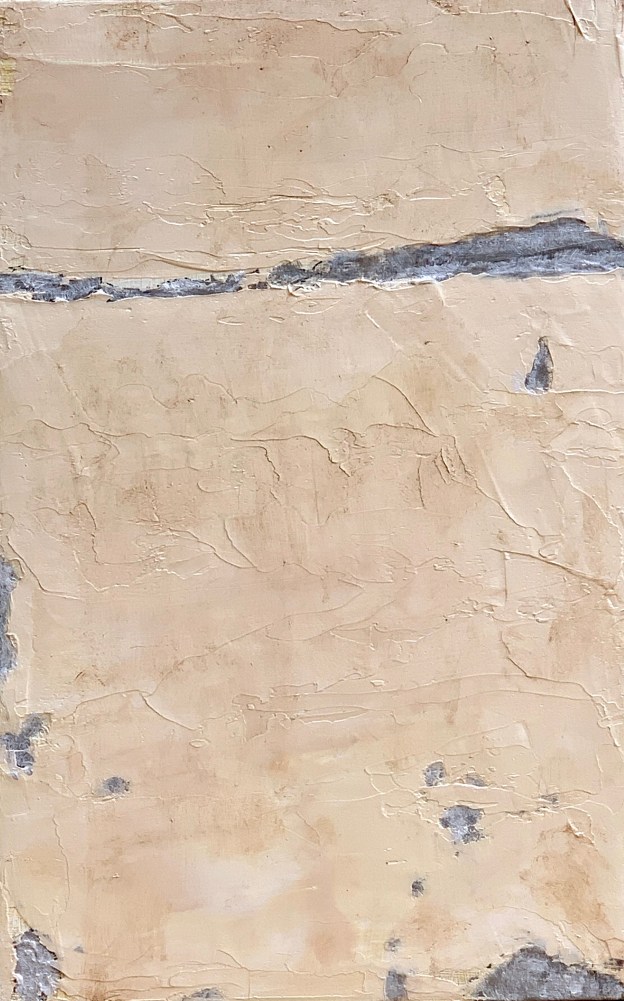
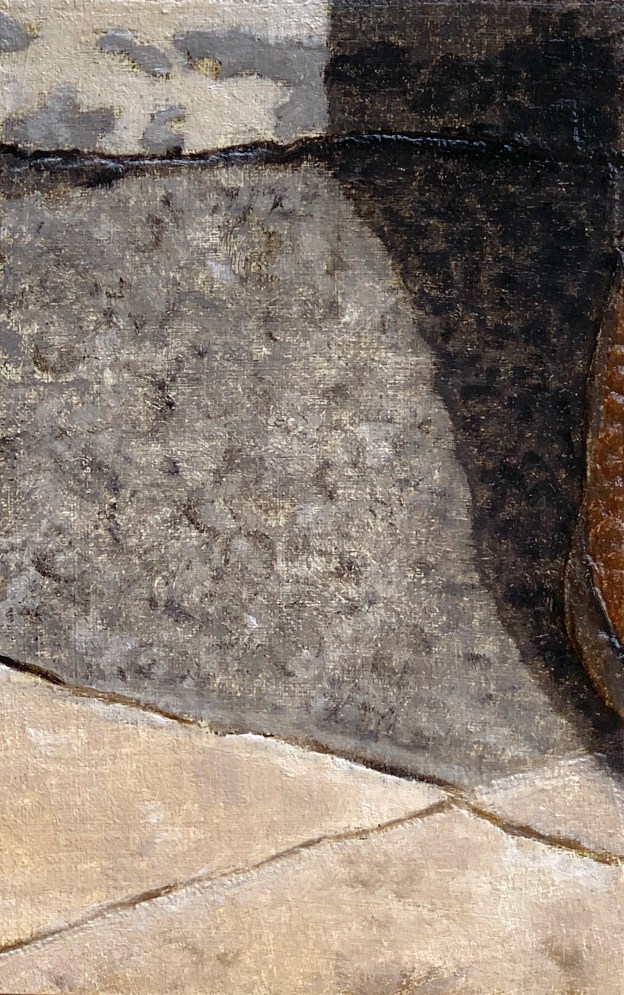
A Piece of Me #50, oil over pre textured acrylic modeling paste on panel. 21 x 13.3 cm or 5 1/4 x 8 1/4 in.

A Piece of Me #50, oils

A Piece of Me #50, oil over pre textured acrylic modeling paste on panel. 21 x 13.3 cm or 5 1/4 x 8 1/4 in.

A Piece of Me #50, oil over pre textured acrylic modeling paste on panel. 21 x 13.3 cm or 5 1/4 x 8 1/4 in.

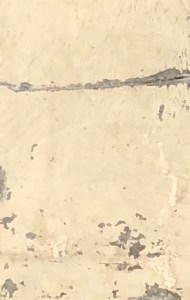
A Piece of Me #50, the original photograph.

A Piece of Me #50, the original photograph.

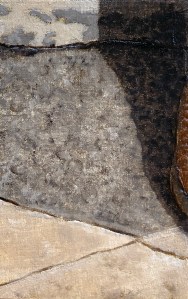
Texture, texture and more texture. This panel was created with the painting knife, either during the modelling-paste-pre-painting-sculpting phase or during the painting phase, with thick slabs of light pastel coloured paint.

The grey areas were dug out from the paste as well as the paint in the attempt to mimic the cement behind the lightly coloured plastered wall. I don’t have a photograph of the underdrawing phase (was there even one??) so I’ll use this rare occasion to post the original photograph.

Except for the captions, can you tell the difference?

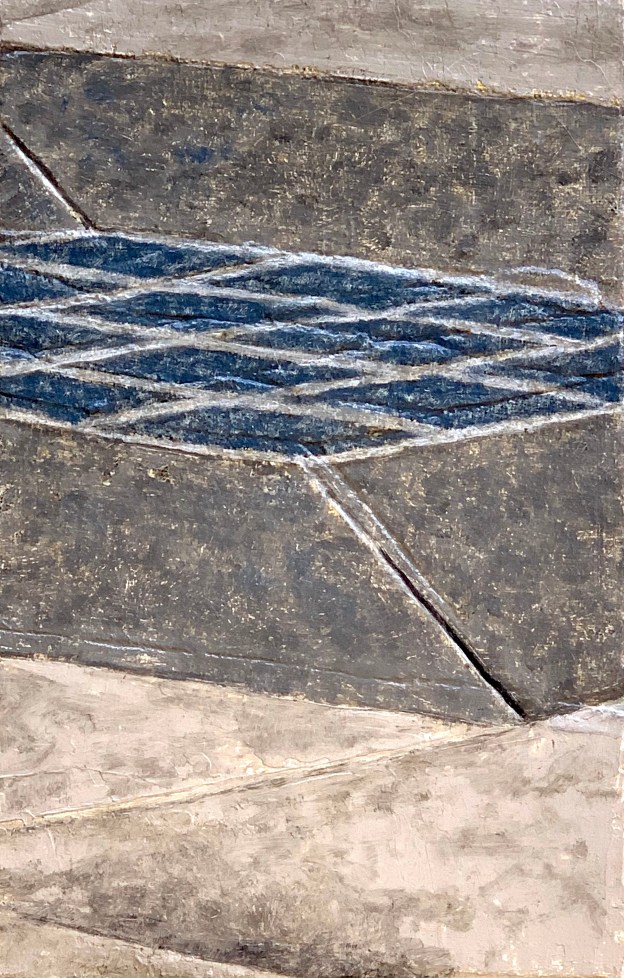
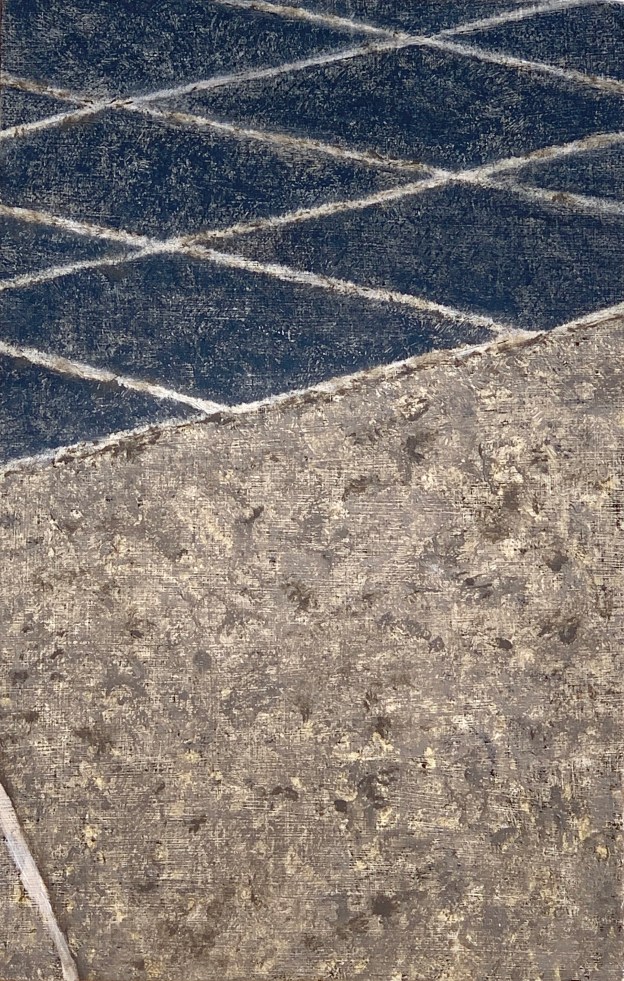
A Piece of Me #40, oil over collage on panel. 21 13.3 cm or 5 1/4 x 8 1/4 in.

A Piece of Me #40, oils

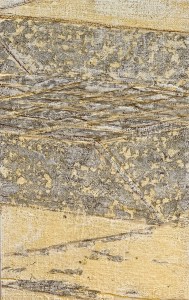
A Piece of Me #40, underdrawing over collage.

A Piece of Me #40, underdrawing over collage.

A Piece of Me #40, oil over collage on panel. 21 13.3 cm or 5 1/4 x 8 1/4 in.

A Piece of Me #40, oil over collage on panel. 21 13.3 cm or 5 1/4 x 8 1/4 in.

This panel had some particular challenges to it, both of which were my own creation. The first problem came from the lack of alignment of my collaged panel (created more than one year ago during the preparation phase) to my black and white transposed design. Although (I thought) I had used the same transfer process, my alignment was off by a few millimetres. Well, OK, I’ll live with that, knowing the texture of oil paint can mask things to a certain degree and also that I’m open to whatever happens in this multimedia process of creation. The only real accidents are lack of adhesion or longevity.

The second problem occurred with the absorbency of the black paint tinted underdrawing. Even after three or four days, it’s adhesion to the ground appeared to be insufficient. Parts of it came off when I used my kneaded eraser to erase the charcoal transfer lines (it was too heavily diluted). Since it’s an underdrawing this too is not a fatal error. Nevertheless I did go into this one with some caution, not sure I would be able to salvage it.

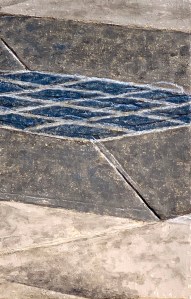
The photograph of the completed panel above left is side lit, so the textural pentementi of the misaligned collage are visible. Those (misaligned) highlights are visually fugitive so they don’t really bother me. Additionally, the lighter-than-I would-wish-for underdrawing did not pose a huge threat, either. I compensated by drawing in the white grouting lines for the blue tiles with white lead paint as an underpainting and let it dry. After a few days I was good to go. Thus, in this piece (and the whole project) I am not out to create perfection, but rather, a visually and tactilely attractive assemblage that ultimately will invite the viewer to unify for themselves. And hopefully experience aesthetic pleasure in doing so!

A Piece of Me #60, oil on panel over collage. 21 x 13.3 cm or 5 1/4 x 8 1/4 in.

A Piece of Me #60, oils

A Piece of Me #60, underdrawing over collage.

A Piece of Me #60, underdrawing over collage.

A Piece of Me #60, oil on panel over collage. 21 x 13.3 cm or 5 1/4 x 8 1/4 in.

A Piece of Me #60, oil on panel over collage. 21 x 13.3 cm or 5 1/4 x 8 1/4 in.

Second in the new series of panels executed exclusively in oil. The underdrawing on the right shows not only the layout of the design but also its intentional graphical harshness. It’s supposed to be that way! You want that firmness, those hard lines and clear contrasts. Then the oil level enhances, softens and sensuously mitigates these things – see left.

Thus, after the yellow imprimatura and the underdrawing dried, I started with the oil level. I covered the whole surface with a clear medium and after fifteen minutes wiped it off. The medium created a slightly tacky surface for working wet-in-wet, painting impasto paint into the clear glaze. I began by developing the highlights and quarter tones on the left first, then the strong shadow areas on the right. My goal was to cover the entire panel, to finish it in one working session. I reserved the strongest shadows and highlights for the end. Using the dry fan brush I could softly blend adjacent areas into one another without smearing. One of my favourite activities!

I’m pleased with the level of detail/interest in the shadows. The impasto paint there is not so thick so as to obscure the ground. And there is enough variation to allow the eye to wander. I did have to contend with the collage: the tip of the shoe on the right edge protrudes maybe two or three millimetres? It’s very tactile but difficult to paint. The side-lit photograph in the top spotlight (online display only ) illumines its 3D aspect. Some of the strong highlights you see in the photograph are not paint but rather fugitive reflections.

A Piece ofMe #55, oil on linen mounted on panel. 21 x 13.3 cm or 5 1/4 x 8 1/4 ".

A Piece of Me #55, oils

A Piece ofMe #55, oil on linen mounted on panel. 21 x 13.3 cm or 5 1/4 x 8 1/4 ".

A Piece ofMe #55, oil on linen mounted on panel. 21 x 13.3 cm or 5 1/4 x 8 1/4 “.

Finally the home stretch. This then is the first of twelve final panels: all panels in this series will be executed exclusively in oil on an oil ground. This particular panel was painted on linen mounted on panel previous to the application fo the oil ground. All these slight variations in pre-treatment to the grounds mean that there will always be a slightly different relationship between the ground and the application of the paint.

Additionally, because this is an oil ground it’s not receptive to the india ink that I used for the underdrawings in the egg tempera, mixed technique and/or encaustic panels. In those cases the ground was a traditional chalk gesso, which is water based and also very absorbent. So I had to switch to a heavily diluted black oil paint for my underdrawings. The imprimatura too, was a heavily diluted yellow ochre. And after both of these treatments I had to let the panel dry for a few days.

However, because I had laid in this groundwork, the thicker oil level proceeded quickly. It took just one working session to develop the main forms and textures – although I did have to let that dry before painting in the final contrasts. When using an indirect technique for oil in this way means that the waiting times are not for impatient temperaments. I’m pretty chill, but even so I do chafe at the bit sometimes. 😉

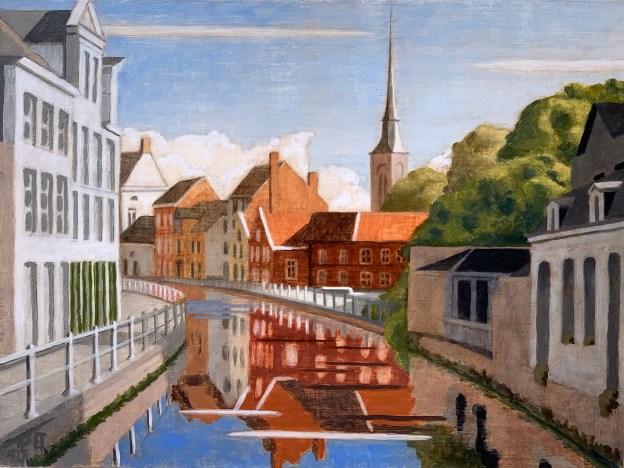
Morning Light on the Verversdijk

Morning light on the Verversdijk. Created in the studio from an “en-plein-air” value study. September 2019.

Mixed technique on board. 30 x 40 c.m. or 11 7/8 x 15 3/4 in.

Technical write up here: https://atelierartisanal.com/2019/09/09/haunted-by-hopper/

Framed. $200 or 200 Euros plus shipping and handling.

Please contact me if you are interested.

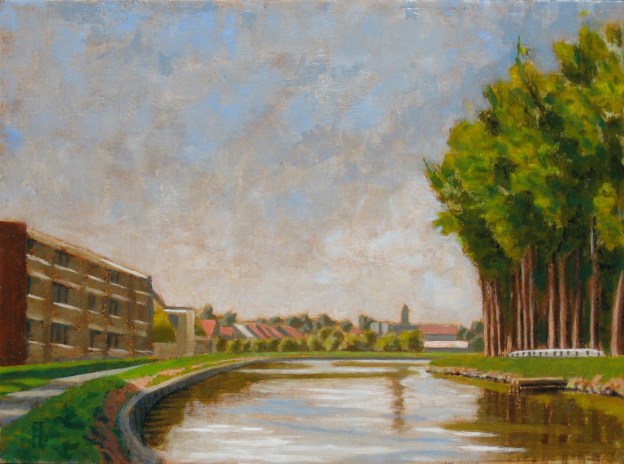
Vaartdijk Oil

Vaartdijk – Oil, August 2012

Oil on panel. Based on a watercolor study. August 2012. 30 40 cm. 11 3/4 x 15 3/4 inches.
You can read about the work up of this piece here.

Framed. $200 or 200 Euros plus shipping and handling.

Please contact me if you are interested.

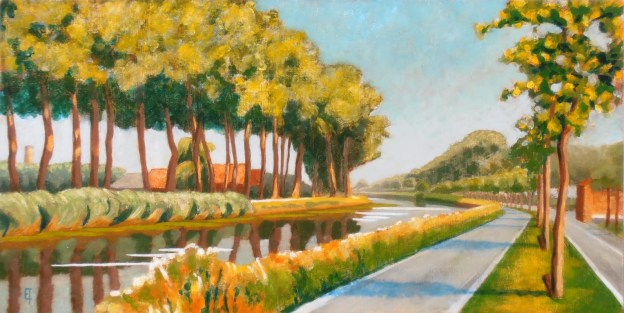
Dammsevaart oil

Damse Vaart – Oil, August 2012

Oil on panel. Based on a watercolor study. August 2012. 30 x 40 cm. 11 3/4 x 15 3/4 inches.
You can read about the work-up to this piece here.

Framed. $200 or 200 Euros plus shipping and handling.

Please contact me if you are interested in this piece.