Category Archives: Oils

Paintings executed exclusively in oils – often but not always without the use of egg tempera either as an underpainting or in an emulsified solution for painting. In such a case, the oil may be applied either indirectly through a series of thinned layers or directly, that is, alla prima, sometimes with a palette knife.

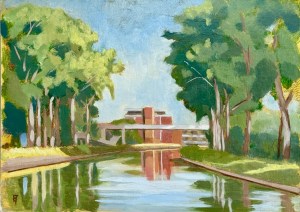
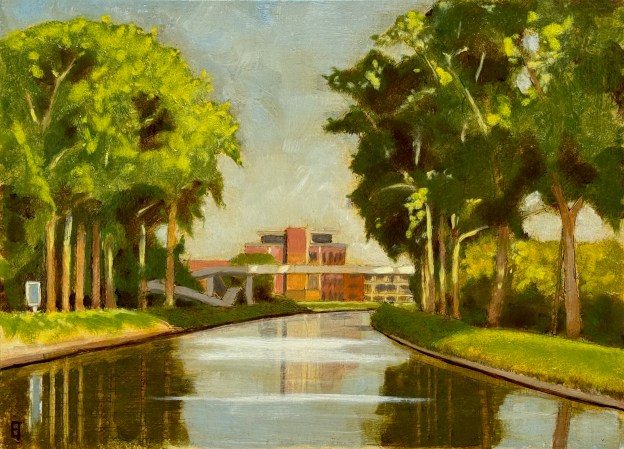
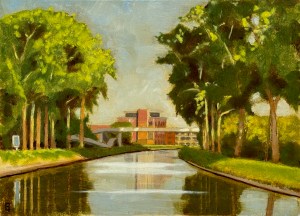
Avond aan de Jachthaven II, August 12, 2024. Oil on panel. 9 x 12" or 23 x 30.5 cm

Avond aan de Jachthaven II, August 12, 2024

During the “on location” sessions for Jachthaven I, I had become very disappointed with my loss of the statement of light, because in the end I had to slap on a lot of titanium white to make it work. The painting that I ended up with was OK, but not really what I had been trying to achieve aesthetically, thus version II.
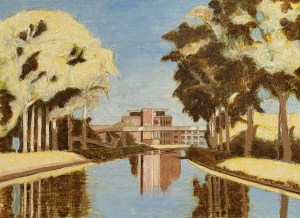
Avond aan het Jachthaven II, studio oil level one.

Avond aan het Jachthaven II, studio oil level one.

This second attempt had the same work-up in silverpoint, egg tempera and India ink as the first, however, I decided to do my first layer of oil in the studio (instead of relying on the vagaries of weather). I laid in a pretty definitive light statement (see right), working wet-in-wet. I used cobalt blue, lead white and burnt umber (mixed with an ET emulsion to help it dry faster) and painted this into a surface wiped thinly with a clear medium. The whole work-up process took only a week to do – in order to have it dry enough for an en plein air session – or two.
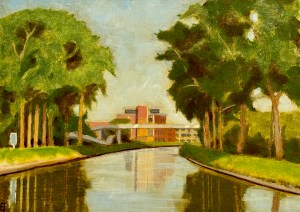
Avond aan de Jachthaven II, intermediate on site oil.

Avond aan de Jachthaven II, intermediate on site oil.

My first session was two hours, during which I  was able to take the light statement (above) to this stage (left). I made use of a technique I have come to call “painting backwards”. It’s where I block in a flat area of color on top of a light statement and then dig the particular highlights I need/want out of it. That’s only possible if-and-when the underpainting is already definitive and dry. Afterwards, I called it done for a few days, though still, I felt something else was needed.
Avond aan de Jachthaven II, August 12, 2024. Oil on panel. 9 x 12" or 23 x 30.5 cm

Avond aan de Jachthaven II, August 12, 2024. Oil on panel. 9 x 12″ or 23 x 30.5 cm

I went out last night, a hot summer’s evening, with perfect conditions. Here on the 52nd parallel north, we are currently about a month and a half past the (almost) 17 hour days of the summer solstice, yet it is still possible to “trip the light fantastic”. I spent about an hour adding small details (of light), which had the effect of bringing my mind’s eye vision to completion. I judiciously used some titanium white (especially in the water), but the magic really began to happen when little brush flecks of cadmium yellow light hit the trees.

I’m very glad to be able to chip away at the amount of time it takes me to create a landscape oil painting, because really, I’m notoriously slow. I still to try to avoid titanium white as much as possible, because it’s never made sense to me to prepare a white ground and then, through the act of painting, proceed to lose its luminosity so that you need to add titanium white back in in order to regain it. Don’t make no sense.

The difference between these two versions and techniques then, is luminosity. The first one relies primarily on TW and reflected light, while the second one relies essentially on refracted light, emanating, glowing, from the underpainting itself. That latter has always been my aesthetic goal, though admittedly, the results have often  been mixed. 😦

This one, however, is trending up! Let’s see what happens next.

If you are interested in this piece shoot me an email.
July, 2024, Avond aan de jachthaven, Brugge: "there is a light, never goes out"

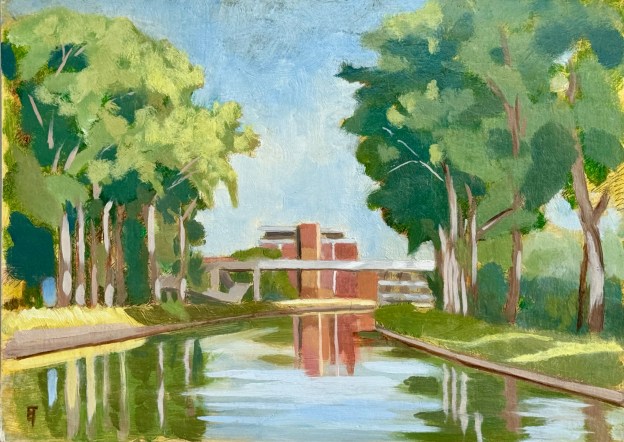
July 2024, Avond aan de Jachthaven I, Brugge: “There is a light, never goes out”

July, 2024, Avond aan de jachthaven, Brugge: "there is a light, never goes out" 9 x 12" or 23 x 30 cm

July, 2024, Avond aan de jachthaven, Brugge: “there is a light, never goes out” 9 x 12″ or 23 x 30 cm

Last night I completed the third “on location” painting session for this little piece. It felt a bit like (finally) pulling a rabbit out of a hat.

It’s been a struggle primarily because of the summer Belgian weather (or lack of it). Secondly, because I’ve been navigating various tweaks to my newly self-designed and self-created pochade box. For example, at the start of session #2, the bracket attaching the box to my tripod fell off. 😦 So I had to sit on the ground for two hours. It was OK, but for the physical activity of painting, suboptimal. Thirdly, because I’m still (always) refining my technique.

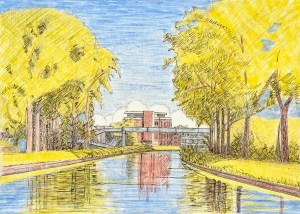
aan de jacht haven Brugge/ the marina in Bruges. Watercolor on hot pressed paper. 9" x 12" or 23 x 30 cm.

aan de jacht haven Brugge/ the marina in Bruges. Watercolor on hot pressed paper. 9″ x 12″ or 23 x 30 cm.

Thus, in part because of my temperament, and in part because of the weather, I worked up the initial layers in the studio. I already had the composition since it was based on a watercolor I had completed last summer: I loved the receding canal, the light on it at the end of the day, plus the glowing red brick building in the middle distance.

Aan de jacht haven Brugge/ the marina in Bruges. Underdrawing and underpainting on panel, touched up by India ink. 9" x 12" or 23 x 30 cm.

Aan de jacht haven Brugge/ the marina in Bruges. Underdrawing and underpainting on panel, touched up by India ink. 9″ x 12″ or 23 x 30 cm.

So I used that study to create an underdrawing (with silverpoint) and on that lovely, soft drawing, an underpainting (with egg tempera). After a light coat of shellac (to seal the panel off from the absorptions of the oil phase to come) I used a pen nib loaded with India ink to emphasize the composition’s darker values. All this was possible in the studio – and it laid down a solid, graphical foundation before all the accidents I knew painting “on location” would bring.

Both silverpoint and egg tempera are well suited to a panel prepared with true gesso (rabbit skin glue and chalk), however as techniques they cannot be used on a flexible canvas (the substrate of choice by painters since the 16th-17th century) primed with acrylic gesso (the ground of choice by painters since about the 1950’s). The record of my experiments in these against-the-current techniques is on my companion blog site atelierartisanal.com .

Why I have chosen this anachronistic technical direction is perhaps best examined from a therapist’s couch: it’s been the subject of much failure as well as heart-ache, but alas, it is the choice of my gevoelsmatig-bewustzijn (feeling-consciousness). And even though many of my experiments over these decades have not been successful, some have. There is a kind of internal mind’s-eye light I’ve been chasing. And I would also say that, thankfully, my batting average is beginning to improve! There is light at the end of this tunnel!

Additionally, I’m not sure if it’s even appropriate to call this an “en plein air” painting. The reason being, it was not painted “alla prima”, that is, all at once, in one session. For, besides the studio levels of image development described above, there were also the three “on location” evening sessions. So, if “alla prima” is an essential element of a definition of an “en plein air” painting, my work in general and this one in particular doesn’t fit. And relative to those three evening sessions, I’m hoping to whittle them down to just one or two (as long as the weather and my pochade-box holds ;-)). We’ll see what the future brings. 😉

If you are interested in this pieces please email me.

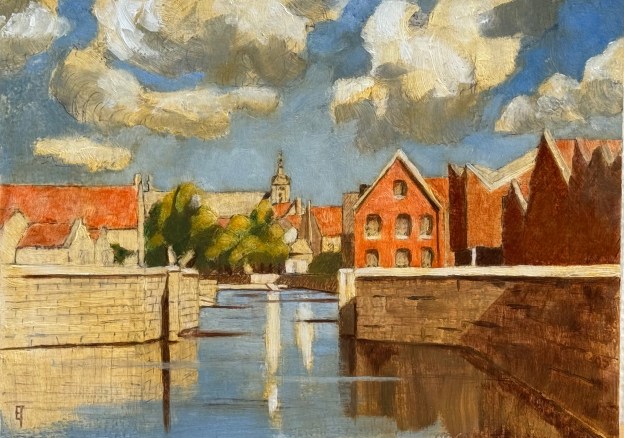
Schaarstraatbrug, Right. Oil on panel. June 10, 2024. 9 x 12" or 23 x 30.5 cm

Schaarstraatbrug, middag, kijkend naar het weste/Schaarstraat bridge, noon, looking (mostly) west

Schaarstraatbrug, Right. Oil on panel. June 10, 2024. 9 x 12" or 23 x 30.5 cm

Schaarstraatbrug, Right. Oil on panel. June 10, 2024. 9 x 12″ or 23 x 30.5 cm

For years I’ve been entranced by the view from the Schaarstraat bridge. I knew the time of year and time of day I wanted to capture for it offers a great opportunity to explore the complimentary colors of blue and orange. Last summer I was able get down a watercolor that I liked. Compositionally, it had what I was looking for, so I decided it could be a good start for an oil. The best part about that study was that I could work up the underdrawing in the studio and, so I imagined, finish it en plein air.

I know that most of the activity that goes by the name “en plein air” refers to an alla prima painting technique, which means the whole painting from start to finish is executed on location. (Of course, small touch ups in the studio are OK, but principally, the immediacy of painting “en plein air”, means painting in the moment, with (hopefully) a zen-like aesthetic insight and accuracy). I’ve got nothing against that, it’s just that I’ve come to realize that my aesthetic interests are a little different. The kind of color statements I want to make appear to be best supported by an indirect technique(!). Which means working up a painting, through layers – and these take time to dry.

Schaarstraatbrug, Right. Watercolor on hot pressed paper. July 2, 2023. 9 x 12" or 23 x 30.5 cm

Schaarstraatbrug, Right. Watercolor on hot pressed paper. July 2, 2023. 9 x 12″ or 23 x 30.5 cm

So, back to this piece. In the studio I worked up a drawing using silverpoint (it’s a very soft way to lay out the composition and make preliminary value statements). Then I lay in the basic color statements using egg tempera (it too, is a light and soft medium and, relative to oil, quite siccative). After the ET dried (about a week) I realized I might as well go ahead and do the first oil session indoors (since the weather was so bad!).

That first oil session was a return to the starting value statement but this time, stronger and more extreme, I used white, burnt umber and ultramarine blue. Woah, the result was more like a solarized photo, but promising. After it dried, I wanted to go out to finish it on site, but again the weather frustrated my building creative momentum: I just couldn’t wait. So I thought, heck, forget the men’s finals of the French Open, let’s see what can happen in the studio.

Surprisingly after a few hours of judicious glazing (the yellow ochre starting glaze was definitive), I saw what I had been looking for emerge on the panel. Nice! It’s so important to know when to stop when – beside the dinner bell – it’s time to lay down your brushes.

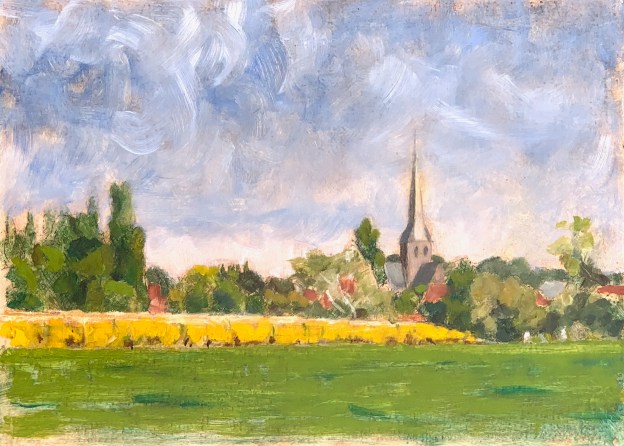
Vivenkapelle. September 2023. Oil on panel. 9 x 12 Inches or 23 x 32 cm.

Vivenkapelle, Oil

Vivenkapelle. September 2023. Oil on panel. 9 x 12 Inches or 23 x 32 cm.

I biked out yesterday, late afternoon, to my current favourite spot along the Legeweg outside of Bruges. Besides my light-weight field easel and folding chair, I was equipped with brushes, an apron, painting rags, oils and my three small bottles of potions (medium, emulsion and turps). This was intended to be my second and (hopefully) final en-plein-air painting session of Vivenkapelle.

I had completed a watercolour there in late August. I liked it well enough to decide to attempt an oil of the same view, so I laid in the design onto a true-gesso panel, first in silverpoint, subsequently in fine-tipped lines of india ink.

Vivenkapelle. First session. Early September.


In early September I ventured out with my abbreviated field equipment (as described above). It had been more than ten years since I had tried to paint en plein air in oils(!!!). In fact (for numerous reasons) I had kinda given up on it. So this time I truly felt las though I had nothing to lose (which for artistic creation is a very good place to be). In addition, I had decided to try out a new recipe for my emulsion (one whole egg instead of the usual methyl-cellulse glue component). The first session went OK. I blocked in the main shapes and colours. But it all dried so fast (too much egg white in the emulsion!). Nevertheless, I was glad to get something down and was hopeful that the painting could be concluded before the weather changed and/or the corn got mowed.

Three weeks later I tried my luck (hooray! the corn was still there!). This time I adjusted my emulsion recipe to include just the yolk of one egg, deleting the watery white. It had the effect I was looking for: it allowed the wet oil strokes to stick to the substrate/ground (which had been lightly-covered-and-wiped-with-medium) as well as allowing the wet strokes to retain their integrity when gently dry brushed. In this way, the perennial smearing, smudging, dirty-colour problem of oil painting can (for the most part) be avoided! I already knew that whenever small corrections needed to be made, a small dry brush dipped in medium can function like an eraser, allowing the corrected stroke to be placed on top (and dry brushed in as needed).

Because I was painting over an underpainting, the decisions I had to make were greatly reduced. (Hooray!!!) Also, all those previous decisions enhanced the further development of the image. With the scene in front of me, I kept to my original mind’s-eye image, playing back and forth between the two. The cows stopped by to say hello. A number of passers-by, too. The evening lengthened. Weather-wise I was in luck; it was full-on Indian Summer glory. After approximately two hours, I was done: not too much; not too little; just right. Perhaps just enough to invite the viewer to join in the dance.

A Piece of Me #05, oil on panel over cotton. 21 x 13.3 cm or 5 1/4 x 8 1/4 in.

A Piece of Me #05, oils

Underdrawing for A Piece of Me #05.

Underdrawing for A Piece of Me #05.

A Piece of Me #05, oil on panel over cotton. 21 x 13.3 cm or 5 1/4 x 8 1/4 in.

A Piece of Me #05, oil on panel over cotton. 21 x 13.3 cm or 5 1/4 x 8 1/4 in.

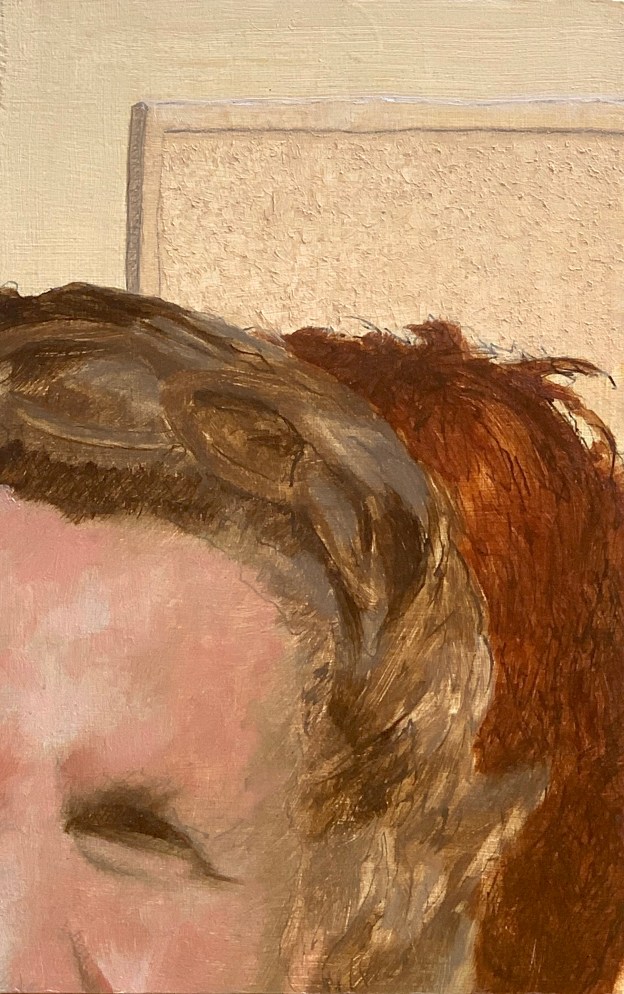
I can’t believe it, but this panel marks the end of the line. It’s the final oil panel as well as the final panel in the whole project of sixty-four. Soon begins the work of mounting and assembling. And from there, tweaking decisions. I am expecting and welcoming a certain amount of visual dissonance but I also know that (just like in American politics) too much dissonance can destroy the unitive vibration of the whole. So there may be some changes to make? We’ll see. But for now there’s cause to celebrate! The champagne is in the fridge. It’s been almost two years.

So again, this was the last panel. One quarter of my face. For those of you who have been following this project you will remember that in any particular medium I tend to leave the more important/challenging panels for the last. I begin with the abstract compositions, then proceed to the body parts compositions, then the complex figurative groupings, leaving my face (which was cut up into four sections) for the last.

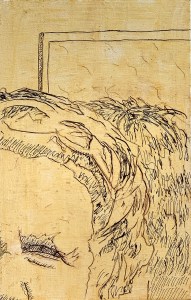
To render this panel I began with the underdrawing in pen and ink over a yellow imprimatura. See above, right. Then I covered the face area with an underpainting of terra verte (green) and let it dry. After a few days I laid in a  clear glaze and set to work, moving from background to foreground. There was: the back wall, two heads of hair and one face. After three hours of work I had achieved what I was looking for – a rendering of the forms with spontaneity and freshness. I’ll leave it to dry and see if anything else begs for my attention. But I’m pleased with what I have so far. If I make further changes they will be small ones.

A Piece of Me#30, oil over acrylic modeling paste on panel. 21 x 13.3 cm or 5 1/4 x 8 1/4 in.

A Piece of Me #30, oils

Underdrawing over yellow ochre imprimatura for A Piece of Me #30.

Underdrawing over yellow ochre imprimatura for A Piece of Me #30.

A Piece of Me#30, oil over acrylic modeling paste on panel. 21 x 13.3 cm or 5 1/4 x 8 1/4 in.

A Piece of Me#30, oil over acrylic modeling paste on panel. 21 x 13.3 cm or 5 1/4 x 8 1/4 in.

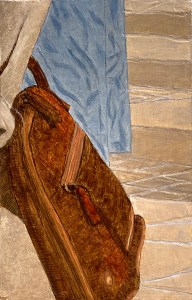
Wow, sculptured texture. Twice. This panel is a celebration of the painting knife. It all began on the preparation phase. I applied an acrylic modelling paste to the lightly primed panel. (The design had already been transferred.) I started with the rear tiles and worked my way forward, the fabric folds and my beloved leather handbag. At that level it was white on white: a polar bear in a snow storm (toting a handbag).

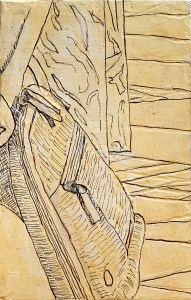
After that dried, I covered the panel with a light yellow ochre imprimatura, and transferred the design (once again), this time to lay in the underdrawing (see above right). I find as I work on these panels, in acrylic, encaustic and (pure) oil, that the hard lines of the pen nib are much preferable to the light washes created  by a brush. Both can render a design and set up formal values, but the nib sets up texture in such a way that a few covering strokes can soften but not eliminate them. Nice! Egg tempera and the mixed technique – as media – do not possess the covering power needed to soften this harshness, so it’s necessary to use washes for the underdrawing.

Underpainting for A Piece of Me #30, oil on panel over pre-sculpted acrylic modelling paste. 21 x 13.3 cm or 5 1/4 x 8 1/4 in..

Underpainting for A Piece of Me #30, oil on panel over pre-sculpted acrylic modelling paste. 21 x 13.3 cm or 5 1/4 x 8 1/4 in..

During my first painting session (see second image, right) and after a few hour’s work I had introduced the main colours of the compositional forms. Overall, it looked good but was too coarse, light and sketchy. Something more was needed. But what? I let it dry for about a week as I wondered.

Then yesterday after detailing the tiles, my linen jacket and glazing the lady’s blue shirt with some ultramarine blue, I decided to bring that blue glaze into the purse. Everything darkened in a nice way but now there was nothing left to do but reclaim that beautiful russet glow of the leather with the painting knife. I spread on burnt sienna, just like buttering toast. A delicious bodily opacity emerged. Oh yeah, this is going in a good direction. Then I had to dig out the highlights and shadows describing the form now buried under this avalanche. I added detail where needed, letting the form tell me what to do. (See above left as well as the spotlighted image in the online view of this post.) It took me about an hour, but wow, just as dinner was ready, I was satisfied, ready to surrender to different kind of knife.

A Piece of Me #15 oil on panel. 21 x 13.3 cm or 5 1/4 x 8 1/4 in.

A Piece of Me #15, oils

A Piece of Me #15 oil on panel. 21 x 13.3 cm or 5 1/4 x 8 1/4 in.

A Piece of Me #15 oil on panel. 21 x 13.3 cm or 5 1/4 x 8 1/4 in.

Underdrawing for A Piece of Me #15.

Underdrawing for A Piece of Me #15.

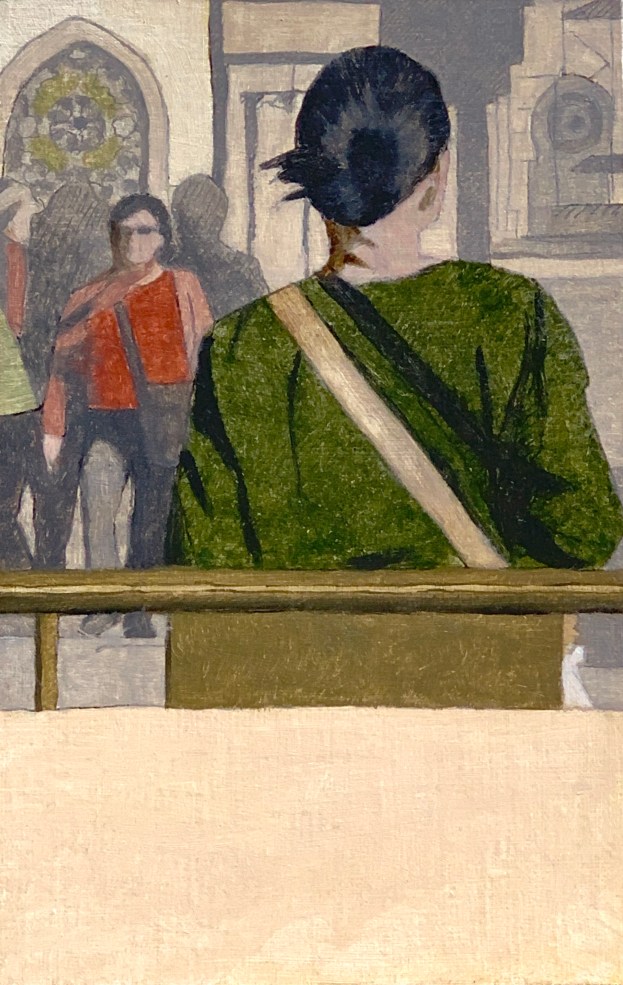
The original photographic image which was cut up into 64 sections for rendering separately contained a horizontal background swathe consisting of groups of small tourist figures receding into the far distance. So there ended up being five panels containing these figural groupings as well as the architectural backgrounds behind them. Because of the need to employ a sliding scale of finely tuned (gray) values to describe these distances, rendering these panels (in any medium) is proving to be one of the most challenging tasks of this whole project.

This panel then was no exception. I worked on it yesterday and a few hours today. In general, I’m happy now with the hues and the values that have been established. The distance reads well enough. There is a red/green complimentary colour contrast, too. I’m posting it now as a beta version. After it dries I intend to clean up some passages that became muddy. When that’s done (and I’m satisfied) I’ll update this page.

Another interesting challenge was my decision to change the hue for the guard-rail (that you see in front of the girl in the dark green sweater). In the original photograph it’s a bright viridian green, but since that guard-rail is the only element in the whole photograph requiring such a pigment – and because on this panel I wanted to create more distinction between the figure and the rail in front of her, I switched the hue to an olive-green. That means I’ll need to do some additional tweaking on two other guard-rail panels but that’s not a problem. Artistic license rules.

A Piece of Me #10 oil on panel over pre-sculpted relief. 21 x 13.3 cm or 5 1/4 x 8 1/4 in.

A Piece of Me #10, oils

Underdrawing over yellow ochre imprimatura for A Piece of Me #10.

Underdrawing over yellow ochre imprimatura for A Piece of Me #10.

A Piece of Me #10 oil on panel over pre-sculpted relief. 21 x 13.3 cm or 5 1/4 x 8 1/4 in.

A Piece of Me #10 oil on panel over pre-sculpted relief. 21 x 13.3 cm or 5 1/4 x 8 1/4 in.

This panel has been one of my favourites from the get-go. Back then I was pleasantly surprised by the serendipitous composition. Foreground, middle-ground and background all very well stated in a figurative sort of way. It felt like a comic strip panel from Archie and Jughead, evoking an untold story.

The call out for the panel then was oil over low sculpted relief. I prepared that relief with GOLDEN acrylic modelling paste, then primed it with a few layers of oil based (lead white) gesso and let that cure. (That curing turned out to be almost one year!). Not my  intention, just, what happened.

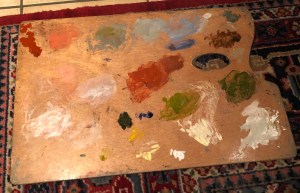
To begin I covered the whole panel with glaze, let it dry fifteen minutes and wiped it off. The surface was slightly tacky, receptive. Then I started painting, wet-in-wet. I began with the background primarily as gray values, progressing forward to the stronger, definitive, more colourful statements. Although I prefer to work with as limited a palette as possible, this particular panel required all the usual earth tones plus the main primary colours. I’ve included a photo of the palette below – just for fun. BTW: red and green are complimentary colors, which in their natural saturated state, are also of a similar value. So together they always create an interesting vibration in a painting. The two shirts of the two men then in this panel presents no exception.

The whole project took me about four to five hours to do. That’s longer than usual, but these panels with a more complex composition tend to require that. Nevertheless, I was happy to set my work aside and call it done when the dinner bell rang. Another curry for a hungry artist.

Palette for A Piece of Me #10

Palette for A Piece of Me #10


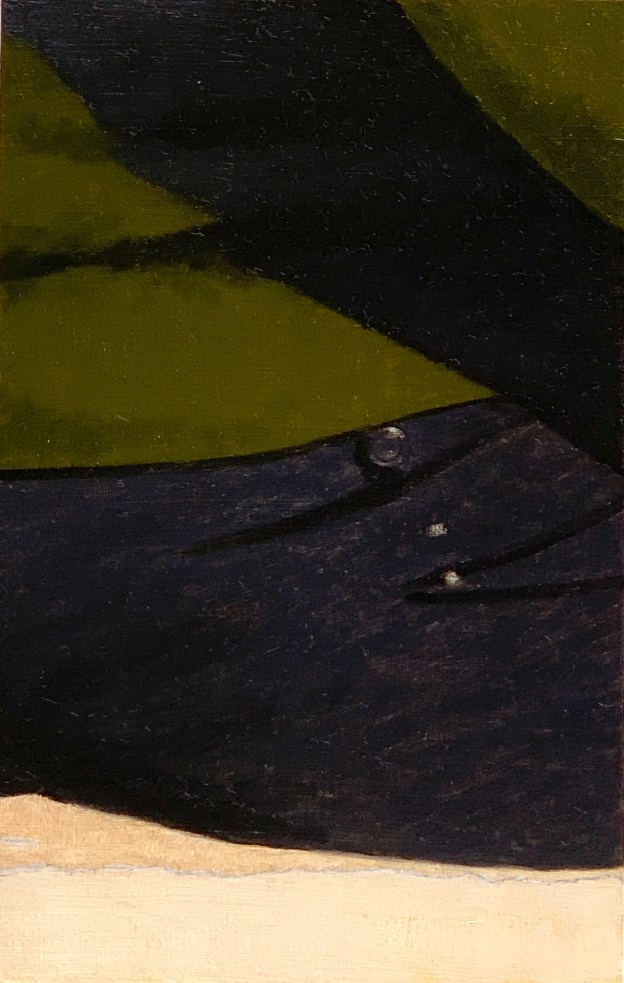
A Piece of Me #25, oil on panel. 21 x 13.3 cm or 5 1/4 x 8 1/4 in.

A Piece of Me #25, oils

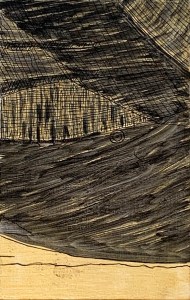
A Piece of Me #25, underdrawing.

A Piece of Me #25, underdrawing.

A Piece of Me #25, oil on panel. 21 x 13.3 cm or 5 1/4 x 8 1/4 in.

A Piece of Me #25, oil on panel. 21 x 13.3 cm or 5 1/4 x 8 1/4 in.

The challenge on this panel was simply dimensionality. The man’s pants and sweater were both quite dark, so it was difficult to read where the fabric folds and shadows were. Of course, I could guess a bit, given its placement relative to the whole image, but in any case, I wanted to create interest and motion there. So I introduced that in the underdrawing. See the image to the right.

Thus on the oil level I had three basic shapes to render: the ledge, the pants and the sweater. I rendered the pants in dark gray and reserved black only for the creases and deepest shadow accents. Same with the sweater, two tints of dark green accentuated by dark gray and/or black for the deepest creases/shadows. As it turns out, the buttons on his pants piqued the interest, interrupting an otherwise monovalumatic field of grey (hey, I just created a word!). BTW: those buttons were created by removing paint so as to expose the substrate rather than adding white back in on top (which I avoid whenever possible). It’s one of my pet-painting-peeves.

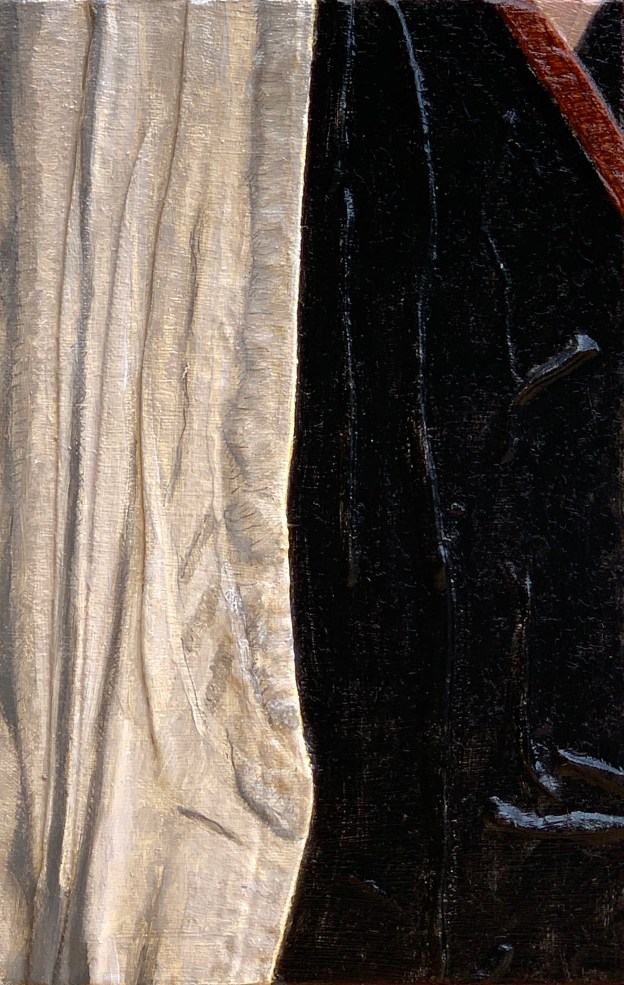
A Piece of Me #20, oil on panel over collage. 21 x 13.3 cm or 5 1/4 x 8 1/4 in.

A Piece of Me #20, oils

A Piece of Me #20, oil on panel over collage. 21 x 13.3 cm or 5 1/4 x 8 1/4 in.

A Piece of Me #20, oil on panel over collage. 21 x 13.3 cm or 5 1/4 x 8 1/4 in.

A Piece of Me #20, underdrawing over collage..

A Piece of Me #20, underdrawing over collage..

Collage on panel. What can I say? These kinds of panels go quickly. The oil level took me just two hours. Sometimes I think I should put more time into them on the final stages but then I remember how much time I put into getting the collages right, so I don’t.

This time around I did the underdrawing slightly differently though (pictured to the right). The panel posed a further challenge after resolving the underdrawing adhesion issues that I had had earlier. That’s because I didn’t want to create a large cross-hatched value using a pen nib for the black shirt area. instead I wanted to set in a darker wash quickly and easily, plus I knew the collage with its uneven surfaces would present challenges to a pen nib, anyway. So I mixed up a thin wash of mars black oil paint and laid it in with a brush. After a few days of drying time it helped me to achieve a dark, undulating mass rather quickly.

The linen jacket to the left required the most “effort”. I put that in scare quotes because it’s actually a process of discovery which, though it does take time, does not feel like work. The reason being that because the collaged shapes did not entirely match the highlights and shadows of the jacket folds in the original design, I had to do some tweaking. In the end I’m really happy with how it turned out. It reads quite well and I think will pair nicely with its neighbours in the final assemblage.