Tag Archives: painting in oil using an indirect technique

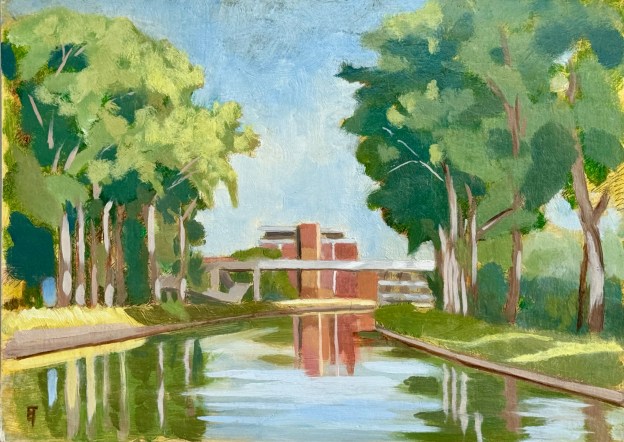
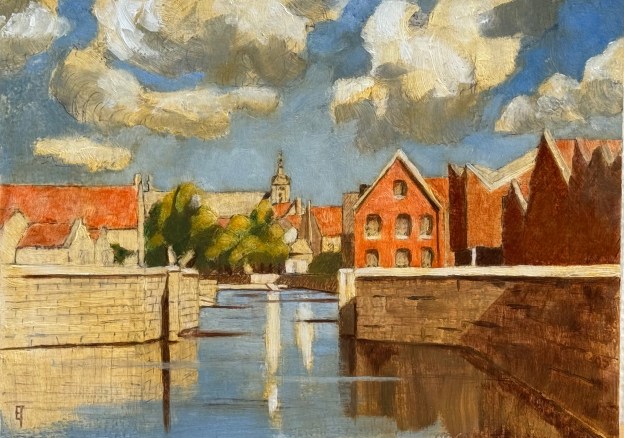
July, 2024, Avond aan de jachthaven, Brugge: "there is a light, never goes out"

July 2024, Avond aan de Jachthaven I, Brugge: “There is a light, never goes out”

July, 2024, Avond aan de jachthaven, Brugge: "there is a light, never goes out" 9 x 12" or 23 x 30 cm

July, 2024, Avond aan de jachthaven, Brugge: “there is a light, never goes out” 9 x 12″ or 23 x 30 cm

Last night I completed the third “on location” painting session for this little piece. It felt a bit like (finally) pulling a rabbit out of a hat.

It’s been a struggle primarily because of the summer Belgian weather (or lack of it). Secondly, because I’ve been navigating various tweaks to my newly self-designed and self-created pochade box. For example, at the start of session #2, the bracket attaching the box to my tripod fell off. 😦 So I had to sit on the ground for two hours. It was OK, but for the physical activity of painting, suboptimal. Thirdly, because I’m still (always) refining my technique.

aan de jacht haven Brugge/ the marina in Bruges. Watercolor on hot pressed paper. 9" x 12" or 23 x 30 cm.

aan de jacht haven Brugge/ the marina in Bruges. Watercolor on hot pressed paper. 9″ x 12″ or 23 x 30 cm.

Thus, in part because of my temperament, and in part because of the weather, I worked up the initial layers in the studio. I already had the composition since it was based on a watercolor I had completed last summer: I loved the receding canal, the light on it at the end of the day, plus the glowing red brick building in the middle distance.
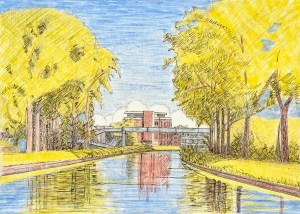
Aan de jacht haven Brugge/ the marina in Bruges. Underdrawing and underpainting on panel, touched up by India ink. 9" x 12" or 23 x 30 cm.

Aan de jacht haven Brugge/ the marina in Bruges. Underdrawing and underpainting on panel, touched up by India ink. 9″ x 12″ or 23 x 30 cm.

So I used that study to create an underdrawing (with silverpoint) and on that lovely, soft drawing, an underpainting (with egg tempera). After a light coat of shellac (to seal the panel off from the absorptions of the oil phase to come) I used a pen nib loaded with India ink to emphasize the composition’s darker values. All this was possible in the studio – and it laid down a solid, graphical foundation before all the accidents I knew painting “on location” would bring.

Both silverpoint and egg tempera are well suited to a panel prepared with true gesso (rabbit skin glue and chalk), however as techniques they cannot be used on a flexible canvas (the substrate of choice by painters since the 16th-17th century) primed with acrylic gesso (the ground of choice by painters since about the 1950’s). The record of my experiments in these against-the-current techniques is on my companion blog site atelierartisanal.com .

Why I have chosen this anachronistic technical direction is perhaps best examined from a therapist’s couch: it’s been the subject of much failure as well as heart-ache, but alas, it is the choice of my gevoelsmatig-bewustzijn (feeling-consciousness). And even though many of my experiments over these decades have not been successful, some have. There is a kind of internal mind’s-eye light I’ve been chasing. And I would also say that, thankfully, my batting average is beginning to improve! There is light at the end of this tunnel!

Additionally, I’m not sure if it’s even appropriate to call this an “en plein air” painting. The reason being, it was not painted “alla prima”, that is, all at once, in one session. For, besides the studio levels of image development described above, there were also the three “on location” evening sessions. So, if “alla prima” is an essential element of a definition of an “en plein air” painting, my work in general and this one in particular doesn’t fit. And relative to those three evening sessions, I’m hoping to whittle them down to just one or two (as long as the weather and my pochade-box holds ;-)). We’ll see what the future brings. 😉

If you are interested in this pieces please email me.
Schaarstraatbrug, Right. Oil on panel. June 10, 2024. 9 x 12" or 23 x 30.5 cm

Schaarstraatbrug, middag, kijkend naar het weste/Schaarstraat bridge, noon, looking (mostly) west

Schaarstraatbrug, Right. Oil on panel. June 10, 2024. 9 x 12" or 23 x 30.5 cm

Schaarstraatbrug, Right. Oil on panel. June 10, 2024. 9 x 12″ or 23 x 30.5 cm

For years I’ve been entranced by the view from the Schaarstraat bridge. I knew the time of year and time of day I wanted to capture for it offers a great opportunity to explore the complimentary colors of blue and orange. Last summer I was able get down a watercolor that I liked. Compositionally, it had what I was looking for, so I decided it could be a good start for an oil. The best part about that study was that I could work up the underdrawing in the studio and, so I imagined, finish it en plein air.

I know that most of the activity that goes by the name “en plein air” refers to an alla prima painting technique, which means the whole painting from start to finish is executed on location. (Of course, small touch ups in the studio are OK, but principally, the immediacy of painting “en plein air”, means painting in the moment, with (hopefully) a zen-like aesthetic insight and accuracy). I’ve got nothing against that, it’s just that I’ve come to realize that my aesthetic interests are a little different. The kind of color statements I want to make appear to be best supported by an indirect technique(!). Which means working up a painting, through layers – and these take time to dry.

Schaarstraatbrug, Right. Watercolor on hot pressed paper. July 2, 2023. 9 x 12" or 23 x 30.5 cm

Schaarstraatbrug, Right. Watercolor on hot pressed paper. July 2, 2023. 9 x 12″ or 23 x 30.5 cm

So, back to this piece. In the studio I worked up a drawing using silverpoint (it’s a very soft way to lay out the composition and make preliminary value statements). Then I lay in the basic color statements using egg tempera (it too, is a light and soft medium and, relative to oil, quite siccative). After the ET dried (about a week) I realized I might as well go ahead and do the first oil session indoors (since the weather was so bad!).

That first oil session was a return to the starting value statement but this time, stronger and more extreme, I used white, burnt umber and ultramarine blue. Woah, the result was more like a solarized photo, but promising. After it dried, I wanted to go out to finish it on site, but again the weather frustrated my building creative momentum: I just couldn’t wait. So I thought, heck, forget the men’s finals of the French Open, let’s see what can happen in the studio.

Surprisingly after a few hours of judicious glazing (the yellow ochre starting glaze was definitive), I saw what I had been looking for emerge on the panel. Nice! It’s so important to know when to stop when – beside the dinner bell – it’s time to lay down your brushes.

A Piece of Me #60, oil on panel over collage. 21 x 13.3 cm or 5 1/4 x 8 1/4 in.

A Piece of Me #60, oils

A Piece of Me #60, underdrawing over collage.

A Piece of Me #60, underdrawing over collage.

A Piece of Me #60, oil on panel over collage. 21 x 13.3 cm or 5 1/4 x 8 1/4 in.

A Piece of Me #60, oil on panel over collage. 21 x 13.3 cm or 5 1/4 x 8 1/4 in.

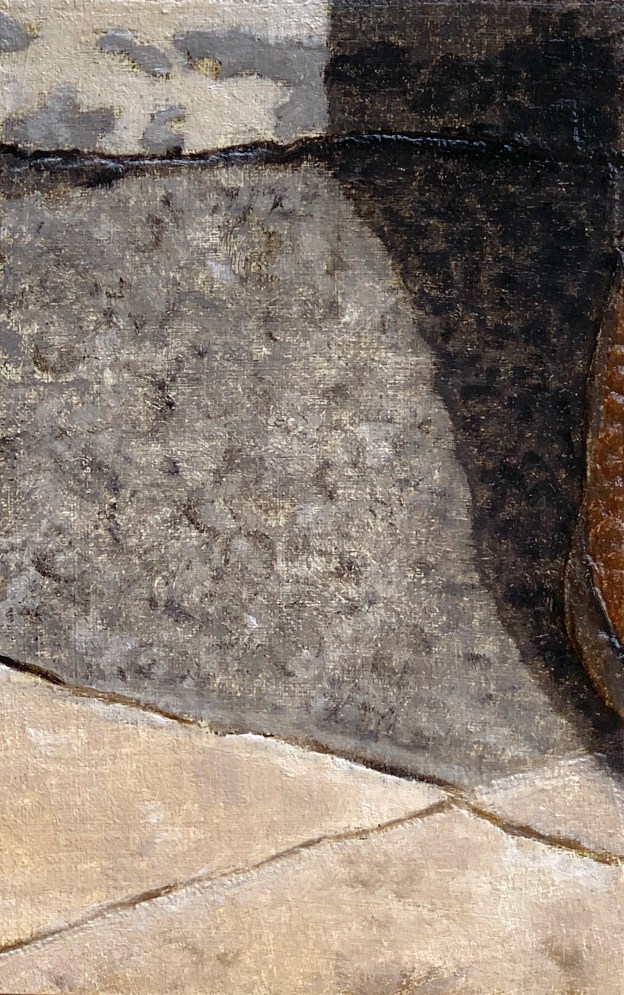
Second in the new series of panels executed exclusively in oil. The underdrawing on the right shows not only the layout of the design but also its intentional graphical harshness. It’s supposed to be that way! You want that firmness, those hard lines and clear contrasts. Then the oil level enhances, softens and sensuously mitigates these things – see left.

Thus, after the yellow imprimatura and the underdrawing dried, I started with the oil level. I covered the whole surface with a clear medium and after fifteen minutes wiped it off. The medium created a slightly tacky surface for working wet-in-wet, painting impasto paint into the clear glaze. I began by developing the highlights and quarter tones on the left first, then the strong shadow areas on the right. My goal was to cover the entire panel, to finish it in one working session. I reserved the strongest shadows and highlights for the end. Using the dry fan brush I could softly blend adjacent areas into one another without smearing. One of my favourite activities!

I’m pleased with the level of detail/interest in the shadows. The impasto paint there is not so thick so as to obscure the ground. And there is enough variation to allow the eye to wander. I did have to contend with the collage: the tip of the shoe on the right edge protrudes maybe two or three millimetres? It’s very tactile but difficult to paint. The side-lit photograph in the top spotlight (online display only ) illumines its 3D aspect. Some of the strong highlights you see in the photograph are not paint but rather fugitive reflections.

A Piece ofMe #55, oil on linen mounted on panel. 21 x 13.3 cm or 5 1/4 x 8 1/4 ".

A Piece of Me #55, oils

A Piece ofMe #55, oil on linen mounted on panel. 21 x 13.3 cm or 5 1/4 x 8 1/4 ".

A Piece ofMe #55, oil on linen mounted on panel. 21 x 13.3 cm or 5 1/4 x 8 1/4 “.

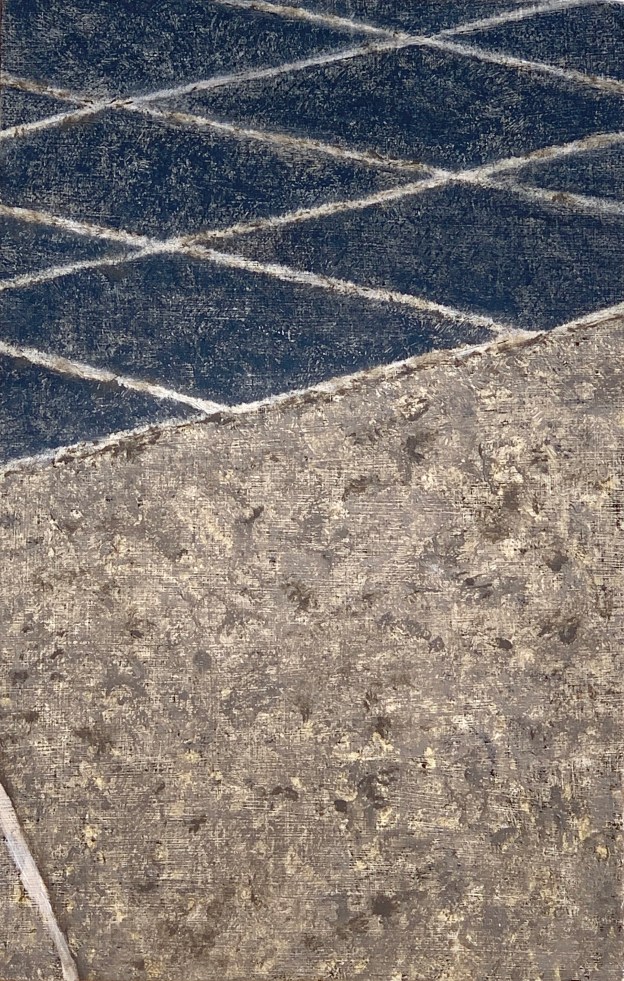
Finally the home stretch. This then is the first of twelve final panels: all panels in this series will be executed exclusively in oil on an oil ground. This particular panel was painted on linen mounted on panel previous to the application fo the oil ground. All these slight variations in pre-treatment to the grounds mean that there will always be a slightly different relationship between the ground and the application of the paint.

Additionally, because this is an oil ground it’s not receptive to the india ink that I used for the underdrawings in the egg tempera, mixed technique and/or encaustic panels. In those cases the ground was a traditional chalk gesso, which is water based and also very absorbent. So I had to switch to a heavily diluted black oil paint for my underdrawings. The imprimatura too, was a heavily diluted yellow ochre. And after both of these treatments I had to let the panel dry for a few days.

However, because I had laid in this groundwork, the thicker oil level proceeded quickly. It took just one working session to develop the main forms and textures – although I did have to let that dry before painting in the final contrasts. When using an indirect technique for oil in this way means that the waiting times are not for impatient temperaments. I’m pretty chill, but even so I do chafe at the bit sometimes. 😉