Tag Archives: art

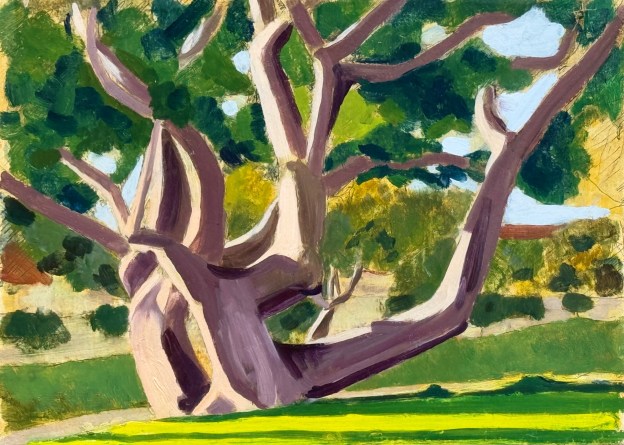
The Coral Tree, Oil on panel. 9 x 12.5" or 21 x 32 cm. November 2025

The Coral Tree, November 2025

The Coral Tree, Oil on panel. 9 x 12.5" or 21 x 32 cm. November 2025
The Coral Tree, Oil on panel. 9 x 12.5″ or 21 x 32 cm. November 2025

After a productive summer in Belgium, I began to dream of doing something similar here at my new home in Oceanside. I spent about a month refining the design of my pochade box to reflect the latest changes I have found helpful in the field. I bought a new travel stool and discovered I could carry all my stuff around in my bike bags–and also in the back carrier of my golf cart. Nice!

So in early November I began scouting for locations. The first and most obvious choices were the amazing coral trees planted near the front entrance to our community. I’ve admired them for years. There are three ancient mariners there whose gestural limbs astound. Their silhouettes are highlighted in the afternoon light as the sun goes down. I wanted to try out my chops.

The first painting of the first tree is still in progress iIt may or may not be salvaged). But the second attempt of the middle tree is pictured here. With a few caveats, I’m pretty happy with it.

Plein air set up for The Coral Tree. November, 2025. Oceanside, California

I’m learning as I go, adapting my palette to the more intensive colors of Southern California. In this case, I broke out into titanium white (I usually use lead white) and cadmium orange (totally new). Also used a whole new-to-me range of purplish tones by mixing ultramarine blue with cadmium red (brought to earth with raw umber). That last combo helped me to describe the tree trunks. (I did go too far in one area but that will be easily remedied when the painting dries a bit more)

My last session was pure bliss. I was able to achieve that gentle, toothy grab from the surfaced glazed medium of my new, sable, oil-laden brush strokes. A dip into my egg yolk emulsion assists in their on-panel integrity while also assuring a quick dry. Soft, sensuous, like the Merovingian in the Matrix II would have said (referring the French language): “It’s like wiping your ass with silk”. Ahhhhh….. the private pleasures of the en-plein-air painter.

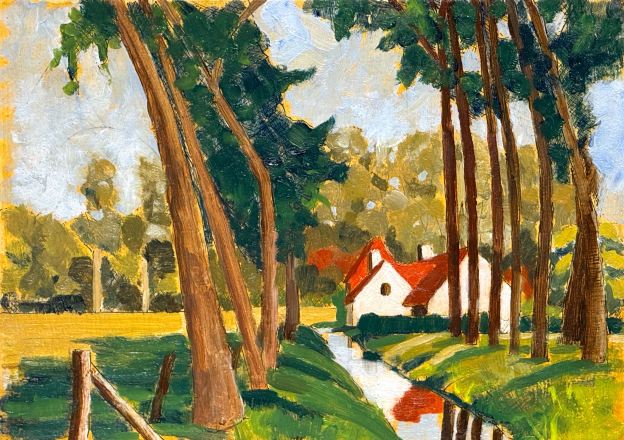
Olie schilderij van de Paarden Hoeve aan Fort van Beieren. 23 x 32 cm or 9 x 12.5 "Oil on panel. August 12, 2025

Midday at the horse farm/Middag op de paardenborderij, August 12, 2025

Last week I created a watercolor of this sweet little landscape that I discovered just outside of Bruges near the Fort van Beieren. I’m always on the lookout for landscapes that combine nature with a few geometrical, manmade shapes. And when the light spotlights these shapes, I’m in hog heaven. This one, including the white washed sides of a red roofed farm house, surrounded by fields and a small creek had all the ingredients I’m usually on the look out for. So, the watercolor was fine, but I was particularly interested in the intensity that can only oil can offer.

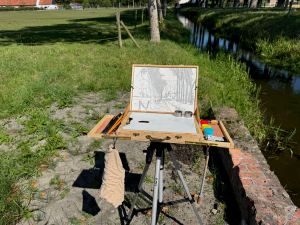
I transposed the composition from the watercolor – since that saves making a ton of new decisions in the field. I used india ink and silverpoint on a chalk gesso panel, then gave it a quick shellac-seal for protection and to reduce absorbency.

Field set up of pochade box with transposed India inked drawing, ready for oil.

The first painting session last Saturday involved laying in a yellow ochre tint into which I blocked in the values and tints of all the basic forms. At the end of that session I had a good, gestural underpainting, everything was understated, earthy and yet harmonized. Ever since I changed my recipe last year to egg yolk (instead of a methyl cellulose glue) for my painting emulsion, I’ve had good success – both in drying time as well as fluid paint handling. Encouraging!

The underpainting was dry to the touch after two days(!). I went out yesterday to see what might happen. The weather was perfect. Warm and sunny with a gentle breeze. I set up my traveling oil pochade box and set to work (it has a different design than my traveling drawing/watercolor box due to the requirements of the different media). The time passed. After three hours I looked back happy and decided to call it a day. (“Day!”)

Olie schilderij van de Paarden Hoeve aan Fort van Beieren. 23 x 32 cm or 9 x 12.5 "Oil on panel. August 12, 2025
Olie schilderij van de Paarden Hoeve aan Fort van Beieren. 23 x 32 cm or 9 x 12.5 “Oil on panel. August 12, 2025

I love the white building gently nested near the center, with the mirrored creek leading forward. The complimentary colors of organic reds and greens provide all the passion this kind of landscape evokes. The trees gawkily bend upwards: my kind of cathedral. Here’s hoping the weather continues to provide a few more opportunities to my Belgian muse.

If you are interested in this piece shoot me an email.

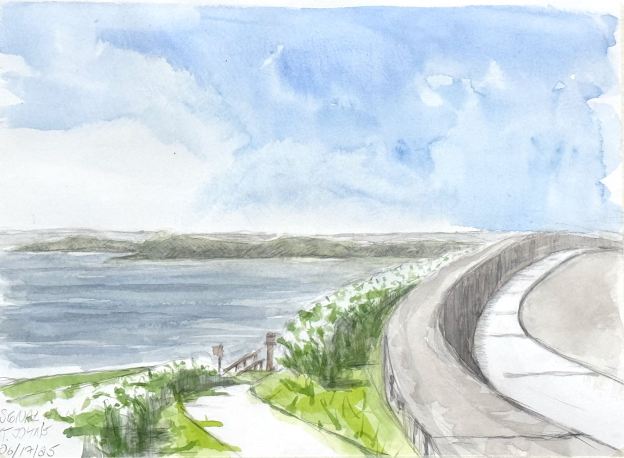
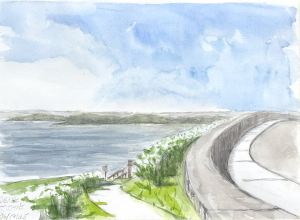
Signal Hill, St. John's Newfoundland. 17 June, 2025. Watercolor of hot pressed paper. 23 x 31 cm or 9 x 13"

Two Watercolors of St. John’s, Newfoundland, June 17, 2025

We had the chance to visit Halifax, Nova Scotia and St. John’s, Newfoundland as we traveled up the coast preparing for our transatlantic crossing. In Halifax, though I had intended to sketch, I spent most my time at its Art Museum, enjoying their collection of Inuit Art. The second floor had some gems. I find the art of Indigenous peoples resonates very well with the Modern Contemporary impulse – but it’s often better, more authentic. The Museum also had some precious early 20th century watercolors by an artist named Henry M. Rosenberg. Ah… He was new to me, now on my radar.

Signal Hill, St. John's Newfoundland. 17 June, 2025. Watercolor of hot pressed paper. 23 x 31 cm or 9 x 13"
Signal Hill, St. John’s Newfoundland. 17 June, 2025. Watercolor of hot pressed paper. 23 x 31 cm or 9 x 13″

Luckily the sun shone well enough when we pulled into St. John’s so I was able to get a brief sketch down at each of the cliffside locations we visited before we had to return to town. (Both pieces were completed later as we headed out to sea.) The Signal Hill piece is perhaps the more effective of the two as it emphasizes a really strong composition. I like the treatment of the sky and the sea – cause that’s how they felt that day. I also feel relatively successful at holding back the white of the paper for those white blossoms on the waving seagrass in the foreground. It was a very windy day!

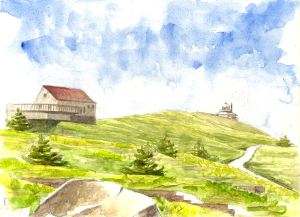
Cape Spear, St. John's Newfoundland. 17 June, 2025. watercolor on hot pressed paper. 23 x 31 cm or 9 x 13"
Cape Spear, St. John’s Newfoundland. 17 June, 2025. watercolor on hot pressed paper. 23 x 31 cm or 9 x 13″

The second piece comes from Cape Spear. It is a remote location about 30 minutes drive from St. John’s. It was, so we were told, the easternmost point of land on the North American continent(!). It felt like it. While I was drawing, again just concentrating on getting down a composition for later completion, I heard one of our companions cry out “whales”. I turned my neck to spot a few baby whales breaching in the bay near to us. Thrilling! Otherwise, the two (geometric) buildings on the soft undulating hillside initially attracted me. Later, including the large foreground rock and steps along the winding pathway helped to establish distance. I used some latex masking fluid to hold back the light on some of those foreground elements. It worked out OK. With every watercolor I learn more and more about masking, wet-in-wet, and wet-on-dry.

If you are interested in either of these pieces please shoot me an email.

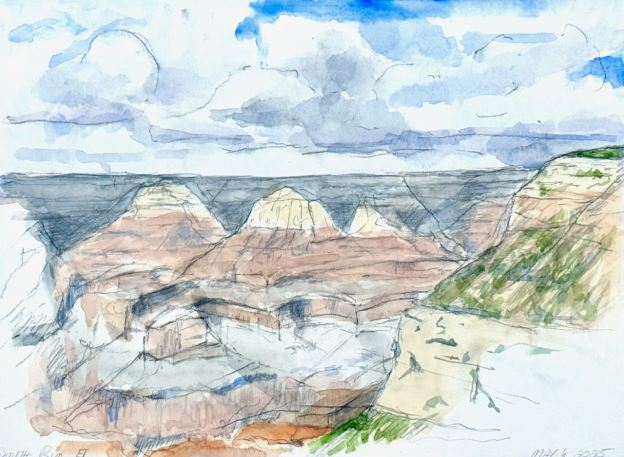
Afternoon Vista from the Grand Canyon's SouthRim. Watercolor. May 5, 2025 9 x 12" or 23 31 cm.

South Rim Vista @ the Grand Canyon, May 6th 2025

Afternoon Vista from the Grand Canyon's SouthRim. Watercolor. May 6, 2025 9 x 12" or 23 31 cm.
Afternoon Vista from the Grand Canyon’s SouthRim. Watercolor. May 6, 2025 9 x 12″ or 23 31 cm.

We visited the Grand Canyon at the beginning of May. It was my first time there. Ever. Jaw dropping awe barely describes it. Actually, after leaving the car and taking in the view, I wept. (It could have easily been the travel fatigue but the overwhelming shock of it is no joke.)

The weather was cloudy, then rainy, then cloudy again but finally on the afternoon of the 6th, clear. I had a few hours free, so I grabbed my handy-dandy watercolor box and headed to the rim.

After a brief reconnaissance I found a good spot with some foreground interest to help establish scale so I set up and got to work. Principally, by creating this small travelling easel, I was now able to use my arm instead of my hand to draw. That makes a huge difference!!! And since I have been learning how to use a charcoal pencil for figure drawing at the Watts Atelier, I decided to use that for my initial sketch (in contrast to a graphite pencil which I have been using). The charcoal makes quick dark lines. Perhaps too quick and too dark but I was already on my way and decided to bugger through. After creating a design of the shapes before me I felt ready to begin laying in washes. The charcoal made the colors too muddy, too soon, so I had to improvise.

I had about an hour to try to capture the scene before me. The light kept changing so that meant the layout of the strata was also constantly changing: hidden, then revealed, then hidden again. Given all the challenges of the terrain and my ongoing experiments with the tools of the trade I’m grateful to have come up with something at all. I did snap a photo reference for later touch ups, but strangely enough, didn’t need to consult it much after we got home. A small half hour of tightening up was all that was needed.

If you are interested in this piece shoot me an email.