Category Archives: Uncategorized

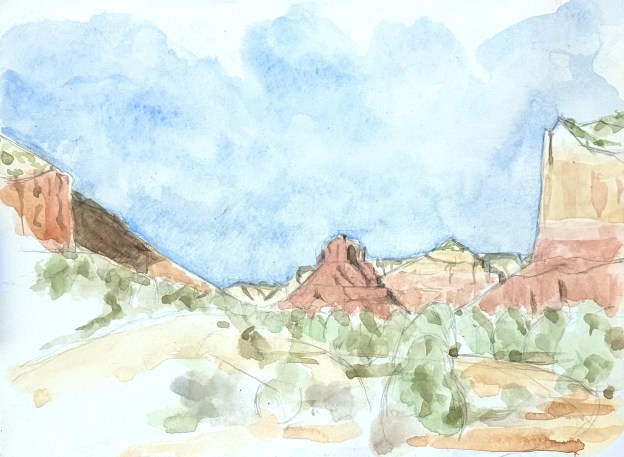
Red Rock Ranger Station Sedona, Arizona. Watercolor on hot pressed paper. 9 x 12.5' or 21 x 32 cm.

Watercolors in Sedona, January 2026

I’m just back from a quick trip to Sedona. The impetus for the visit was primarily family but still, I was able to squeeze in a few watercolors.
Tree at Montezuma's Well in Sedona. Watercolor on hot pressed paper. 9 x 12.5 " or 21 x 32 cm.
Tree at Montezuma’s Well in Sedona. Watercolor on hot pressed paper. 9 x 12.5 ” or 21 x 32 cm.

The first was a wiry tree next to a location called Montezuma’s Well. (It’s the site of an ancient sink hole, just outside of Sedona, which is filled with spring water and was used by the Sinagua Indians.) The view from above the well did not speak to me but the wiry tree next to the main lookout did. I sat down and had about an hour and a half to grab something before my companions would reappear – and also before the light had changed. Luckily, for me, for watercolors, there was plenty of value/contrast in the subject matter so the resulting painting is a bit bolder than I am usually able to achieve. As the light moved toward noon, the shadows intensified. Additionally, there were accents of color in the tree, rocks and surrounding vegetation. Voila!
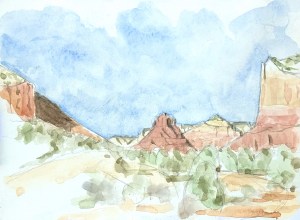
Red Rock Ranger Station Sedona, Arizona. Watercolor on hot pressed paper. 9 x 12.5' or 21 x 32 cm.
Red Rock Ranger Station Sedona, Arizona. Watercolor on hot pressed paper. 9 x 12.5′ or 21 x 32 cm.

The second watercolor is a long, landscape composition from the Red Rock Ranger Station. You discover this turnout just as you enter the Sedona area from highway 17. I sat at the lookout area for about two hours in the mid to late afternoon. For anyone who has been to the area, you know that the late afternoon sunset upon the already red rocks creates a dazzling display of brilliant warmth that can be absolutely mind-blowing. Well, I wasn’t gonna try to capture that (this time), I just wanted to get in a reasonably accurate statement that would allow me to place the shadows where they belonged as the afternoon progressed.

I worked about an hour getting my drawing in. I prefer to use a gestural charcoal pencil to feel my way into the flow of shapes and proportional relationships in a subject. After I’ve got something that I like, I use a kneaded eraser to erase the charcoal (I don’t leave it there because it can bleed into the paint during the watercolor session). Nevertheless, the charcoal does leave a ghosted image that I then go over with a fine graphite pencil to define the edges of the shapes to come. (I avoid using a graphite pencil for the beginning stage because any rubber erasure tends to abrade the surface of the paper in an unfortunate way – and my initial strokes aren’t always right).

Once the composition felt complete enough, and knowing that the afternoon light was moving quickly, I broke out my watercolor box. I had a feeling about how I wanted to handle my washes, and I knew I had only about an hour to do so. The central feature was, of course, the red rock front-and-center but it was balanced on either side by the cliffs, like bookends. The far distance had plenty of (subdued) interest to capture, while the rhythms of foliage and earth in the foreground allowed me to guide the viewer in. Luckily, the day was neither too warm (so my wet-in-wet washes didn’t evaporate too quickly), nor too cold (so my fingers didn’t freeze). Finally, as with any painting, you need to know when to stop.

So I did.

I might be able to do better on another day but for today. I was happy. Happy that I was able to create a reasonable expression of this majestic and beautiful place.
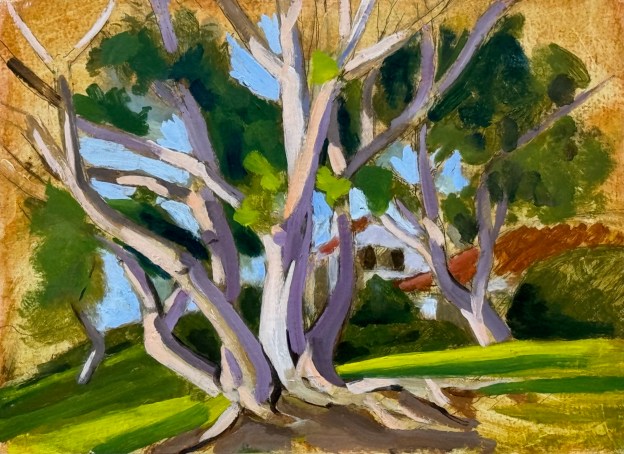
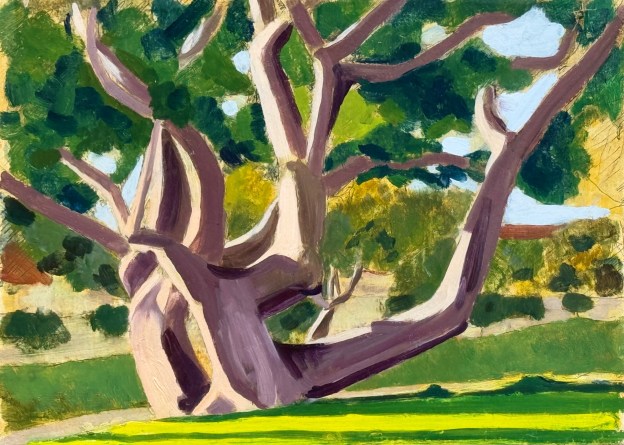
The six trunked Coral Tree. December 2025. Oil on panel. 9.5 x12' oe 21 x 32 cm.

The six branched Coral Tree, December 2025

The six trunked Coral Tree. December 2025. Oil on panel. 9.5 x12' oe 21 x 32 cm.
The six trunked Coral Tree. December 2025. Oil on panel. 9.5 x12′ oe 21 x 32 cm.

I went out last Saturday afternoon to see if I could rescue a painting that been stuck. I had done all my underdrawing and underpainting in November (in three or four plein air sessions), but felt as though I didn’t know exactly how to resolve various issues: painting wiry trees in Southern California, with a new-to-me palette of colors.

In the mean time, I had found relative success by painting the tree next to it. Its form was simpler to grasp. It’s gesture, too. When you spend a few hours on location in each session, noticing how the light falls as the afternoon progresses, seeing how the shadows group as they define the foliage, you build an internal image repository of what it is you want to say. That light, there. Even though no particular stroke can ever define it: the effect is cumulative.

So I decided to retry the first tree. It has six main trunks or branches which intertwine, and it’s not always possible to see what is what. But if–as the artist–you know what is what then, you can place a spontaneous splotch of light accurately. If not, then not.

So I had already done my homework, the question was whether I could breathe some life into my ugly duckling. A palette of cadmium orange, titanium white, ultramarine blue, cadmium red, cadmium yellow light and raw umber did the trick. Four bright colors earthed by umber, lightened with a strong titanium white, as needed.

I’m happy.

The Coral Tree, Oil on panel. 9 x 12.5" or 21 x 32 cm. November 2025

The Coral Tree, November 2025

The Coral Tree, Oil on panel. 9 x 12.5" or 21 x 32 cm. November 2025
The Coral Tree, Oil on panel. 9 x 12.5″ or 21 x 32 cm. November 2025

After a productive summer in Belgium, I began to dream of doing something similar here at my new home in Oceanside. I spent about a month refining the design of my pochade box to reflect the latest changes I have found to be helpful in the field. I bought a (cheesy) new travel stool and discovered I could carry all my stuff around in my e-bike bags–but also in the back carrier of my golf cart. Nice!

So in early November I began scouting for locations. The first and most obvious choices were the amazing coral trees planted near the front entrance to our community. I’ve admired them for years. There are three ancient mariners there whose gestural limbs astound. Their silhouettes are highlighted in the afternoon light as the sun goes down. I wanted to try out my chops.

The first painting of the first tree is still in progress (it may or may not be salvaged). But the second attempt of the middle tree is pictured here. With a few caveats, I’m pretty happy with it.

Plein air set up for The Coral Tree. November, 2025. Oceanside, California

I’m learning as I go, adapting my palette to the more intensive colors of Southern California. In this case, I broke out into titanium white (I usually use lead white) and cadmium orange (totally new to me). Also, used a whole new-to-me range of purplish tones by mixing ultramarine blue with cadmium red (brought to earth with raw umber). That last combo helped me to describe the tree trunks. (It might be that I went too far in one area but that will be easily remedied if and when)

My last session was pure bliss. I was able to achieve that gentle, toothy grab from the surfaced glazed medium of my new, sable, oil-laden brush strokes. A dip into my egg yolk emulsion assists in their on-panel integrity while also assuring a quick dry. Soft, sensuous, like the Merovingian in the Matrix II would have said (referring the French language): “It’s like wiping your ass with silk”. Ahhhhh….. the private pleasures of the en-plein-air painter.