Category Archives: Landscape

I experience landscape as a doorway, an invitation to eternity, shimmering with light. Sometimes, when that sentiment makes it onto paper or panel, I am grateful.

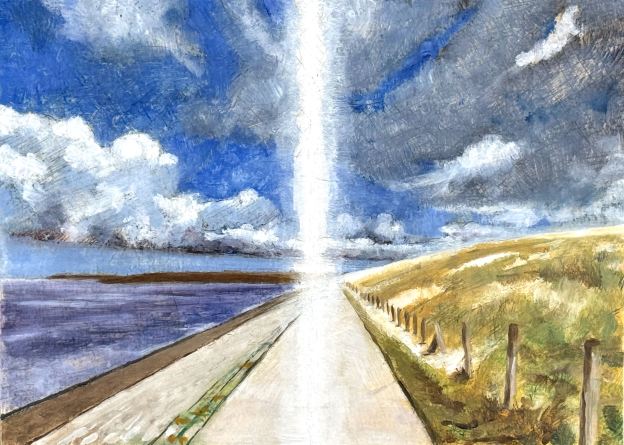
There is a Light, never goes out. July 2025. Oil on panel. 23 x 32 cm or 9 x 12.5"

There is a Light – never goes out, July 27, 2025

There is a Light, never goes out. July 2025. Oil on panel. 23 x 32 cm or 9 x 12.5"
There is a Light, never goes out. July 2025. Oil on panel. 23 x 32 cm or 9 x 12.5″

Last summer my husband and I did a weekend biking trip to Zeeland, a beautiful area of windswept dunes to the east of Brugge. Just before we left on that weekend I had had a biking accident here in Brugge where I met the cobblestones (up-close-and-personal) – and without a helmet. During our trip then, I was suffering from a slight concussion, which may (at least in part) explain this painting.;-)

We were biking along a stretch of pathway a few kilometers outside of Zerikzee when the storm clouds began to threaten and blow: alternating light and darkness; wind and rain. We just kept moving. Meanwhile the song “There is a Light, never goes out” by Steve Gold, came into my head and wouldn’t leave.

Luckily, Johnny had created a small video of that stretch of experience so I could grab parts of it to help me experiment with visualizing the inspiration of that time-less time. My penchant for one-point perspective dominates the composition – and provides a counter point to the strong central shaft of light. But I was careful not to align the two as it would have created a dead center with nowhere to go(!). Additionally, I did integrate a small circle (ultimately not very visible) – which I have been using these days to assist in creating an abstract element to an otherwise basic landscapes.

Is this a new direction? Maybe but maybe not.;-) But still, I like it.

If you are interested in this painting, shoot me an email.

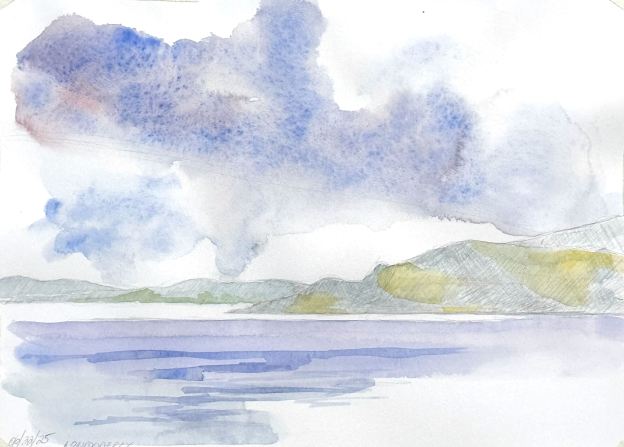
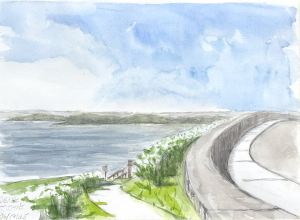
Arriving Londonderry II. 22 June 205. Watercolor on hot-pressed paper. 21 x 32 cm or 9 x 13"

Watercolors of arriving @ Londonderry, Ireland, June 22, 2025

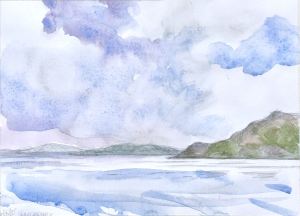
Arriving Londonderry I. 22 June 2025. Watercolor on hot-pressed paper. 21 x 32 cm or 9 x 13"
Arriving Londonderry I. 22 June 2025. Watercolor on hot-pressed paper. 21 x 32 cm or 9 x 13″

When you’ve been out at sea for five days, with the endless horizon stretching in all directions, it is thrilling to spot land once again. As we headed up the coast, approaching Northern Ireland, the Observation Deck became crowded with other passengers who seemed to feel the same way. Excitement, beauty – and the play of light upon rocks and hills and GREEN vegetation!

Arriving Londonderry II. 22 June 205. Watercolor on hot-pressed paper. 21 x 32 cm or 9 x 13"
Arriving Londonderry II. 22 June 205. Watercolor on hot-pressed paper. 21 x 32 cm or 9 x 13″

I brought out my trusty travel box to try to capture some of this excitement – and this light. The challenge of doing a watercolor under these conditions, not only of rapidly changing light, but also of a steadily changing composition of forms (due to a moving boat), meant making quick decisions about what I wanted to say and then sticking with it. Land, sea and sky: three elements in their awesome simplicity. Because of all that, I feel the second attempt is more successful than the first. Even a learning based on the first. I’m posting both because I’m not ashamed or embarrassed of the first one, it has some nice energy, motion and light, but overall, I feel the second one is a bit cleaner. Each one took maybe an hour – at most.

Anyway, here they are Arriving Londonderry I & II. If you are interested in either of these pieces please shoot me an email.

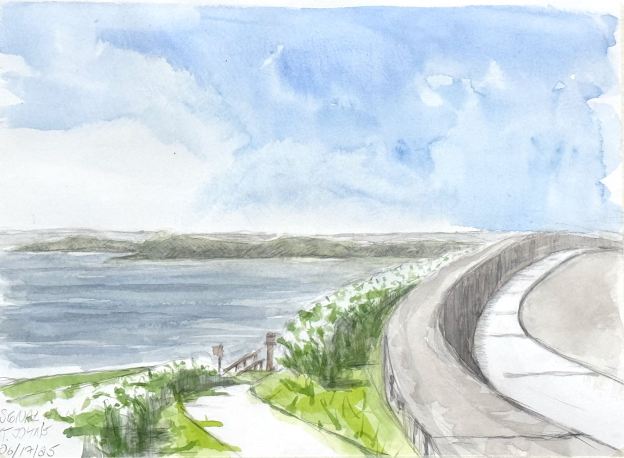
Signal Hill, St. John's Newfoundland. 17 June, 2025. Watercolor of hot pressed paper. 23 x 31 cm or 9 x 13"

Two Watercolors of St. John’s, Newfoundland, June 17, 2025

We had the chance to visit Halifax, Nova Scotia and St. John’s, Newfoundland as we traveled up the coast preparing for our transatlantic crossing. In Halifax, though I had intended to sketch, I spent most my time at its Art Museum, enjoying their collection of Inuit Art. The second floor had some gems. I find the art of Indigenous peoples resonates very well with the Modern Contemporary impulse – but it’s often better, more authentic. The Museum also had some precious early 20th century watercolors by an artist named Henry M. Rosenberg. Ah… He was new to me, now on my radar.

Signal Hill, St. John's Newfoundland. 17 June, 2025. Watercolor of hot pressed paper. 23 x 31 cm or 9 x 13"
Signal Hill, St. John’s Newfoundland. 17 June, 2025. Watercolor of hot pressed paper. 23 x 31 cm or 9 x 13″

Luckily the sun shone well enough when we pulled into St. John’s so I was able to get a brief sketch down at each of the cliffside locations we visited before we had to return to town. (Both pieces were completed later as we headed out to sea.) The Signal Hill piece is perhaps the more effective of the two as it emphasizes a really strong composition. I like the treatment of the sky and the sea – cause that’s how they felt that day. I also feel relatively successful at holding back the white of the paper for those white blossoms on the waving seagrass in the foreground. It was a very windy day!

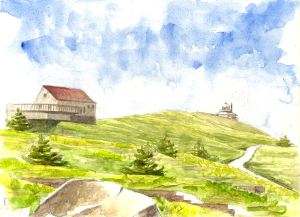
Cape Spear, St. John's Newfoundland. 17 June, 2025. watercolor on hot pressed paper. 23 x 31 cm or 9 x 13"
Cape Spear, St. John’s Newfoundland. 17 June, 2025. watercolor on hot pressed paper. 23 x 31 cm or 9 x 13″

The second piece comes from Cape Spear. It is a remote location about 30 minutes drive from St. John’s. It was, so we were told, the easternmost point of land on the North American continent(!). It felt like it. While I was drawing, again just concentrating on getting down a composition for later completion, I heard one of our companions cry out “whales”. I turned my neck to spot a few baby whales breaching in the bay near to us. Thrilling! Otherwise, the two (geometric) buildings on the soft undulating hillside initially attracted me. Later, including the large foreground rock and steps along the winding pathway helped to establish distance. I used some latex masking fluid to hold back the light on some of those foreground elements. It worked out OK. With every watercolor I learn more and more about masking, wet-in-wet, and wet-on-dry.

If you are interested in either of these pieces please shoot me an email.

RGB but still leaning toward the light

RGB, but still leaning into light, June 1, 2025

RGB but still leaning toward the light

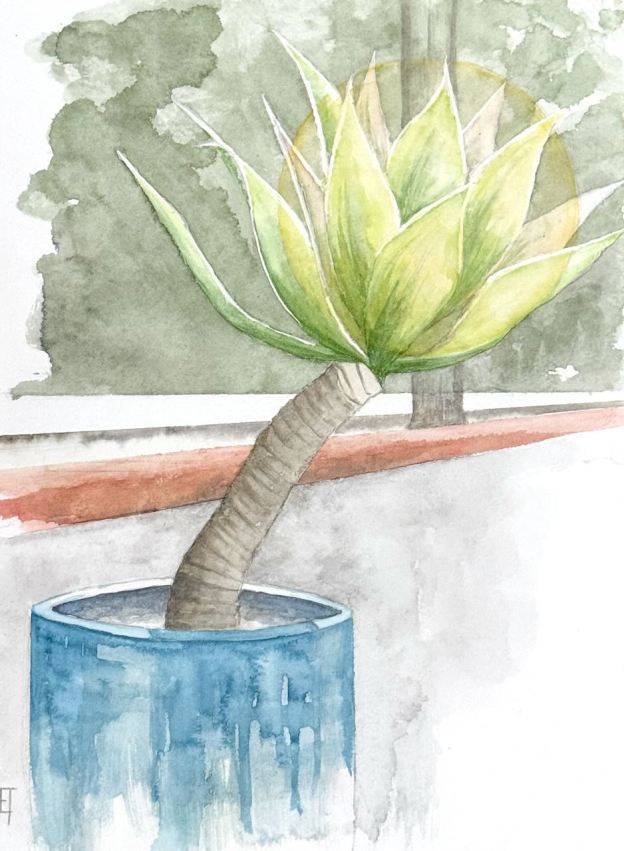
About two weeks ago, as I was drinking my morning matΓ© on our back terrace, I was struck by the light penetrating the outstretched leaves of our potted agave attentuata. So I grabbed my handy-dandy watercolor box and began to sketch it in.

My initial format was horizontal (landscape). What intrigued/challenged me was the silvered edges of the broad leaves. Would it/could it be possible to hold those thin edges back? I knew it would mean retaining the white of the paper, meanwhile filling in all the surrounding contrasts using hue, value and saturation. With watercolor I already knew just how challenging that can be.

So, after getting down a linear design that I liked, I used a combination of masking tape and latex masking fluid to hold back those fine edges. In the end I did three different versions: I switched to vertical (portrait) for the latter two. I experimented with the masking challenge as well as hammering out a simplified composition. I knew upfront that I wanted to accentuate three main chromatic areas; the challenge was finding which “background” landscape elements to include. The gesture of the agave was my guiding light.

Oh yes, and for those who are familiar with my penchant for the circle, I chose to include a yellow halo to help accentuate the stretching of that agave. I think it’s effective – yet hopefully subtle enough to avoid being formulaic. For today, I’m happy.

If you are interested in this piece shoot me an email.
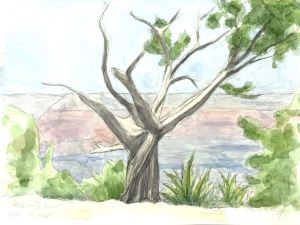
Tree @ Hermit's Rest. Watercolor. May 5, 2025 9 x 12" or 23 31 cm.

Tree @ Hermit’s Rest, May 7 2025

Tree @ Hermit's Rest. Watercolor. May 5, 2025 9 x 12" or 23 31 cm.
Tree @ Hermit’s Rest. Watercolor. May 5, 2025 9 x 12″ or 23 31 cm.

From El Tovar we biked out to the western edge of the South Rim of the Grand Canyon. Because of the scenery it’s one of the most amazing bike rides I’ve ever experienced. We arrived at Hermit’s Rest cold, wet, and happy – especially because of the hot drinks available there. Later outside, while having lunch, I spotted this lone tree standing like a sentinel over the canyon. Fantastic. My husband agreed to hike around for a half hour so that I could get down a quick sketch.

Once again, I pulled out my handy-dandy little easel box and (once again) found I could use my full arm with the charcoal pencil to sketch in a quick design. The gesture of the tree was so compelling, especially before its background of eternity. After my half hour, I felt lucky to have created a good start but, time-wise had no chance to do a watercolor. I snapped a photo of the dramatic lighting on the tree, hoping I might be able to complete it later.

Watercolor as a medium, is demanding because the paper provides the strongest whitest light, so it is critical to know what not to paint before you begin painting. If you don’t make those important decisions up front, you end up with mud. So, once we were back home I had an enjoyable afternoon laying in light background washes and then attempted to sculpt that tree. The lights and shadows tell its story. I’m pretty happy with the result.

If you are interested in this piece shoot me an email.
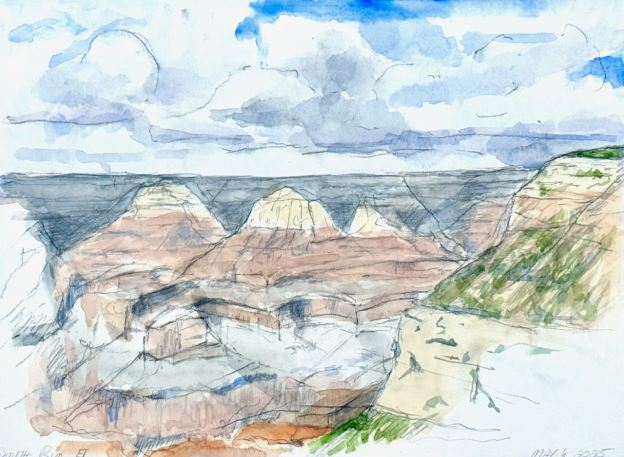
Afternoon Vista from the Grand Canyon's SouthRim. Watercolor. May 5, 2025 9 x 12" or 23 31 cm.

South Rim Vista @ the Grand Canyon, May 6th 2025

Afternoon Vista from the Grand Canyon's SouthRim. Watercolor. May 6, 2025 9 x 12" or 23 31 cm.
Afternoon Vista from the Grand Canyon’s SouthRim. Watercolor. May 6, 2025 9 x 12″ or 23 31 cm.

We visited the Grand Canyon at the beginning of May. It was my first time there. Ever. Jaw dropping awe barely describes it. Actually, after leaving the car and taking in the view, I wept. (It could have easily been the travel fatigue but the overwhelming shock of it is no joke.)

The weather was cloudy, then rainy, then cloudy again but finally on the afternoon of the 6th, clear. I had a few hours free, so I grabbed my handy-dandy watercolor box and headed to the rim.

After a brief reconnaissance I found a good spot with some foreground interest to help establish scale so I set up and got to work. Principally, by creating this small travelling easel, I was now able to use my arm instead of my hand to draw. That makes a huge difference!!! And since I have been learning how to use a charcoal pencil for figure drawing at the Watts Atelier, I decided to use that for my initial sketch (in contrast to a graphite pencil which I have been using). The charcoal makes quick dark lines. Perhaps too quick and too dark but I was already on my way and decided to bugger through. After creating a design of the shapes before me I felt ready to begin laying in washes. The charcoal made the colors too muddy, too soon, so I had to improvise.

I had about an hour to try to capture the scene before me. The light kept changing so that meant the layout of the strata was also constantly changing: hidden, then revealed, then hidden again. Given all the challenges of the terrain and my ongoing experiments with the tools of the trade I’m grateful to have come up with something at all. I did snap a photo reference for later touch ups, but strangely enough, didn’t need to consult it much after we got home. A small half hour of tightening up was all that was needed.

If you are interested in this piece shoot me an email.
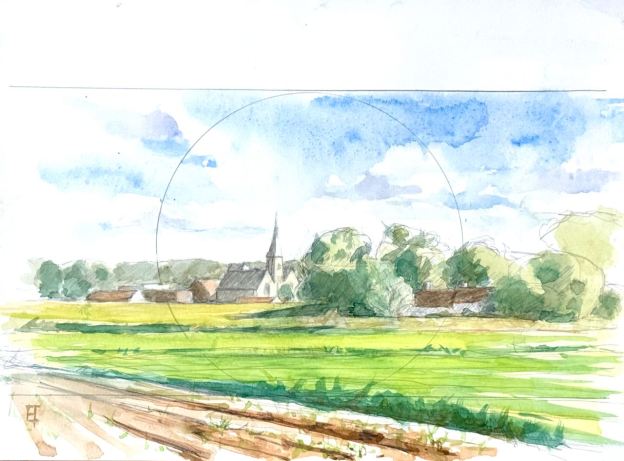
Watercolor of Koolkerke, Belgium. 23 x 31 cm or 9" x 12".

Koolkerke Watercolor, September 2024

Watercolor of Koolkerke, Belgium. 23 x 31 cm or 9" x 12".
Watercolor of Koolkerke, Belgium. 23 x 31 cm or 9″ x 12″.

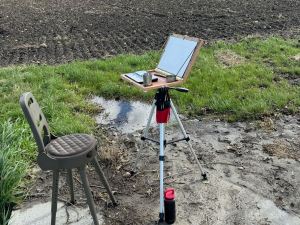
Late in the summer en-plein-air season I discovered this view of the church at Koolkerke near Bruges. I had just designed a new traveling pochade box, exclusively for watercolors, so I was happy to try it out in this new-to-me location. Two birds. One stone.

The box worked out well enough, though I always can’t help but tweak a few things. My interest was in having a sturdy but lightweight box that could exactly fit a standard watercolor block within its lid. Check. Piano hinges gave me a good easel angle. For the inside of the palette base I attached adhesive magnetic discs so my metallic watercolor pan and pots would stay put and not fall over. Underneath I attached a bracket that would take a 1/4″ 20 thread standard camera tripod mount. Check. Everything fit into my bike bag. Check, check, check. The only problem was the lateness of the season: it was very cold!

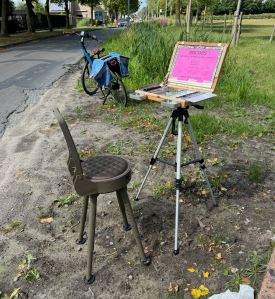
Pochade box for watercolors attached to a camera tripod.

Still, I was able to manage a session or two, enough to lay in this watercolor as a study for an oil next summer. I really love the afternoon light playing on the buildings in the far middle ground. Luckily the farmer’s fields in the foreground gave me something to work with compositionally. As a study I’m happy and have my fingers crossed for next summer.

de groene brug over de Stinker naast het oude sifon, Olie op paneel, august 2024, 23 x 32 cm or 9" x 12"

de groene brug over de “Stinker”, August 2024

de groene brug over de Stinker naast het oude sifon, Olie op paneel, august 2024, 23 x 32 cm or 9" x 12"

de groene brug over de Stinker naast het oude sifon, Olie op paneel, august 2024, 23 x 32 cm or 9″ x 12″


Translation: “The Green bridge over the Schipdonkkanaal.


About two weeks ago I decided to bike out beyond Damme in order to find a nice spot there, somewhere along the two canals that run north/south and out to the sea. The locals call them the “Stinker” and the “Blinker”, for dirty water and clean water, respectively. And although the smell is long gone, it turns out that the dirty nomenclature did not refer to the raw sewage I had always imagined, but rather to the run off from the processing of flax for the linen factories upriver along the Leie near Gent. Now the Stinker runs clean, as the fish and fowl can playfully attest.


I found a spot looking north, where the bridge from Damme crosses over, next to the old sifon that used to run out to Sluis in the Netherlands – before two world wars blew up that dream. It’s so odd to enjoy such a peaceful idyllic spot, when locals stop by and want to chat and tell you where the German, French or Canadian positions once were and/or what their grandmother had to do to keep the farm’s well functioning during the harsh winters of another time.


Back to painting, though. I had already determined that for this particular project I wanted to go pure “en plein air”. That means I did not expect to finish it “alla prima” (in just one session) but neither did I want to base it on an earlier watercolor study which then gets transposed in the studio beforehand. Β Don’t get me wrong, I absolutely love that approach, because it allows other wonderful things to happen and also it appeals to my temperament (since I feel I’m more of a Tonalist/Luminist than an Impressionist), but at the same time, I don’t want studio prep to become a crutch. So this one was a personal challenge. Could I come up with a reasonable painting by just winging it in the field? And if so, how many sessions would it take? As it turns out: three, two hour sessions.


The first session involved creating a drawing on the panel using India ink, followed by blocking in a rough but relatively accurate value statement, using lead white and burnt umber. After two hours I thought it had promise but I certainly wasn’t sure. (No image of this stage is available)


That initial session dried rather quickly, but still I had to wait another week for the weather to clear. I went out two days ago for session #2. At that point I blocked in the major color statements which again took me about two hours. At the end of that time, the light had changed significantly enough that I knew it was best to stop. Was I happy? No. Was I confident? No. Was this going to work out? I wasn’t at all sure. (No image of this stage, either.)


Yet strangely enough, by the next day (which was yesterday), the painting was dry to the touch(!!!). FYI: I use a painting emulsion that helps to keep my oils lean and also speeds up drying time but still, this felt like a record. So, since the weather was perfect and the seasonal clock was ticking I decided to venture out and see what might happen. After another two hour session I came up with the image you see here.


Am I happy? Happy enough. And relative to the challenge I had set for myself, I feel successful. As a painting of the countryside around here, it’s a good image of a late summer afternoon, with light on these magnificent canals. Additionally, it’s the kind of skill/experience that tends to build upon itself. So if I’m lucky, there might be a few Indian Summer days left for a few more shots from this quiver. Stay tuned.

Β If you are interested in this piece shoot me an email.
Avond aan de Jachthaven II, August 12, 2024. Oil on panel. 9 x 12" or 23 x 30.5 cm

Avond aan de Jachthaven II, August 12, 2024

During the “on location” sessions for Jachthaven I, I had become very disappointed with my loss of the statement of light, because in the end I had to slap on a lot of titanium white to make it work. The painting that I ended up with was OK, but not really what I had been trying to achieve aesthetically, thus version II.

Avond aan het Jachthaven II, studio oil level one.

Avond aan het Jachthaven II, studio oil level one.

This second attempt had the same work-up in silverpoint, egg tempera and India ink as the first, however, I decided to do my first layer of oil in the studio (instead of relying on the vagaries of weather). I laid in a pretty definitive light statement (see right), working wet-in-wet. I used cobalt blue, lead white and burnt umber (mixed with an ET emulsion to help it dry faster) and painted this into a surface wiped thinly with a clear medium. The whole work-up process took only a week to do – in order to have it dry enough for an en plein air session – or two.

Avond aan de Jachthaven II, intermediate on site oil.

Avond aan de Jachthaven II, intermediate on site oil.

My first session was two hours, during which I Β was able to take the light statement (above) to this stage (left). I made use of a technique I have come to call “painting backwards”. It’s where I block in a flat area of color on top of a light statement and then dig the particular highlights I need/want out of it. That’s only possible if-and-when the underpainting is already definitive and dry. Afterwards, I called it done for a few days, though still, I felt something else was needed.

Avond aan de Jachthaven II, August 12, 2024. Oil on panel. 9 x 12" or 23 x 30.5 cm

Avond aan de Jachthaven II, August 12, 2024. Oil on panel. 9 x 12″ or 23 x 30.5 cm

I went out last night, a hot summer’s evening, with perfect conditions. Here on the 52nd parallel north, we are currently about a month and a half past the (almost) 17 hour days of the summer solstice, yet it is still possible to “trip the light fantastic”. I spent about an hour adding small details (of light), which had the effect of bringing my mind’s eye vision to completion. I judiciously used some titanium white (especially in the water), but the magic really began to happen when little brush flecks of cadmium yellow light hit the trees.

I’m very glad to be able to chip away at the amount of time it takes me to create a landscape oil painting, because really, I’m notoriously slow. I still to try to avoid titanium white as much as possible, because it’s never made sense to me to prepare a white ground and then, through the act of painting, proceed to lose its luminosity so that you need to add titanium white back in in order to regain it. Don’t make no sense.

The difference between these two versions and techniques then, is luminosity. The first one relies primarily on TW and reflected light, while the second one relies essentially on refracted light, emanating, glowing, from the underpainting itself. That latter has always been my aesthetic goal, though admittedly, the results have often  been mixed. 😦

This one, however, is trending up! Let’s see what happens next.

If you are interested in this piece shoot me an email.
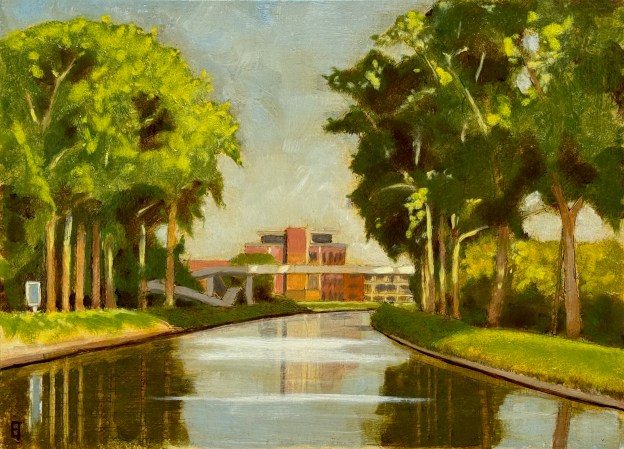
Conzettbrug, midday, looking south. 9 x 12" or 23 x 32 cm watercolor on hot pressed paper.

Conzettbrug, middag kijkend naar het zuiden

Conzettbrug, midday, looking south. 9 x 12" or 23 x 32 cm watercolor on hot pressed paper.

Conzettbrug, midday, looking south. 9 x 12″ or 23 x 32 cm watercolor on hot pressed paper.

Another piece along the theme: ‘there is a light, never goes out”.

I began this composition last summer by creating an on-location drawing. However, as conditions in Belgium often are, the window of opportunity for creating a finished piece was far too brief. So, a few days ago, in the shining light, I decided to re-approach the project.

The challenge to this particular spot is that the perspective I really like is from the exact middle of a pedestrian bridge that spans the Coupure canal at the edge of the city. It’s a narrow span, maybe two meters in width? This allows for an active two way traffic flow of bi-peds, quadrupeds and bi-cycles. To plant myself in the middle of that bridge is to create an obstacle to the traffic flow: everyone is usually polite about it, but conditions are defo not optimal. Also, experiencing joggers there is quite something, their vibrations quickly announce themselves, and I bounce like a ceramic animal with a hinged neck on a car’s rear shelf window. πŸ˜‰ So I gave myself enough time to create a fairly detailed value study but did not push my luck and chose to do the watercolor washes at home.

In addition, as anyone who has ever tried to create a drawing or painting of a boat harbor knows, boats come and go, so you have to quickly decide which to include and which to neglect. And even though that’s true of any type of painting, I think it’s especially true of harbors.

the Conzettbrug

2009, Drawing from the Conzettbrug in Bruges

In the end I had about an hour to complete my drawing, to solidify my vision of it, to understand the conditions of light – and to snap a few photo-references. Back home, as I laid in my washes, I knew I wanted to say something more than a sweet little study of light (I had done that anyway, some fifteen years ago, see image to the right).

So, because I’m deeply drawn to one-point perspectives and I’m still using a circle motif to set-up my compositions, I decided to emphasize that circle with a cadmium yellow line wash, strengthened it with alizarine crimson, after my descriptive washes were done. Now the circle was certainly strong but it looked like a James Bond bulls-eye. Not the visual echo I was looking for, so I started laying in washes of yellow ochre outside the circle’s edges, tipping the block so that the washes always dripped away from center. Nice.

The final cherry on top was the fine line of light, created by running a finely sharpened eraser-pencil, up and down, vertically through the center.

NB: I like it, though as usual, it’s extremely difficult to get a good photograph of a high-key watercolor.