Category Archives: Oils

Paintings executed exclusively in oils – often but not always without the use of egg tempera either as an underpainting or in an emulsified solution for painting. In such a case, the oil may be applied either indirectly through a series of thinned layers or directly, that is, alla prima, sometimes with a palette knife.

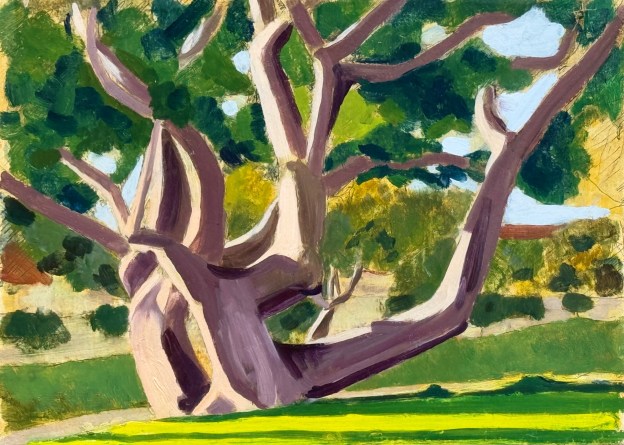
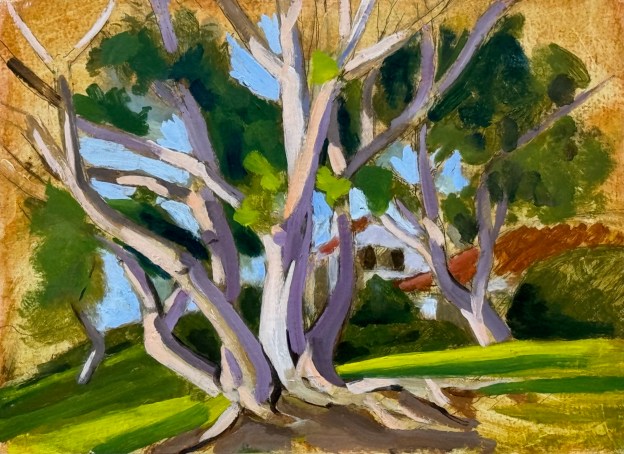
The six trunked Coral Tree. December 2025. Oil on panel. 9.5 x12' oe 21 x 32 cm.

The six branched Coral Tree, December 2025

The six trunked Coral Tree. December 2025. Oil on panel. 9.5 x12' oe 21 x 32 cm.
The six trunked Coral Tree. December 2025. Oil on panel. 9.5 x12′ oe 21 x 32 cm.

I went out last Saturday afternoon to see if I could rescue a painting that been stuck. I had done all my underdrawing and underpainting in November (in three or four sessions), but felt as though I didn’t know exactly how to resolve various issues: painting wiry trees in Southern California, with a new-to-me palette of colors.

In the mean time, I had found relative success by painting the tree next to it. Its form was simpler to grasp. It’s gesture, too. When you spend a few hours on location in each session, noticing how the light falls as the afternoon progresses, seeing how the shadows group as they define the foliage, you build an internal image repository of what it is you want to say. That light, there. Even though no particular stroke can ever define it: the effect is cumulative.

So I decided to retry the first tree. It has six main trunks or branches which intertwine, and it’s not always possible to see what is what. But if–as the artist–you know what is what, then you can place a spontaneous splotch of light accurately. If not, then not.

So I had already done my homework, the question was whether I could breathe some life into my ugly duckling. A palette of cadmium orange, titanium, ultramarine blue, cadmium red, cadmium yellow light and raw umber did the trick. Four bright colors earthed by umber, lightened with a strong titanium white, as needed.

I’m happy.

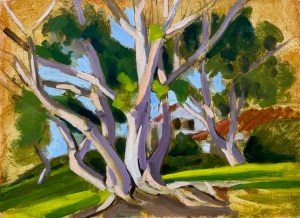
The Coral Tree, Oil on panel. 9 x 12.5" or 21 x 32 cm. November 2025

The Coral Tree, November 2025

The Coral Tree, Oil on panel. 9 x 12.5" or 21 x 32 cm. November 2025
The Coral Tree, Oil on panel. 9 x 12.5″ or 21 x 32 cm. November 2025

After a productive summer in Belgium, I began to dream of doing something similar here at my new home in Oceanside. I spent about a month refining the design of my pochade box to reflect the latest changes I have found helpful in the field. I bought a new travel stool and discovered I could carry all my stuff around in my bike bags–and also in the back carrier of my golf cart. Nice!

So in early November I began scouting for locations. The first and most obvious choices were the amazing coral trees planted near the front entrance to our community. I’ve admired them for years. There are three ancient mariners there whose gestural limbs astound. Their silhouettes are highlighted in the afternoon light as the sun goes down. I wanted to try out my chops.

The first painting of the first tree is still in progress iIt may or may not be salvaged). But the second attempt of the middle tree is pictured here. With a few caveats, I’m pretty happy with it.

Plein air set up for The Coral Tree. November, 2025. Oceanside, California

I’m learning as I go, adapting my palette to the more intensive colors of Southern California. In this case, I broke out into titanium white (I usually use lead white) and cadmium orange (totally new). Also used a whole new-to-me range of purplish tones by mixing ultramarine blue with cadmium red (brought to earth with raw umber). That last combo helped me to describe the tree trunks. (I did go too far in one area but that will be easily remedied when the painting dries a bit more)

My last session was pure bliss. I was able to achieve that gentle, toothy grab from the surfaced glazed medium of my new, sable, oil-laden brush strokes. A dip into my egg yolk emulsion assists in their on-panel integrity while also assuring a quick dry. Soft, sensuous, like the Merovingian in the Matrix II would have said (referring the French language): “It’s like wiping your ass with silk”. Ahhhhh….. the private pleasures of the en-plein-air painter.

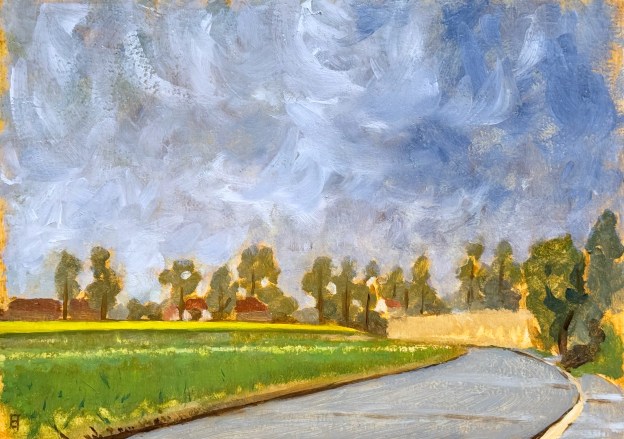
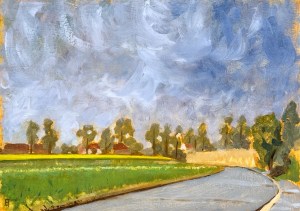
Koolzaden in Koolkerke. September 2025. 9 x 12" or 23 x 32 cm. Plein Air oil on traditional gesso panel.

Koolkerke Koolzaden, September 2025

We are in our last days of Indian Summer here in Bruges, so I went out Saturday, intending to complete a design that I had begun last year of the village of Koolkerke from across the fields. All summer the inked in design has been blocked by six foot high corn! Ha! And I’ve been waiting for the farmers to cut it. On Saturday, once again, no luck.

Rather than turning around and going home, I decided to turn my panel around and use the other side. I noticed a nice composition with a luminous filed of rapeseeds growing nearby, so I thought to try my luck. I set up and had a lovely afternoon communing with nature. Since it was great weather and many people stopped by to chat. The conversations I have in the field are always entertaining. Saturday was no exception. I met a man named Patrick who wants me to do a painting of his home so I tentatively agreed. After exchanging contact info he returned twenty minutes later to give me a box of chocolates. How sweet! (no pun intended). (Well, maybe. )

Koolzaden in Koolkerke. September 2025. 9 x 12" or 23 x 32 cm. Plein Air oil on traditional gesso panel.
Koolzaden in Koolkerke. September 2025. 9 x 12″ or 23 x 32 cm. Plein Air oil on traditional gesso panel.

After about three hours this is what I came up with. I still may want to tone down the long horizontal reflective-light line in the green grass of the foreground – just because it steals the attention from the rape seeds further off. But I’ll let it dry for now and (perhaps) do a small adjustment in the spring.

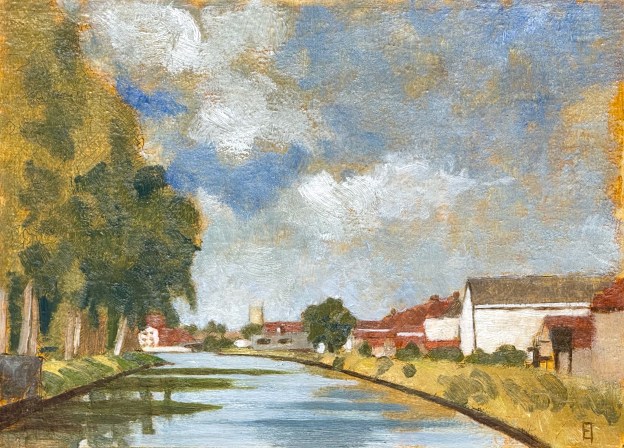
Langs de Vaartdijk II. Oil on panel. September 2025. 9 x 12.5" or 23 x 32 cm.

Langs de Vaartdijk II, September 2025

Langs de Vaartdijk II. Oil on panel. September 2025. 9 x 12.5" or 23 x 32 cm.
Langs de Vaartdijk II. Oil on panel. September 2025. 9 x 12.5″ or 23 x 32 cm.

It’s early September, the last days of summer are upon us. I went out last Sunday, prospecting for a new painting, and ended up choosing this scene along the Vaartdijk, looking back towards Brugge. I had already done one along this canal about ten years ago, different location, different view. In this scene you can just see the tower of the Gentpoorte rising in the distance, a little to the left of center.

I set up with my chair, paintbox and tripod, situated upon a dijk, rising to the left of the bicycle path. It was about four feet wide. I knew: any wrong move would land me in the water, swimming around with the little duckies. (Didn’t happen, but could have been refreshing if it did.)

I spent about three hours sketching in the scene using silverpoint, until I began inking it in with my black pen nibs. After a few lines, both pens dried out(!). Yes, it was a 30 degree centigrade day out there, but still, maybe time to buy some new ones? So I closed up shop and replaced them the following day. I completed my B/W drawing at home, anticipating going out as soon as possible to render the scene in oil en plein air.

The weather on Tuesday was clear enough and warm enough to give it a shot. As I worked, the shadows lengthened, making the reflections in the water more and more and more interesting. By five pm, as I packed up, I knew how I wanted to handle the water but also knew that it would have to wait until its painted surface had dried enough to do what I felt was still needed.

I ended up using five pigments plus white for this one: ultramarine blue, raw umber, yellow ochre, cadmium yellow light, plus cadmium orange. I used bristle brushes to block in my underpainting and sables to render the details. I made the wished for changes to the water yesterday, which means that I can post this today, chalking up yet one more for this summer season in Bruges. I love singing its praises.

If you are interested in hanging this on your wall, please contact me.

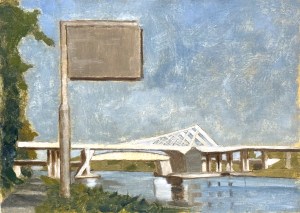
Afternoon light on the A11 bridge over the Zeebrugge Canal. September 2025 Oil on panel. 9 x 12.5' or 23 x 32 cm.

Afternoon light on the A11 bridge over the Zeebrugge Canal

We’ve ridden our bikes up to Lissewege a few times this summer. Every time we turn north onto the Zeebrugge canal, I’ve been struck by the span of a big, white bridge, just as the canal widens towards the sea. So even though it’s a half hour bike ride from home, last Monday I decided to try my luck in capturing it.

Study for the A11 bridge over the Zeebrugge Canal. September 2025  Silverpoint and India ink on gessoed panel.  9 x 12.5' or 23 x 32 cm.
Study for the A11 bridge over the Zeebrugge Canal. September 2025 Silverpoint and India ink on gessoed panel. 9 x 12.5′ or 23 x 32 cm.

I biked out on a sunny day and spent about four hours getting down a relatively detailed drawing – directly onto my gessoed panel. I moved through the free sketch of a charcoal pencil, to the more decisive silverpoint nib and finally committed myself to a finished design using India ink. By that point it was both a composition and a value study. When you spend four hours on location, studying shapes and light, you learn to read the three dimensionality of the scene before you, so that whatever values you end up placing there need to tell that story. See image to the left.

Friday the forecast was for warm and clear skies. I decided to go out. I also wanted to test out my new $$ tripod(!). Its connection to the bracket on the underside of my painting box was solid (no more wobbles) plus the legs themselves were very sturdy. Worth the upgrade (but I do need to sell more paintings to cover that expense! 😉 ).

Afternoon light on the A11 bridge over the Zeebrugge Canal. September 2025 Oil on panel. 9 x 12.5' or 23 x 32 cm.
A11 bridge over the Zeebrugge Canal. September 2025 Oil on panel. 9 x 12.5′ or 23 x 32 cm.

I spent another four hours laying in color, moving through a lean, mid-value underpainting to the definitive highlights and shadows of the final piece you see here. The strong white values of the central bridge dominate the composition while the interstices of the upper supports were defo an exercise for MC Escher himself (!). I couldn’t have rendered them in white paint without having already done my homework in the preparatory drawing stage. Despite their long horizontal slants the (two) bridges balance out compositionally by the path and the water. I like it.

As it turns out, I worked with a limited palette: lead white, yellow ochre, cadmium yellow light, raw umber and ultramarine blue. That’s it! Whenever possible it is good to work with a limited palette, it reduces the choices plus assists in creating a visual harmony. In the end, a success. A completed painting – and yes, in just one session. That’s the third one of this season: hooray! I might finally be on to something. 😉

If you are interested in hanging this on your wall, please contact me.

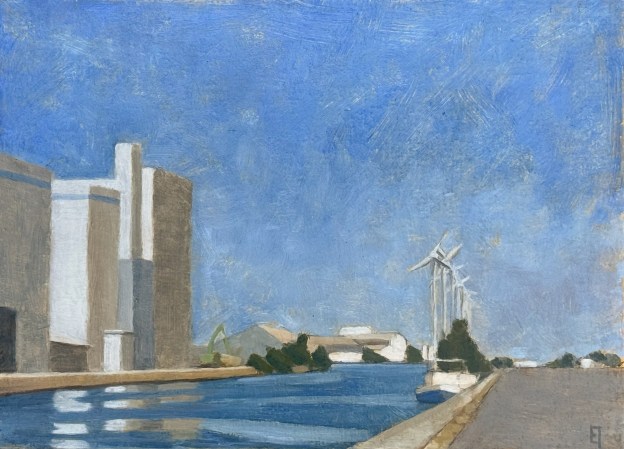
Midday light on the Bruges harbor. Oil on panel. 23 x 32 cm or 9 x 12.5" August 2025.

Brugge Haven Middag, August 2025

Midday light on the Bruges harbor. Oil on panel. 23 x 32 cm or 9 x 12.5" August 2025.
Midday light on the Bruges harbor. Oil on panel. 23 x 32 cm or 9 x 12.5″ August 2025.

I decided to transpose the watercolor composition I did last week onto a panel so that I could try out an expansive harbor painting. It took two en plein air sessions to come up with this.

The challenges: large cargo boats coming and going, obstructing or enhancing the view, what to include what to dismiss?; also the buildings on the left provided strong shifts from early morning to midday, make a choice and stick with it.

Mostly I wanted the composition to enhance the small white buildings in the distance. In order to get them to read, I needed an interesting foreground. Luckily there was a ship on the right during my first session, while the tall, sharply illumined buildings on the left provided balance. A windless day during the second session offered fantastic liquid reflections. (Take the money and run!) Later, I could include traces of its dance along the large, open channel, leaving the sky too, open and clear – as it was.

New Haven harbor from Lighthouse Park. 1979. Oil on panel. 6 x 15"
New Haven harbor from Lighthouse Park. 1979. Oil on panel. 6 x 15″

Oh yes, the session also included (for me) a sweet recognition my penchant for industrial harbors. I originally discovered my passion for landscape painting back in the 1970’s when I lived in New Haven Connecticut. I did a series of landscapes then of its harbor. Oil tanks. Industrial chimneys. Geometric shapes. So, the subject matter is quite similar, the color scheme, too. Yummm….

If you are interested in hanging this on your wall, please contact me.

Light Study on the the Pathoekeweg. Oil on panel. 9 x 12.5" or 23 x 32 cm.

Light Study on the Pathoekeweg

Light Study on the the Pathoekeweg. Oil on panel. 9 x 12.5" or 23 x 32 cm.
Light Study on the the Pathoekeweg. Oil on panel. 9 x 12.5″ or 23 x 32 cm.

There is an industrial area outside the center of Bruges that most tourists don’t see. Perhaps for good reason. It’s the harbor that leads via canal to the port of Zeebrugge on the North Sea and is about 15 kilometers long.

I really like the geometrical shapes you can find there – at scale – especially when illumined by light. A few years ago I noticed the late afternoon light hitting some big ugly buildings at the edge of a scrubby dry field on the Pathoekeweg (the road that runs along next to the harbor). Nothing to see here? I beg to differ.

Light Study on the the Pathoekeweg. India ink and silverpoint on panel. 9 x 12.5" or 23 x 32 cm.
Light Study on the the Pathoekeweg. India ink and silverpoint on panel. 9 x 12.5″ or 23 x 32 cm.

Last summer I did a drawing of the grouping, intending to create a watercolor first, but in the end, just transposed the drawing to a gessoed panel so I could jump right into oils. The panel-drawing was done in silverpoint and India ink. I shellac-sealed it then waited for a warm, sunlit afternoon. A few days ago conditions arose; I packed up my gear and headed off to see what might happen. On arrival, at 4 pm, the light was OK, but nothing spectacular. Yet as the afternoon waned and early evening approached, it all got glorious. By 6 pm I was singin’.

The painting you see here was created in a two and one half hour session. At the time I had treated it as an underpainting, fast and loose, fully expecting to return for a final session. But the more I live with it now, the more I recognize that there is no need to do that. Sometimes less is more.

If you are interested in hanging this on your wall, please contact me.

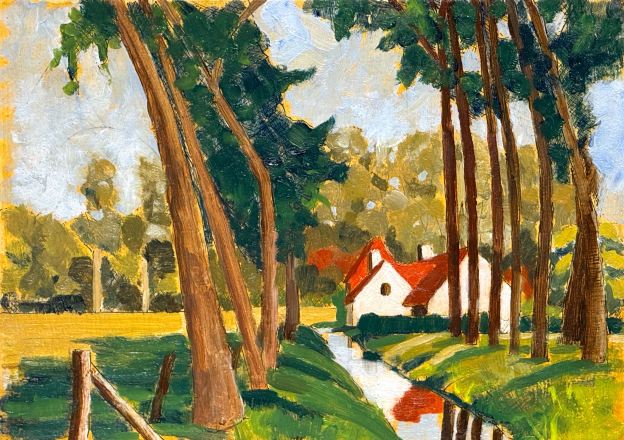
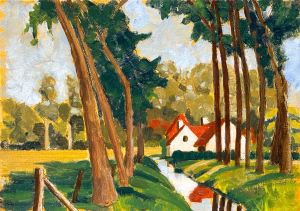
Olie schilderij van de Paarden Hoeve aan Fort van Beieren. 23 x 32 cm or 9 x 12.5 "Oil on panel. August 12, 2025

Midday at the horse farm/Middag op de paardenborderij, August 12, 2025

Last week I created a watercolor of this sweet little landscape that I discovered just outside of Bruges near the Fort van Beieren. I’m always on the lookout for landscapes that combine nature with a few geometrical, manmade shapes. And when the light spotlights these shapes, I’m in hog heaven. This one, including the white washed sides of a red roofed farm house, surrounded by fields and a small creek had all the ingredients I’m usually on the look out for. So, the watercolor was fine, but I was particularly interested in the intensity that can only oil can offer.

I transposed the composition from the watercolor – since that saves making a ton of new decisions in the field. I used india ink and silverpoint on a chalk gesso panel, then gave it a quick shellac-seal for protection and to reduce absorbency.

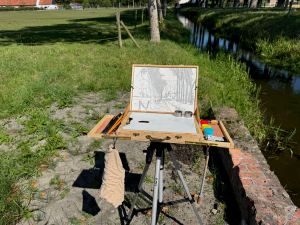
Field set up of pochade box with transposed India inked drawing, ready for oil.

The first painting session last Saturday involved laying in a yellow ochre tint into which I blocked in the values and tints of all the basic forms. At the end of that session I had a good, gestural underpainting, everything was understated, earthy and yet harmonized. Ever since I changed my recipe last year to egg yolk (instead of a methyl cellulose glue) for my painting emulsion, I’ve had good success – both in drying time as well as fluid paint handling. Encouraging!

The underpainting was dry to the touch after two days(!). I went out yesterday to see what might happen. The weather was perfect. Warm and sunny with a gentle breeze. I set up my traveling oil pochade box and set to work (it has a different design than my traveling drawing/watercolor box due to the requirements of the different media). The time passed. After three hours I looked back happy and decided to call it a day. (“Day!”)

Olie schilderij van de Paarden Hoeve aan Fort van Beieren. 23 x 32 cm or 9 x 12.5 "Oil on panel. August 12, 2025
Olie schilderij van de Paarden Hoeve aan Fort van Beieren. 23 x 32 cm or 9 x 12.5 “Oil on panel. August 12, 2025

I love the white building gently nested near the center, with the mirrored creek leading forward. The complimentary colors of organic reds and greens provide all the passion this kind of landscape evokes. The trees gawkily bend upwards: my kind of cathedral. Here’s hoping the weather continues to provide a few more opportunities to my Belgian muse.

If you are interested in this piece shoot me an email.
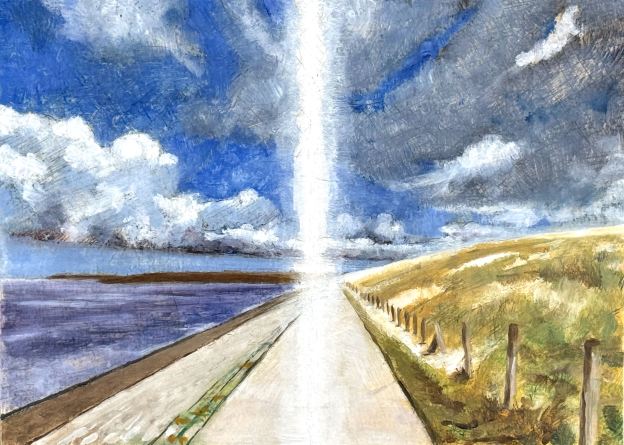
There is a Light, never goes out. July 2025. Oil on panel. 23 x 32 cm or 9 x 12.5"

There is a Light – never goes out, July 27, 2025

There is a Light, never goes out. July 2025. Oil on panel. 23 x 32 cm or 9 x 12.5"
There is a Light, never goes out. July 2025. Oil on panel. 23 x 32 cm or 9 x 12.5″

Last summer my husband and I did a weekend biking trip to Zeeland, a beautiful area of windswept dunes to the east of Brugge. Just before we left on that weekend I had had a biking accident here in Brugge where I met the cobblestones (up-close-and-personal) – and without a helmet. During our trip then, I was suffering from a slight concussion, which may (at least in part) explain this painting.;-)

We were biking along a stretch of pathway a few kilometers outside of Zerikzee when the storm clouds began to threaten and blow: alternating light and darkness; wind and rain. We just kept moving. Meanwhile the song “There is a Light, never goes out” by Steve Gold, came into my head and wouldn’t leave.

Luckily, Johnny had created a small video of that stretch of experience so I could grab parts of it to help me experiment with visualizing the inspiration of that time-less time. My penchant for one-point perspective dominates the composition – and provides a counter point to the strong central shaft of light. But I was careful not to align the two as it would have created a dead center with nowhere to go(!). Additionally, I did integrate a small circle (ultimately not very visible) – which I have been using these days to assist in creating an abstract element to an otherwise basic landscapes.

Is this a new direction? Maybe but maybe not.;-) But still, I like it.

If you are interested in this painting, shoot me an email.
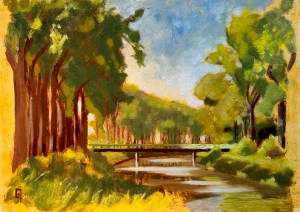
de groene brug over de Stinker naast het oude sifon, Olie op paneel, august 2024, 23 x 32 cm or 9" x 12"

de groene brug over de “Stinker”, August 2024

de groene brug over de Stinker naast het oude sifon, Olie op paneel, august 2024, 23 x 32 cm or 9" x 12"

de groene brug over de Stinker naast het oude sifon, Olie op paneel, august 2024, 23 x 32 cm or 9″ x 12″


Translation: “The Green bridge over the Schipdonkkanaal.


About two weeks ago I decided to bike out beyond Damme in order to find a nice spot there, somewhere along the two canals that run north/south and out to the sea. The locals call them the “Stinker” and the “Blinker”, for dirty water and clean water, respectively. And although the smell is long gone, it turns out that the dirty nomenclature did not refer to the raw sewage I had always imagined, but rather to the run off from the processing of flax for the linen factories upriver along the Leie near Gent. Now the Stinker runs clean, as the fish and fowl can playfully attest.


I found a spot looking north, where the bridge from Damme crosses over, next to the old sifon that used to run out to Sluis in the Netherlands – before two world wars blew up that dream. It’s so odd to enjoy such a peaceful idyllic spot, when locals stop by and want to chat and tell you where the German, French or Canadian positions once were and/or what their grandmother had to do to keep the farm’s well functioning during the harsh winters of another time.


Back to painting, though. I had already determined that for this particular project I wanted to go pure “en plein air”. That means I did not expect to finish it “alla prima” (in just one session) but neither did I want to base it on an earlier watercolor study which then gets transposed in the studio beforehand.  Don’t get me wrong, I absolutely love that approach, because it allows other wonderful things to happen and also it appeals to my temperament (since I feel I’m more of a Tonalist/Luminist than an Impressionist), but at the same time, I don’t want studio prep to become a crutch. So this one was a personal challenge. Could I come up with a reasonable painting by just winging it in the field? And if so, how many sessions would it take? As it turns out: three, two hour sessions.


The first session involved creating a drawing on the panel using India ink, followed by blocking in a rough but relatively accurate value statement, using lead white and burnt umber. After two hours I thought it had promise but I certainly wasn’t sure. (No image of this stage is available)


That initial session dried rather quickly, but still I had to wait another week for the weather to clear. I went out two days ago for session #2. At that point I blocked in the major color statements which again took me about two hours. At the end of that time, the light had changed significantly enough that I knew it was best to stop. Was I happy? No. Was I confident? No. Was this going to work out? I wasn’t at all sure. (No image of this stage, either.)


Yet strangely enough, by the next day (which was yesterday), the painting was dry to the touch(!!!). FYI: I use a painting emulsion that helps to keep my oils lean and also speeds up drying time but still, this felt like a record. So, since the weather was perfect and the seasonal clock was ticking I decided to venture out and see what might happen. After another two hour session I came up with the image you see here.


Am I happy? Happy enough. And relative to the challenge I had set for myself, I feel successful. As a painting of the countryside around here, it’s a good image of a late summer afternoon, with light on these magnificent canals. Additionally, it’s the kind of skill/experience that tends to build upon itself. So if I’m lucky, there might be a few Indian Summer days left for a few more shots from this quiver. Stay tuned.

 If you are interested in this piece shoot me an email.