Monthly Archives: August 2024

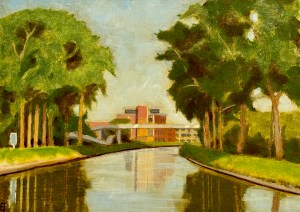
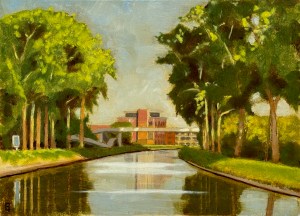
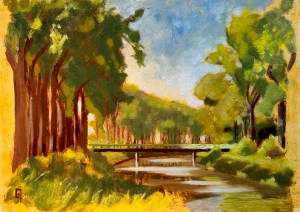
de groene brug over de Stinker naast het oude sifon, Olie op paneel, august 2024, 23 x 32 cm or 9" x 12"

de groene brug over de “Stinker”, August 2024

de groene brug over de Stinker naast het oude sifon, Olie op paneel, august 2024, 23 x 32 cm or 9" x 12"

de groene brug over de Stinker naast het oude sifon, Olie op paneel, august 2024, 23 x 32 cm or 9″ x 12″


Translation: “The Green bridge over the Schipdonkkanaal.


About two weeks ago I decided to bike out beyond Damme in order to find a nice spot there, somewhere along the two canals that run north/south and out to the sea. The locals call them the “Stinker” and the “Blinker”, for dirty water and clean water, respectively. And although the smell is long gone, it turns out that the dirty nomenclature did not refer to the raw sewage I had always imagined, but rather to the run off from the processing of flax for the linen factories upriver along the Leie near Gent. Now the Stinker runs clean, as the fish and fowl can playfully attest.


I found a spot looking north, where the bridge from Damme crosses over, next to the old sifon that used to run out to Sluis in the Netherlands – before two world wars blew up that dream. It’s so odd to enjoy such a peaceful idyllic spot, when locals stop by and want to chat and tell you where the German, French or Canadian positions once were and/or what their grandmother had to do to keep the farm’s well functioning during the harsh winters of another time.


Back to painting, though. I had already determined that for this particular project I wanted to go pure “en plein air”. That means I did not expect to finish it “alla prima” (in just one session) but neither did I want to base it on an earlier watercolor study which then gets transposed in the studio beforehand.  Don’t get me wrong, I absolutely love that approach, because it allows other wonderful things to happen and also it appeals to my temperament (since I feel I’m more of a Tonalist/Luminist than an Impressionist), but at the same time, I don’t want studio prep to become a crutch. So this one was a personal challenge. Could I come up with a reasonable painting by just winging it in the field? And if so, how many sessions would it take? As it turns out: three, two hour sessions.


The first session involved creating a drawing on the panel using India ink, followed by blocking in a rough but relatively accurate value statement, using lead white and burnt umber. After two hours I thought it had promise but I certainly wasn’t sure. (No image of this stage is available)


That initial session dried rather quickly, but still I had to wait another week for the weather to clear. I went out two days ago for session #2. At that point I blocked in the major color statements which again took me about two hours. At the end of that time, the light had changed significantly enough that I knew it was best to stop. Was I happy? No. Was I confident? No. Was this going to work out? I wasn’t at all sure. (No image of this stage, either.)


Yet strangely enough, by the next day (which was yesterday), the painting was dry to the touch(!!!). FYI: I use a painting emulsion that helps to keep my oils lean and also speeds up drying time but still, this felt like a record. So, since the weather was perfect and the seasonal clock was ticking I decided to venture out and see what might happen. After another two hour session I came up with the image you see here.


Am I happy? Happy enough. And relative to the challenge I had set for myself, I feel successful. As a painting of the countryside around here, it’s a good image of a late summer afternoon, with light on these magnificent canals. Additionally, it’s the kind of skill/experience that tends to build upon itself. So if I’m lucky, there might be a few Indian Summer days left for a few more shots from this quiver. Stay tuned.

 If you are interested in this piece shoot me an email.
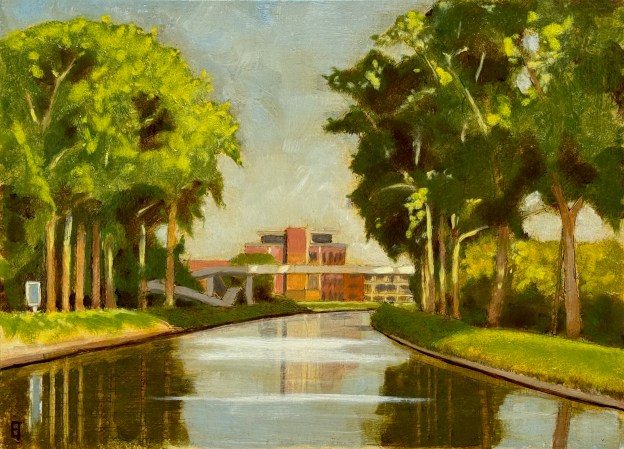
Avond aan de Jachthaven II, August 12, 2024. Oil on panel. 9 x 12" or 23 x 30.5 cm

Avond aan de Jachthaven II, August 12, 2024

During the “on location” sessions for Jachthaven I, I had become very disappointed with my loss of the statement of light, because in the end I had to slap on a lot of titanium white to make it work. The painting that I ended up with was OK, but not really what I had been trying to achieve aesthetically, thus version II.

Avond aan het Jachthaven II, studio oil level one.

Avond aan het Jachthaven II, studio oil level one.

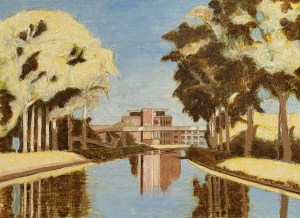
This second attempt had the same work-up in silverpoint, egg tempera and India ink as the first, however, I decided to do my first layer of oil in the studio (instead of relying on the vagaries of weather). I laid in a pretty definitive light statement (see right), working wet-in-wet. I used cobalt blue, lead white and burnt umber (mixed with an ET emulsion to help it dry faster) and painted this into a surface wiped thinly with a clear medium. The whole work-up process took only a week to do – in order to have it dry enough for an en plein air session – or two.

Avond aan de Jachthaven II, intermediate on site oil.

Avond aan de Jachthaven II, intermediate on site oil.

My first session was two hours, during which I  was able to take the light statement (above) to this stage (left). I made use of a technique I have come to call “painting backwards”. It’s where I block in a flat area of color on top of a light statement and then dig the particular highlights I need/want out of it. That’s only possible if-and-when the underpainting is already definitive and dry. Afterwards, I called it done for a few days, though still, I felt something else was needed.

Avond aan de Jachthaven II, August 12, 2024. Oil on panel. 9 x 12" or 23 x 30.5 cm

Avond aan de Jachthaven II, August 12, 2024. Oil on panel. 9 x 12″ or 23 x 30.5 cm

I went out last night, a hot summer’s evening, with perfect conditions. Here on the 52nd parallel north, we are currently about a month and a half past the (almost) 17 hour days of the summer solstice, yet it is still possible to “trip the light fantastic”. I spent about an hour adding small details (of light), which had the effect of bringing my mind’s eye vision to completion. I judiciously used some titanium white (especially in the water), but the magic really began to happen when little brush flecks of cadmium yellow light hit the trees.

I’m very glad to be able to chip away at the amount of time it takes me to create a landscape oil painting, because really, I’m notoriously slow. I still to try to avoid titanium white as much as possible, because it’s never made sense to me to prepare a white ground and then, through the act of painting, proceed to lose its luminosity so that you need to add titanium white back in in order to regain it. Don’t make no sense.

The difference between these two versions and techniques then, is luminosity. The first one relies primarily on TW and reflected light, while the second one relies essentially on refracted light, emanating, glowing, from the underpainting itself. That latter has always been my aesthetic goal, though admittedly, the results have often  been mixed. 😦

This one, however, is trending up! Let’s see what happens next.

If you are interested in this piece shoot me an email.
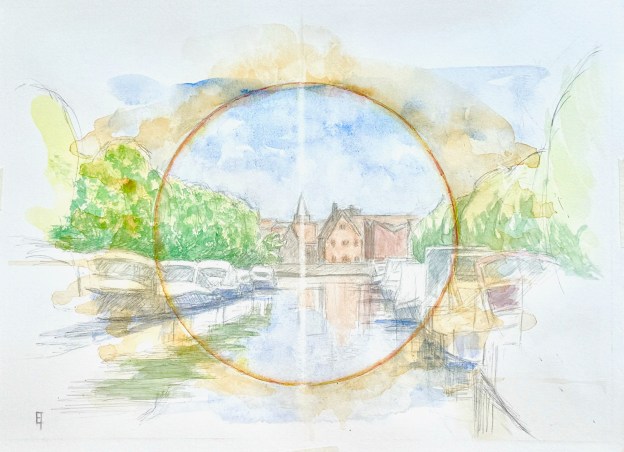
Conzettbrug, midday, looking south. 9 x 12" or 23 x 32 cm watercolor on hot pressed paper.

Conzettbrug, middag kijkend naar het zuiden

Conzettbrug, midday, looking south. 9 x 12" or 23 x 32 cm watercolor on hot pressed paper.

Conzettbrug, midday, looking south. 9 x 12″ or 23 x 32 cm watercolor on hot pressed paper.

Another piece along the theme: ‘there is a light, never goes out”.

I began this composition last summer by creating an on-location drawing. However, as conditions in Belgium often are, the window of opportunity for creating a finished piece was far too brief. So, a few days ago, in the shining light, I decided to re-approach the project.

The challenge to this particular spot is that the perspective I really like is from the exact middle of a pedestrian bridge that spans the Coupure canal at the edge of the city. It’s a narrow span, maybe two meters in width? This allows for an active two way traffic flow of bi-peds, quadrupeds and bi-cycles. To plant myself in the middle of that bridge is to create an obstacle to the traffic flow: everyone is usually polite about it, but conditions are defo not optimal. Also, experiencing joggers there is quite something, their vibrations quickly announce themselves, and I bounce like a ceramic animal with a hinged neck on a car’s rear shelf window. 😉 So I gave myself enough time to create a fairly detailed value study but did not push my luck and chose to do the watercolor washes at home.

In addition, as anyone who has ever tried to create a drawing or painting of a boat harbor knows, boats come and go, so you have to quickly decide which to include and which to neglect. And even though that’s true of any type of painting, I think it’s especially true of harbors.

the Conzettbrug

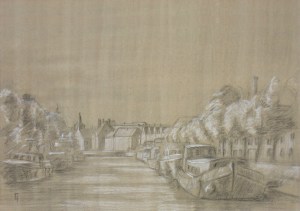
2009, Drawing from the Conzettbrug in Bruges

In the end I had about an hour to complete my drawing, to solidify my vision of it, to understand the conditions of light – and to snap a few photo-references. Back home, as I laid in my washes, I knew I wanted to say something more than a sweet little study of light (I had done that anyway, some fifteen years ago, see image to the right).

So, because I’m deeply drawn to one-point perspectives and I’m still using a circle motif to set-up my compositions, I decided to emphasize that circle with a cadmium yellow line wash, strengthened it with alizarine crimson, after my descriptive washes were done. Now the circle was certainly strong but it looked like a James Bond bulls-eye. Not the visual echo I was looking for, so I started laying in washes of yellow ochre outside the circle’s edges, tipping the block so that the washes always dripped away from center. Nice.

The final cherry on top was the fine line of light, created by running a finely sharpened eraser-pencil, up and down, vertically through the center.

NB: I like it, though as usual, it’s extremely difficult to get a good photograph of a high-key watercolor.